Almond in Perfumery: A Gourmet and Natural Note
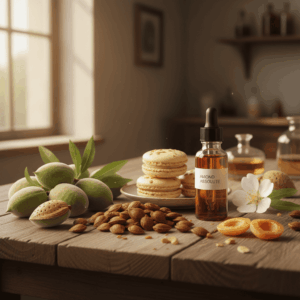
I adore the almond note, in all its states! First of all in sweets: frangipane, orgeat syrup, calissons, Gazelle horns, tiramisu, financiers, macaroons, amandines, amaretto liqueur, and finally the “granita de mandorle” at Grom. It’s an absolutely irresistible almond granita ice cream.
Almond in the History of Perfume
I also loved it in perfumes: in some sometimes disappeared like that of Castelbajac, or in Hypnotic Poison by Dior, Portofino by Dior, L by Lolita, Heliotrope by Etro. Without forgetting Héliotrope Blanc by Pivert, which is historically the first almond perfume, a mixture of icing sugar and almond powder. It is still marketed. It is the ancestor of almond perfumes. Its original version was released in 1850.
I had it added by Randa Hammami in the creation of L’Instant Magic, and in Mon Précieux Nectar. It is also present in La Petite Robe Noire (to make a cherry in perfumery, you have to add almond to red fruits), but also in Tonka Impériale from the Exclusives of Guerlain perfumes, which I developed as The very first Petite Robe Noire with Delphine Jelk.
L’Homme Idéal, by Guerlain, is a “masculine almond” homage to Jicky. It is an “amaretto” accord: made of natural almond notes, also called benzaldehyde, but “natural” accompanied by tonka bean and leather notes.
How to Recreate Almond? (Molecules and Natural)
Most of the time, very fleeting benzaldehyde is added to flowery, powdery, vanilla, and almondy heliotropin as well as tonka bean which is balsamic, vanilla, and slightly almondy.
1. Benzaldehyde (Natural Almond)
To make it, we start from the inside of apricot kernels and perform a hydro distillation. This allows extracting benzaldehyde. So the result gives this product called natural benzaldehyde.
When apricot brandy (abricotine) is made, only the flesh of the apricot is used and the kernel is thrown away. So this is a new use for the kernel where the inside of the kernel is recovered and hydro-distilled.
2. Heliotropin
Another almond note: heliotropin discovered in 1869, used for the first time in Après L’Ondée, then in L’Heure Bleue, and 100 years later in L’Heure de Nuit (exclusive).
It is a molecule that I adore, which is not as good as the natural scent of heliotrope: this little magic flower that looks a bit like violet (found at good nurserymen) with the delicate smell of vanilla and rice powder. But alas, this flower does not deliver its soul! Fortunately, heliotropin came to the rescue of perfumers.
Emile Zola: “They walked through mignonettes, which rose up to their knees, like a true perfume. Beside them, a field of heliotropes, with a breath so sweet of vanilla, that it gave to the wind like a velvet caress.”
3. Anisic Aldehyde and Amandolene
In slightly almondy notes, one can also consider anisic aldehyde, which acts more in the top notes than heliotrope, thus prolonging it into the heart of the formula. It was also used for the first time in Après L’Ondée. And finally: amandolene from Firmenich which has an almondy, quite floral, really interesting note.
4. Tonka Bean and Coumarin
And finally tonka bean, a very rich note with its multiple almondy, tobacco, woody, gingerbread facets. Coumarin present (in tonka bean and synthesized) discovered in 1868, true “soul” of the tonka bean also used for the first time by Guerlain in Jicky in 1889. Tonka bean is a material that I covered in a full post on my blog.
Almond in Sylvaine Delacourte Collections
- It is present with natural almond in Vangelis from the Vanilla Collection.
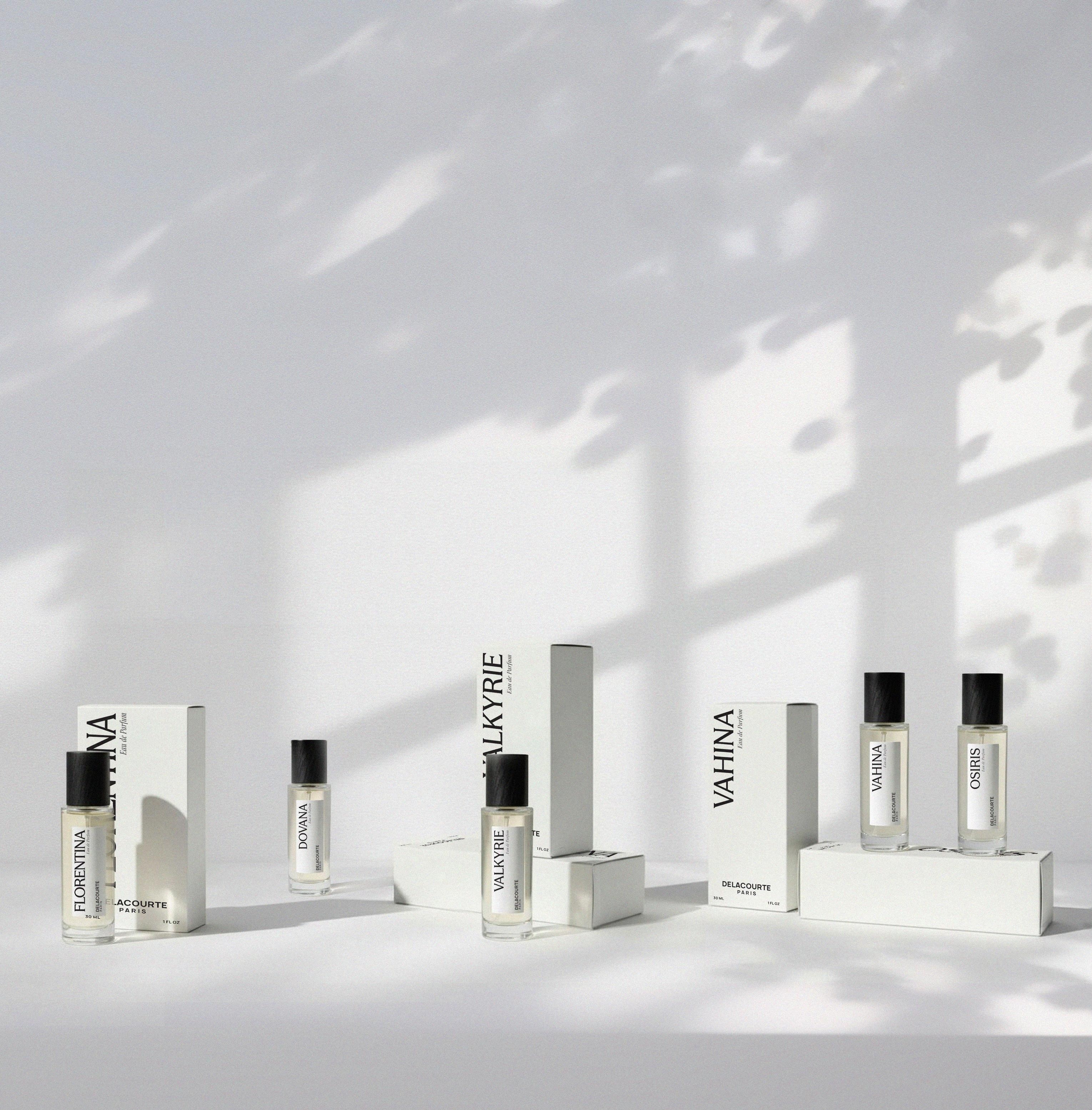
- The natural almond note is very present in the top notes in Florentina from the Musk Collection, as a top note, which is followed by a cohort of powdery flowers: mimosa, heliotrope, violet, and iris root. The vetiver note traverses the fragrance and gives it its vibration.
The Virtues of Almond (Health)
What if we talked about its virtues? Almonds are very rich in vitamin E, minerals, and trace elements.
- Almond is an alkalizing, highly nutritious, energetic, remineralizing fruit. This fruit is cholesterol-free, rich in phytosterols and vegetable proteins.
- Beneficial for the chest, lungs, stomach, intestines. It has intestinal antiseptic properties. It opposes all untimely fermentations.
- Favorable to a good nervous balance. Its richness in magnesium and assimilable phosphorus makes it an excellent tonic for our nervous system.
- It is excellent for bone health thanks to its high calcium content.