Balms and Resins in Perfumery: Guide to Balsamic Notes
Balms and resins are part of the raw materials used in the composition of perfumes. They often intervene in fragrances of the oriental or amber family.
These materials complement vanilla and bring a note of mystery to the fragrance. Balms and resins are also called “balsamic notes.” The most used in perfumery are myrrh, incense, styrax, benzoin, balsam of Peru, and copaiba balsam.
Myrrh
Myrrh is an aromatic gum-resin produced by the myrrh tree (Commiphora Myrrha). Considered the most exquisite and precious perfume in existence, it consists of 60% gum, 30% resin and essence, and, in addition, a bitter principle.
There are over a hundred different varieties of myrrh, also called Commiphora Myrrha, which is native to Saudi Arabia and Abyssinia.
The three most known species are:
- Commiphora Myrrha Nees
- Commiphora abyssinica
- Commiphora schimperi
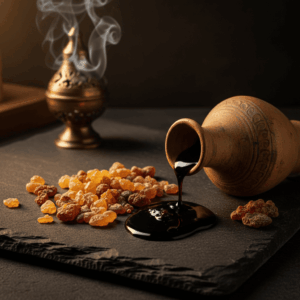
The varieties most prized in perfumery are those producing “oleo-gum-resin,” in the form of natural exudations, true fragile and shiny “tears,” of a color oscillating between light yellow and dark red and with a strong aromatic smell.
Use and Olfaction
Perfumers use myrrh essence obtained by steam distillation of the gum harvested from the tree. It displays an intense and rising balsamic smell with a licorice, woody, almost fruity facet and an incense scent.
Myrrh is also largely associated with religion, notably in the form of incense, during the worship of Gods in Antiquity, and as an offering by the Three Wise Men. In Greek mythology, myrrh is associated with Myrrha, the incestuous daughter of the king of Cyprus, transformed into a myrrh tree, before giving life to Adonis.
Incense (Olibanum)
Incense comes from the Latin “incendere” which means to burn, to shine, and which also gave the name incandescent. It is also named olibanum which comes from the Hebrew “lebonah” itself coming from a root “laban” meaning what is white or purity. Olibanum symbolizes the protective power of god and purifies all sins. The Queen of Sheba often offered it to Solomon.
Incense is like Myrrh: a gum. It is collected on incense trees. Indeed, the notion of incense tree has a collective meaning. It includes a certain number of Boswellia species native to various countries: Somalia, Yemen, Sudan, Ethiopia, and India, each with specific olfactory characteristics.
The most frequently used tree is Boswellia carteri Roxb. They are all shrubs of 4 to 5 meters from the mountains of the Middle East and Africa. Incense trees have a trunk and branches whose gray bark peels off easily.
In perfumery, the gum harvested after incision of the tree trunk, a week later, the incense pearls are harvested are then steam distilled to obtain the essence.
Olfactory Description of Incense
- Boswellia Sacra from Oman: has a mint and eucalyptus note.
- Boswellia Serrata from India and Boswellia papyrifera: possess a bitter lemon facet.
- Boswellia frerana or Maydi: has floral and fruity caramel accents; it is used by the Coptic Church of Ethiopia.
- Boswellia Rivae: possesses gourmand accents.
- But the most known of these essences is a very powerful, dark, aromatic base note with a camphorated, resinous, smoky effect.
Uses of Incense
- The uses of incense throughout the centuries have always corresponded to a certain ceremonial: worship of Gods, remedies, or perfumes.
- Ancient Egyptians used it to heal themselves; incense is a powerful antiseptic also used to embalm their dead (flesh preservative) and especially for fumigations in places of worship, for its spiritual power, but also to protect against miasmas.
- Religions have never ceased to resort to it.
- Far Easterners devote almost sacred attention to it in their private life.
- Incense is also used in cosmetics.
Styrax
Like many other balms and resins, styrax balsam is secreted in the bark of two species of trees called liquidambar, coming from Syria, Asia Minor, and South America.
Liquid styrax is composed of a small proportion of resin, an essence with a benzine smell, named styrol, cinnamic acid, and styracin. Styrax essence is obtained by distillation of the balsam. Its smell is strong and vanilla-like, balsamic, floral, but also animalic, leathery, and close to tar.
Benzoin
Benzoin is a balsamic resin. Also called benzoin gum or tear, it is secreted by the trunk of Styrax Tonkinensis, of the Styracaceae family.
In perfumery, this gum is treated by volatile solvent extraction to obtain benzoin absolute, a very rich note, with multiple facets: sweet vanilla, almond, roasted coffee, honeyed, floral (close to carnation), milky, liquor-like, even medicinal.
Origins and Harvest
Benzoin comes from Siam, Sumatra, the Indonesian island, as well as Laos, formerly called “the land of a million elephants.” Each year, the country produces about 50 tons of it, 2/3 of which are exported to Europe. It is mainly found in the north of the country, in the province of Phongsali, a mountainous region with immense forests.
Benzoin balsam is harvested by hand, by creating a notch on the bark of the trunk in several places to make the tree cry and collect the benzoin tears.
In its liquid state, this exudation is white, and becomes yellow when drying; when harvested, about 6 months later, it is already semi-solid. Benzoin is then transported to warehouses where it is treated like gold nuggets then cleaned and sorted.
Uses of Benzoin
Scientifically discovered in 1853 by Garcia de Orta, benzoin was formerly burned in houses to purify the atmosphere, attract positive vibes, and ward off unwanted beings and creatures. Benzoin also enters into the composition of balms with healing and antiseptic virtues.
It perfumes Botot water, this mouthwash notably used by Louis XV, and also enters into the composition of Baume de la Ferté, created in 1830 by Pierre-François-Pascal Guerlain, a very effective balm for treating chapped lips and other cracks. The product is known today as “Super Lips”.
Benzoin also played a role in the treatment of pulmonary diseases. Moreover, benzoin tears develop a very suave perfume, highly appreciated in Buddhist temples where it is used as incense. Indeed, benzoin has long been considered a variety of incense or myrrh and a precious substance.
Different Varieties and Perfumes
There are different qualities of benzoin:
- Laos Benzoin: very qualitative, with a vanilla and caramel note, without being too sweet however, and which is also powdery and milky.
- Siam Benzoin: a variety highly sought after by perfumers, very rare and very expensive. It possesses a very present vanilla facet.
- Sumatra Benzoin: obtained from two sources, styrax benzoin and styrax parallelorum.
Perfumes containing benzoin: Bois des Îles by Chanel, Habanita by Molinard, Opium by YSL, L’Eau by Diptyque, Serge Noire by Serge Lutens, Shalimar, L’Heure Bleue, and L’Instant by Guerlain, and many others.
Balsam of Peru
Balsam of Peru is a natural balsamic resin of brown or red color. It is a product derived from the resin of a tree: Myroxylon pereirae, native to Central America (San Salvador, Colombia, and Venezuela). The tree therefore does not grow in Peru as its name might suggest. However, it was formerly exported from one of its ports, Callao.
Like Tolu balsam, Balsam of Peru is obtained by incision of the bark of the balsam of Peru tree (result of a pathological reaction of the tree).
The essential oil is obtained by steam distillation of the balsam and the resinoid by volatile solvent extraction. Its scent is vanilla-like, sweet, with caramel, cinnamic notes, and a slight pharmaceutical note.
Just like Tolu balsam, Balsam of Peru is found in many familiar products. It is often ignored that it is present in these cosmetics or perfumes, and allergies are therefore quite frequent, and caused mainly by coniferyl benzoate, a major allergen.
Various Uses of Balsam of Peru
Balsam of Peru is found in many cosmetic products and food products, such as flavored teas and pastries, but also in many medical applications (cough syrup, efferalgan…) and in certain household products, disinfectants, or other dust control products.
The first major application of Balsam of Peru essential oil is dermatological. Applied as an ointment, it will allow you to easily treat all problems of dry, damaged, chapped, or cracked skin. It will also be very useful to young breastfeeding mothers suffering from cracked nipples, as it promotes cell renewal.
Balsam of Peru essential oil is a tonic that helps fight hypotension and fatigue by stimulating the organism and the immune system, as well as a powerful disinfectant of the respiratory tract and fluidifier of bronchial secretions. Balsam of Peru essential oil also promotes relaxation and meditation.
Copaiba Balsam
Copaiba balsam is an oleoresin extracted from different species of South American trees of the genus Copaifera. It is harvested by drilling the trunk of these trees and inserting a tube to collect the substance that flows out, which can then be steam distilled to obtain an essential oil.
Various uses: Copaiba balsam is used in pharmacy for its numerous therapeutic virtues: anti-inflammatory, antiseptic, healing, expectorant, and antirheumatic.
Olfactory description in perfumery: This balsam is described as woody, resinous, and spicy, with aromatic accents (mint and eucalyptus). The smell is quite soft and possesses a woody character that could approach sandalwood.
Perfumes with Copaiba Balsam:
- Aouda Comptoir Sud Pacifique
- Bois d’Arménie Guerlain
- Bois d’Ombrie Eau d’Italie
- Cerruti Si Cerruti
- Kingdom Alexander McQueen
- Pure Oud By Kilian
- Songes Annick Goutal
- Bois de Copaïba Parfumerie Générale
- Tam Dao Diptyque