Benzoin in Perfumery: The Vanilla Tears of Laos
Origin: Laos, Land of Benzoin
Benzoin is harvested primarily in Laos. Laos was formerly nicknamed the land of a million elephants. Laos has the scent of a land still virgin. As the French writer Jean Ajalbert wrote in 1991, “Over there, time is all of one piece, like the seamless cloth that women wrap around their loins, like the scarf loose across their chest. It merges with space. It is nothing but sun, large and small moons, like a river without banks.”
One of the riches of Laos is benzoin. Each year, the country produces about 50 tons. It is found mainly in the north, in the Phongsaly province, a mountainous region with immense forests. It is there that one meets the benzoin people. Two-thirds are exported to Europe.
History and Traditions
Scientifically discovered in 1853 by Garcia de Orta. In distant times, its fragrant aromatic wood was transported and burned in houses to purify the atmosphere, attract positive vibes, and ward off unwanted beings and creatures.
Benzoin is used to make incense, whether in the churches of Russia or other Orthodox communities, in the Arab countries of the Gulf, in India, etc., where this resin is burned on coals. Benzoin tears develop a very sweet perfume, highly appreciated in Buddhist temples where it is used like incense in Catholic Churches.
At the origin of the word perfume: the Latin name “perfumare” (through smoke), resins, balsams, and gums were burned, rising in swirls, to honor the gods. In summary, benzoin has long been considered a variety of incense or myrrh and as a precious substance.
Benefits: From Balsam to Perfumery
Benzoin enters into the composition of balsams with healing and antiseptic virtues. It scents Eau de Botot: an officinal product, this mouthwash was notably used by Louis XV.
Benzoin also played a role in the treatment of pulmonary diseases used in fumigations and as an antiseptic. It treats cuts and skin irritations, as well as gum inflammation, fights rheumatism, and blood poisoning.
Historical Anecdotes
The Baume de la Ferté, created in 1830 by Pierre-François-Pascal Guerlain, was initially designed for the cracked nipples of his wife who was breastfeeding. Nowadays, it is advised for lips, the mucous membrane of the lips being of the same nature as that of the nipple. This balm is based on emollient bodies and Bordeaux wine very rich in tannins, therefore healing, and benzoin. It is now called: Superlips.
It is the base of the recipe for Papier d’Arménie, a secret recipe of benzoin and spices made in the Paris region; its scent inspired an exclusive perfume by Guerlain: Bois d’Arménie.
Botany and Varieties
Benzoin is a balsamic resin. Also called gum or benzoin tear, it is secreted by the trunk of the Styrax Tonkinensis, of the Styracaceae family. Benzoin allows for the obtaining of benzoic acid.
There are different qualities of benzoin:
- Laos Benzoin: very qualitative, vanilla note as well as a caramel note, without being too sweet, powdery and milky.
- Siam Benzoin: is a variety highly sought after by perfumers. It is very rare and therefore very expensive. It presents a very present vanilla facet. Farmers begin to exploit the trees at the age of 8.
- Sumatra Benzoin: in the composition of benzoin one finds: vanillin and cinnamic acid. Farmers begin to exploit the trees at the age of 25.
Harvest and Extraction
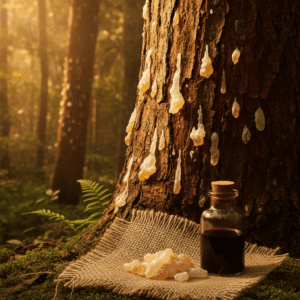
The resin is harvested by hand. The farmer climbs to the top of the tree using a makeshift ladder and, while descending, slits the bark of the trunk in several places to make the tree weep. This is why we speak of benzoin tears.
Voluntary incisions are made on the tree over a period of ten years. This exudation is white when liquid and turns yellow upon drying. When harvested, about 6 months later, it is already semi-solid.
A tree yields 4 to 6 kg of resin or gum per year. Then, the benzoin is transported in jute bags to warehouses where it will be treated like gold nuggets. Then, it will be cleaned and sorted (work ensured by women).
In perfumery, the gum is treated by volatile solvent extraction to obtain benzoin absolute.
Olfactory Description
This benzoin note is very rich in facets: sweet vanilla, almond and roasted coffee, honeyed, floral (carnation), milky, liquorous, cocoa butter effect, slightly medicinal.
Perfumes Containing Benzoin
Perfumes containing benzoin:
- Bois des Iles by Chanel
- Habanita by Molinard
- Opium by YSL
- L’Eau by Diptyque
- Serge Noire by Lutens
- Terre d’Hermès
Also present in Shalimar, L’Heure Bleue, Lui, L’Instant de Guerlain (the latter which I developed with Maurice Roucel), and Bois d’Arménie co-created with Annick Ménardo.