Blackcurrant Bud in Perfumery: A Fruity and Green Note
We continue our overview of raw materials used in perfumery with the fruit of the blackcurrant bud. Origin, processing, benefits, and use in perfumery and food flavoring—you will know everything about blackcurrant.
Botany and History
Botanical Name: Ribes nigrum
Botanical Family: Saxifragaceae, Grossulariaceae
Main Constituents: Allyl amyl glycolate, sabinene, beta-caryophyllene
This fruit was apparently known to the Greeks and Romans. Twelfth-century archaeologists were able to testify to its therapeutic action, notably as a means of curing gout attacks.
This tree only appeared in France at the end of the 16th century, but it was really in the 18th century that the word cassis (blackcurrant) came into being. Until then, it was called poyvrier (pepper plant), most certainly due to its black berries.
Origin and Production
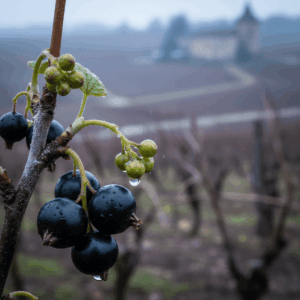
The fruit or black berry with smooth skin most often forms clusters. The blackcurrant bud, mainly grown in Burgundy, comes from a tree called the black currant bush or cassis bush, which can reach two meters in height. The blackcurrant bush is a bushy shrub that grows spontaneously in Northern Europe, as far as Lapland and Siberia.
Russia is the world’s leading producer of blackcurrant, with 300,000 tons of blackcurrant berries per year intended mainly for self-consumption. France holds 4th place behind Poland and the United Kingdom.
In France, it is in Burgundy, in the Loire Valley, or the Rhône Valley that the largest productions of blackcurrant buds are noted; 70% of blackcurrant buds are reserved for perfumery. The blackcurrant harvest takes place from late November until late February.
Classification of Fruity Notes
It is very popular in Europe. A medicinal reputation precedes it, later becoming one of the rare natural raw materials, even though more and more producers or perfume houses are developing new natural fruity notes. There are different categories of fruity notes:
- Red fruits: blackcurrant or blackcurrant bud, raspberry, strawberry, cherry, wild strawberry, blueberry, blackberry.
- Yellow fruits: peach, plum, apricot.
- Exotic fruits: coconut, mango, pineapple, banana, passion fruit.
- Watery fruits: melon, watermelon.
- Juicy fruits: pear, apple, lychee, kiwi.
- Others: fig.
Extraction and Manufacturing of the Absolute
It was really from the 1960s-1970s that this note was worked on in perfumery. Blackcurrant absolute is obtained by volatile solvent extraction of blackcurrant buds, in order to obtain the concrete. For 1 kg of absolute, 30 kg of blackcurrant buds are needed.
Most of the time, blackcurrants are picked by hand, due to the high cost of mechanization. As one person can only pick 1 kg of buds per day, the price of this raw material is quite high.
Virtues, Cuisine, and Various Uses
It is a popular product in pharmacopoeias from India to Europe. It is used by the pharmaceutical industry. It is said to have numerous virtues, both the fruit rich in vitamins C and B12 and the leaf with antioxidant and laxative virtues.
It is said to be active against respiratory infections, migraines, flu, viral diseases, rheumatism, osteoarthritis, etc. It is also recommended for treating dogs victim of viper bites, the leaves being able to treat insect bites.
Blackcurrant is widely used in pastry (jellies, jams, ice creams, pies…) and is also very well known in the form of liqueur. Also called crème de cassis, it appeared in 1841 in Dijon in the famous kir, a mixture of wine and liqueur, succeeding ratafia, an aperitif drink based on grape juice, alcohol, and macerated blackcurrant buds.
The glory of blackcurrant reached its peak when King Louis XV, stopping for lunch in Neuilly after a hunting party, tasted ratafia for the first time and then introduced it to the court. Blackcurrant is also a raw material processed in Grasse, important in perfumery but also in food flavorings.
Note that it is very appreciated in industrial cooking for its acidic flavor because this note, very aromatic, is also fruity and sweet. A museum is entirely dedicated to blackcurrant south of Dijon in Nuits-Saint-Georges, the Cassissium Museum.
Olfactory Description: Between Green and Red Fruit
Blackcurrant is one of the natural raw materials in the perfumer’s palette, used for the first time by Guerlain in the perfume Chamade in 1969. It is a note situated between green scent and red fruit scent.
It sometimes has unpleasant accents when poorly dosed or poorly orchestrated; it can smell of cat urine, sweat, or even the smell of boxwood bushes.
It is a very powerful raw material that traverses the entire olfactory pyramid and is smelled right from the top notes.
The different facets of blackcurrant: green, sulfurous, fruity, a bit woody, liquorous, vinous, bitter, balsamic.
Use in Perfumery
Blackcurrant bud is often used in citrus, floral, or oriental perfumes.
Perfumes Containing Blackcurrant Bud
Here are the perfumes containing blackcurrant bud:
- Chamade by Guerlain
- Champs-Elysées by Guerlain
- Aqua Allegoria: Pamplelune by Guerlain
- First by Van Cleef
- Rose by Cardin
- Sublime Balkiss by The Different Company
- L’Ombre dans l’Eau by Diptyque
- Amazone by Hermès
- Belle de Minuit by Nina Ricci
- In Love Again by Saint Laurent
- Corsica Furiosa by Parfum d’Empire
- Angel and Angel Innocence by Mugler
- Oscarine by Delacourte Paris