Carnation in Perfumery: Divine Flower and Spicy Note
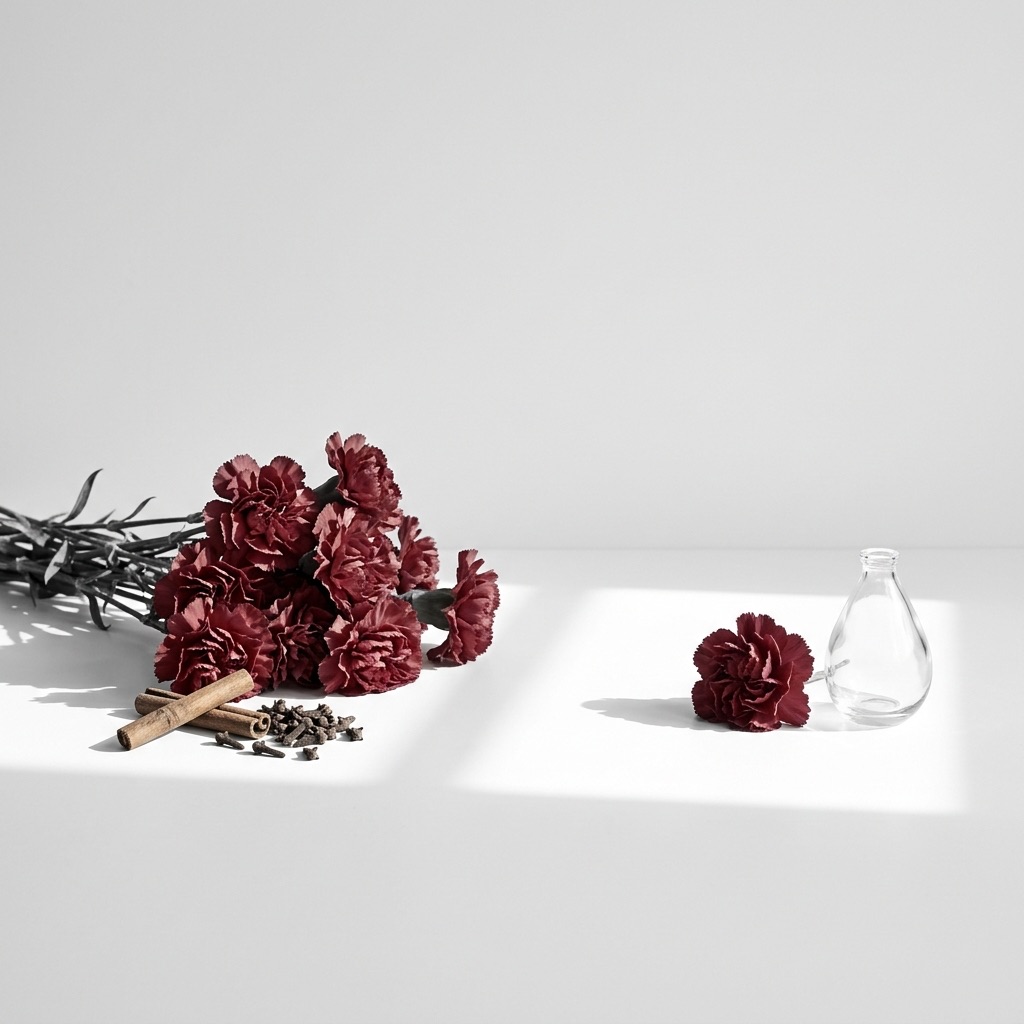
Discover everything there is to know about the carnation flower in perfumery, as well as its history and symbolism.
History and Symbolism: What Does the Carnation Represent?
The carnation is a flower that carries different meanings throughout history and across cultures.
Superstitions and Traditions
In France, it is unthinkable to offer carnations to one’s hostess — but why? This superstition originates from the world of theater: directors would send carnations, inexpensive flowers, to performers.
This signified that the artist was being dismissed. Conversely, the sending of roses to an artist’s dressing room meant their contract would be renewed.
The carnation was often worn as a boutonniere. Henri IV wore it in white, a symbol of traditionalism and conservatism. The red carnation was a revolutionary emblem. As for the green carnation worn by Oscar Wilde, it was a subtle way of declaring his homosexuality.
International Symbolism
The carnation is a flower commonly found in cemeteries in France, whereas in Japan, carnations carry a very positive meaning, symbolizing love and distinction. They are often given on Mother’s Day.
The flower is also widely used in Japanese art: ikebana, poetry, film, literature, kimonos, tableware, origami paper, fans… In China, the carnation symbolizes social success and happiness.
The Carnation in Literature
An extract from the poem by Guillaume Apollinaire, a calligram entitled Étendards — la mandoline, l’œillet et le bambou.
May this carnation impart to you
The law of scents
Not yet proclaimed, which one day shall come
To reign over our minds, more precise and more subtle
Than the sounds that guide us
I prefer your nose to every other organ
O my beloved
It is the throne of future WISDOM
Olfactory Description and Technique in Perfumery
Botanical family: Caryophyllaceae (Dianthus caryophyllus)
It is also known as Dianthus, meaning divine flower in Greek.
The carnation has a subtle balsamic and spicy fragrance, reminiscent of clove. The carnation can yield its scent naturally, processed in Grasse, but the result is rather disappointing as it falls far short of the fresh flower. Moreover, its yield being extremely low, it is seldom used.
The carnation note has experienced a resurgence in recent years, particularly in niche perfumery (cf. Niche perfumery).
Reconstitution: A “Mute” Flower
It is a flower that is reproduced through a composition known as a carnation accord or carnation reconstitution. It may be considered a mute flower, much like violet, lily of the valley, lilac or freesia (cf. Flowers). It occupies a significant place within a composition (cf. The olfactory pyramid).
A commercial base marketed by Givaudan called Methyl Dianthilis is widely used in perfumery. A carnation accord or reconstitution is broadly composed of:
- Rose and Jasmine
- Methylionone (cf. Powdery flowers, violet scent)
- Benzyl salicylate (cf. The solar note)
- Isoeugenol derived from clove (cf. Spices)
- Heliotropin
- Ylang-ylang (cf. White flowers)
- Vanillin (cf. Vanilla)
The eugenol and methyl eugenol notes are heavily regulated and restricted by current perfumery legislation (IFRA). In essence, the scent of carnation is that of a spicy rose.
Other Spicy Flowers
The other spicy flowers are wallflower and immortelle. The carnation should not be confused with the French marigold, also known as tagetes.
Carnation-Based Perfumes
L’Origan by François Coty (1905) was the first carnation-based perfume. It featured this spicy floral carnation base (clove, nutmeg, cinnamon) that blended with oriental or amber notes, creating what might be described as floriental notes.
Here is the list of perfumes from its prolific lineage:
- L’Air du Temps by Nina Ricci
- Opium by YSL
- Youth Dew by Estée Lauder
- Cinnabar by Estée Lauder
- Bellodgia by Caron
- En Avion by Caron
- Tabu by Dana
- Infusion d’Oeillet by Prada
- Après L’Ondée by Guerlain
- L’Heure Bleue by Guerlain
- Lui by Guerlain
- L’Heure Convoitée by Cartier
- Vitriol d’œillet by Serge Lutens
- Anaïs Anaïs by Cacharel
- Fidji by Guy Laroche
- Florabotanica by Balenciaga
- Œillet Louis XV by Oriza L Legrand
- Œillet Sauvage by L’Artisan Parfumeur
- Œillet de Bengale by Aedes de Venustas
- Shanghai Lily by Tom Ford
- Florentina by Delacourte Paris