Coriander in Perfumery: The Spice with Citrus Facets
Often relegated to the kitchen, coriander is nonetheless a fascinating raw material for the perfumer. Both aromatic and spicy, it possesses a dual personality: polarizing when fresh, it becomes subtle, vibrant, and elegant once dried and distilled.
Botany and Origins
Botanical Name: Coriandrum Sativum.
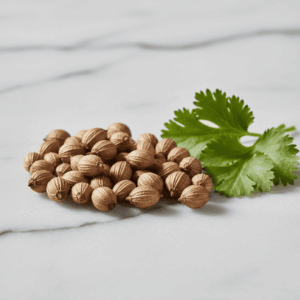
An herbaceous umbelliferous plant 20 to 80 cm high, native to the Middle East, coriander is today cultivated in Europe and Russia. This herb with fine foliage, insignificant flowers, and typical round and fairly large fruits, is found mainly in meadows and fields.
It is also called Chinese parsley or Arab parsley. It belongs to the carrot family (Apiaceae). All parts of this plant are edible: leaves, seeds, roots, even if their taste is different. The leaves have a slightly aniseed smell; the seeds and roots have a taste of orange peel.
There is a striking contrast between the fresh plant and the dried seed. Fresh, it releases a peculiar smell of wood bugs (the word coriander comes from the Greek koris which means bug). Its scent becomes much better after drying the seeds, losing this facet to keep only the spicy elegance.
Olfactory Description: A “Cold Spice”
In perfumery, coriander is classified among fresh spices (or cold spices), as opposed to hot spices like cinnamon or clove.
Its smell is a very uplifting citrus scent, fresh, lemony, slightly camphorated, then, slight aniseed note, spicy floral note. This proximity to bergamot and lavender is explained by its chemical composition.
Its main constituent is linalool (about 60 to 70%). It is this molecule that gives it its tonic and airy accents, allowing it to bridge the gap between citrus top notes and floral or spicy heart notes.
History, Legends and Uses
Traces of coriander are found in the tombs of pharaohs and, in the Middle Ages, it was used to ward off demons: a handful of coriander in the fire. Charlemagne cherished it for its bactericidal functions and, later, it was even considered an aphrodisiac plant. So many virtues!
Outside of perfumery, it is one of the main components of curry, flavors gin, chartreuse, and chili.
The Anecdote of “Sugar Drops”
During the Second World War, raw products being rationed, “sugar drops” were created, coriander seeds coated with white or pink sugar, which were thrown to the crowd like “confetti” during rare moments of festivity, notably during the carnival. An improvised treat that testifies to the cultural importance of this seed.
Coriander in Perfumes
Coriander essence is obtained by steam distillation of dried seeds. It brings lift, vibrancy, and a peppery elegance to compositions.
It is found in many perfumes, especially masculine ones, but also in great feminine chypres. It is notably found in fairly large quantities in Héritage by Guerlain, where it brings a spicy vibration right from the opening.
Some emblematic perfumes containing coriander:
- Héritage by Guerlain
- L’Instant pour Homme by Guerlain
- Habit Rouge by Guerlain
- Coco by Chanel (where it nuances opulent flowers)
- Drakkar Noir by Guy Laroche
- Déclaration by Cartier (a very present coriander, associated with cumin)
- Gentleman by Givenchy
- Coriandre by Jean Couturier (a cult chypre from the 70s)