Eau de Senteur: The Alcohol-Free Perfume for Babies and Toddlers
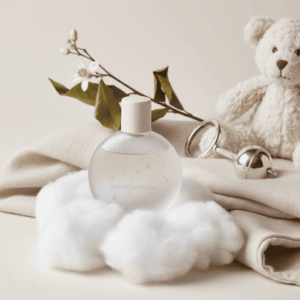
Perfumery counts different types of fragrances, which will be more or less concentrated in alcohol, and whose tenacity will vary: Eaux de Cologne, Eaux Fraîches, Eaux de Parfum, Perfume Extracts, and Eau de Senteur. The latter has the particularity of not containing alcohol. It is therefore particularly adapted to babies and young children.
What is Eau de Senteur?
Eau de Senteur is a perfume intended for children under 3 years old. It contains no alcohol at all, which is replaced by a solvent. Mixed with the fragrant concentrate, this solvent can give, to the touch, a slightly cosmetic, or even somewhat sticky impression. These perfumes are subject to numerous rigorous dermatological tests.
Babies can therefore have their own perfume, so as to sublimate the wonderful and unique scent characteristic of infants. Numerous proposals of Eaux de Senteur exist today to awaken their olfactory sense from the youngest age.
The Olfactory Awakening of the Baby
The baby is, even in utero, already capable of perceiving flavors transmitted by the amniotic fluid. From birth, they are in contact with the smells surrounding them: the smell of their parents’ skin, their perfumes, the smells of the house. The baby is therefore very solicited olfactorily.
History of the First Eaux de Senteur
The first Eaux de Senteur were Baby Dior in 1970, following the birth of “luxury” fashion for children. However, the resounding success goes to L’Eau de Bonpoint, which is still marketed today, and which was very prized not only for use for babies but also for young mothers.
Ptisenbon by the brand Tartine et Chocolat by Givenchy (1987) also met with international success. Bolstered by these successes, other brands launched their scents for children, such as Petit Guerlain, now discontinued in favor of Baby Guerlain, in the exclusives range.
Regulations and Composition (Safety Above All)
In recent years, regulations have tightened considerably. Very few natural ingredients are authorized today in perfumes for infants. This is logical because toddlers have very fragile and thin skin: an ingredient applied in small quantities can end up present in high concentration in their organism.
Contrary to popular belief, citrus fruits are often banned in these compositions, because they can provoke allergies or intolerances (photosensitization).
The exercise is very difficult for the perfumer, because the register of authorized raw materials is limited. They must succeed in creating a perfume with a very natural scent, while using very few natural raw materials.
Which Scents to Choose for Children?
- For babies: Fragrances recall the smell of an infant’s skin. They must be fresh and soft (talc scents). Notes with a musky base (white musks) dressed in a citrus effect (without containing citrus) and haloed with abstract flowers are acclaimed.
- From 7-8 years old: Children want a more mature fragrance, still fresh and light, but often with fruity or gourmand notes. The latter do not have the same regulatory restrictions as those for babies.
Tips for Choosing and Applying Your Eau de Senteur
Before buying an Eau de Senteur, check the composition (via an application like Yuka). For an Eau de Senteur to be suitable for babies, it must be hypoallergenic, without phthalates, parabens, or phenoxyethanol.
Application: We recommend that you never apply Eau de Senteur directly to a baby’s skin. Before 3 years old, the fragrance must be sprayed on clothes only, or on their comfort blanket (doudou).
Eau de Senteur References
For Toddlers (0-3 years)
- Eau Bonpoint
- Ptisenbon Givenchy
- Baby Touch Burberry
- Baby Guerlain
- J Jacadi
- Eau de Senteur Mustela
- Musti Mustela
- Eau de Senteur Klorane
- Baby Ikks
- Eau de Senteur Uriage
For Older Children
- Little Woman Ikks
- Young Man Ikks
- Jeune homme Jacadi
- Mademoiselle Jacadi