Eau de Toilette: Definition, Sillage, and Application Tips
An Eau de Toilette is a perfume with a lower concentration of essential oils. The higher the concentration of the Eau de Toilette, the longer the hold will be.
However, the orchestration of the perfume is crucial, and its good hold will depend on the perfumer’s talent (and not solely on the concentration).
Eau de Toilette can be applied to clothes and must be sprayed in a particular way to guarantee perfect diffusion.
What is Eau de Toilette?
Eau de Toilette is fresher and richer in top notes than Eau de Parfum. With rapid diffusion, this type of fragrance can be applied to clothes. However, given its low concentration (it has 3 to 20% concentrate in 80% vol. alcohol), Eau de Toilette has limited lasting power over time. It can therefore, according to taste, be used in addition to Perfume Extract or Eau de Parfum.
By analogy between perfumery and painting, Perfume Extract could be assimilated to the original work; Eaux de Parfum would be limited and numbered editions; and Eaux de Toilette would be lithographs.
How to Apply Eau de Toilette?
To guarantee a perfect sillage, the ideal is to spray your Eau de Toilette once dressed, in such a way as to trace a large triangle with the fragrance. Start spraying from the top of your hair (this will not damage your hair, but be careful not to spray too close) to the inside of your jacket, then ending at the hem of your garment.
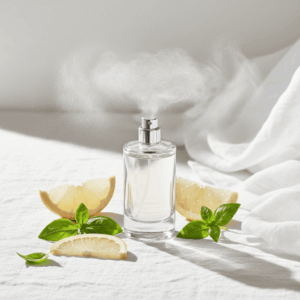
You can also spray your Eau de Toilette by creating a “cloud” in front of you, then walking through the sprayed fragrance in the air a few seconds later. In this way, you can be sure that no damage will be caused to your clothes or jewelry.
Also consider using all derivatives (body lotion, talc, soaps, deodorants…) which will allow obtaining greater tenacity and better diffusion of your fragrance (cf. Making a perfume last).
Finally, you can perfect your sillage by including a few drops of Eau de Toilette in the rinse water of your lingerie, or by washing it with the shower gel from the same range as your Eau de Toilette, to obtain supreme refinement.
By following these Eau de Toilette application techniques, you will be able to smell every centimeter of your skin deliciously perfumed!
Why Does a Product Differ According to Each Skin?
Eau de Toilette, Eau de Parfum, and Perfume Extract have different concentration levels, and each product will react differently depending on the skin on which it is applied (cf. Skin type).
Each skin is unique and possesses its own scent, which varies according to diet, pH, physical activity, or even treatments and medications taken by each person.
Moreover, the scent of the fragrance will not be the same if breathed from Paris, New York, Shanghai, or Dubai! Indeed, it will vary according to the atmosphere, air conditioning, or weather (if it is humid, dry, or hot).
Everything is ultimately only a question of alchemy between the Eau de Toilette and your skin. If this alchemy no longer operates, do not believe that the Eau de Toilette is no longer good. It simply means that the encounter with the fragrance does not work on your skin.
The most important thing is to feel in harmony with your fragrance, and to get compliments around you, proof that you have chosen a perfume or an Eau de Toilette that corresponds to you.
“I like to say that it is not the perfume that perfumes the person but the person who perfumes their perfume”
Furthermore, Perfume Extracts becoming rare, customers increasingly tend to turn towards Eaux de Parfum, or towards Eaux de Toilette, whose prices are more attractive. In general, each product will be orchestrated differently according to the category of fragrance to which it belongs (Eau de Toilette, Eau de Parfum, and Perfume Extract).
However, some brands do not change the orchestration of their product according to the type of fragrance, and will only modulate the degree of concentration.
Concentration of Eau de Toilette
An Eau de Toilette concentrated from 6% to 20% will be more extroverted, and will actually be better smelled by people in your wake than by yourself! It will, however, be less tenacious. Nevertheless, some new Eaux de Toilette are so concentrated and sometimes so well orchestrated that they can be very high-performing and “very diffusive”.
- Perfume Extract is concentrated from 20% to 40%: it is only perceived by the person wearing it and by those who are closest.
- Eau de Parfum can be concentrated from 7% to 30%: it is a good compromise because it combines tenacity and sillage. Delacourte Paris perfumes are orchestrated as Eaux de Parfum, with a minimum concentration of 15%, and can go up to 20%.
Each product therefore has very variable concentrations, which will sometimes be similar, because there are no particular regulations in this area.
Tenacity and a good sillage prove that the fragrance has been perfectly orchestrated, and above all demonstrate the perfumer’s talent. For a fragrance to last a long time, it must therefore above all possess good orchestration, rather than a strong concentration (even if this also influences it).
The Role of an Eau de Toilette and a Fragrance
Each fragrance (perfume, Eau de Parfum, or Eau de Toilette) is the reflection of the personality of the person wearing it. When well chosen, the perfume and Eau de Toilette will give a signature to the person: they help them assert themselves, and carry the message one wishes to transmit to others.
A perfume must therefore enter into harmony with the individual wearing it (an ill-adapted fragrance risks giving you the impression of living out of step with yourself).
Perfume and Eau de Toilette are therefore not comparable to a garment that one could change according to mood, weather, or time of day. The fragrance you wear represents the reflection of your soul. Moreover, it is much more appreciable to be recognized and complimented for the sillage one leaves, rather than for the brand or the name of the perfume one wears.
Choosing Your Style of Perfume or Eau de Toilette
Most of the time, we tend to be attracted by the same style of perfume or Eau de Toilette. Indeed, throughout our lives, we encounter pleasant smells and flavors, which play a crucial role in forging our olfactory experience, our deep identity, and which guide us unconsciously towards a particular style of fragrance.
If you do not know which perfume or Eau de Toilette to choose, you can carry out a consultation, during which a professional will guide you towards the fragrance that will truly echo your deep identity.
Conclusion
Eau de Toilette is considered the most accessible product in perfumery. This type of fragrance, generally more “extroverted” than other products, possesses a good sillage, even if, sometimes, tenacity is not present.
If your Eau de Toilette is volatile, you will then have to perfume yourself several times during the day (it can also happen that your Eau de Toilette is better smelled by people around you than by yourself, which can be a bit frustrating).