Expression in Perfumery: The Cold Extraction Technique for Citrus Fruits
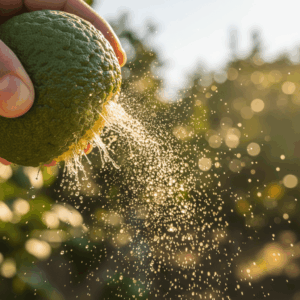
In perfumery, raw materials can be extracted in different ways. Expression is one of these extraction processes. This technique, which is quite ancient, is used to collect the essence contained in the peel of citrus fruits.
Extraction Processes in Perfumery
Here are the different raw material extraction processes that exist in perfumery:
Raw Materials on the Perfumer’s Organ
First of all, you should know that there are 1,000 natural raw materials and 3,000 synthetic raw materials available to the perfumer. Depending on their tastes, they will select about 1,000 raw materials, synthetic or natural, on their perfume organ (furniture allowing the professional to store and classify their bottles of essential oils).
Every year, new raw materials are discovered and marketed, while others disappear due to increasingly strict legislation.
Understanding the Orchestration of a Perfume
Before explaining what the extraction process consists of, it is important to recall how the orchestration of a perfume is organized.
Perfumes often evoke poetry, dreams, and arouse emotions. However, one must know that their design relies on precise scientific and physical notions. Indeed, each perfume is complex, refined, and delicate, and represents a set of notes chosen either for their tenacity or for their ephemeral nature.
The fragrance and its notes can be represented in the form of an olfactory pyramid: the tip is formed by the top notes, the middle part by the heart notes, and the base by the base notes.
This diagram, which seems rather simple and educational, is in reality much more complex than it appears.
Indeed, the notes interlock with each other, respond to and sublimate one another.
A well-constructed perfume will allow the base notes to be smelled from its very flight.
“One could say in this case that the flight prepares its conclusion”
The olfactory pyramid serves to balance the orchestration of a formula. This allows the perfumer to make the fragrance harmonious, and to ensure that its evaporation is continuous and gradual. Thus, the perfume can deliver all its facets, which will give it more life and interest.
Expression and Top Notes
Top notes create the first impression of the perfume. They are made up of fresh, volatile, and often sparkling notes. These top notes escape after the first scents of alcohol, which are even more ephemeral.
Citrus fruits are part of the top notes (cf. Hesperidic facet). They bring a smile to the perfume, open the fragrance, and give it sparkle and vivacity. The main citrus fruits used in perfumery are bergamot, sweet orange, bitter orange (bigarade), mandarin, lime, and lemon.
History of the Expression Process
The expression process, which was developed in Sicily, Italy, has existed since the 19th century, so it is quite old. It is a mechanical treatment allowing the recovery of essential oil (or essence), located in the skin of citrus fruits (also called zest or epicarp). This treatment is practiced only for citrus fruits.
The “Sponge” Method
In the past, expression was carried out manually by a process called “sponge”. The fruits were cut in half, pulp removed, and left to rest for a few hours. This manual treatment carried out using a stick required great dexterity.
The goal was to extract as much essential oil as possible from the small vesicles located in the citrus zest. One then had to handle the sponges which absorbed the essences, and which were squeezed into large earthenware jars. This method still exists today, but remains very confidential.
The “Spoon” Method
Another ancient expression technique called “spoon” consisted of scraping the skin of citrus fruits using a spoon, in order to harvest the essence.
Today’s Expression Techniques
Today, new expression treatments are now very technical and perfected.
The fruits arrive from plantations and remain on site for 72 hours before their treatment. These citrus fruits (lemon, bergamot…) are then washed and possibly sorted by hand, in order to remove damaged fruits.
The Pelatrice and the Centrifuge
Then, the citrus fruits are placed in small compartments and are confronted with the mechanical scraper, called “pelatrice” (the name is the same in English and French). This machine is essentially used to treat bergamot.
Whole fruits are then introduced into this pelatrice: the walls of the machine peel the zest, then prick the peel to release the essence from the glands (called oil-bearing glands). The mixture obtained, consisting of oil and water, is then separated by the centrifuge.
This process is carried out “cold” and does not require heating, which allows the scents of raw materials to be restored very faithfully. Conversely, with distillation or volatile solvent treatment (cf. Extraction), raw materials are heated.
For orange, for example, extraction is carried out on whole fruits. The fruit is pressed with the zests and the juice, then the centrifuge goes into action to separate the fruit juice from the zest essence.
Initially, these treatments were mainly practiced in Italy, but are now also practiced in Brazil and California.
Raw Materials Obtained by Expression: Citrus Fruits
The expression process can only be used on citrus fruits. Here are a few:
- Bergamot: nicknamed the “fine flower of hesperides”, it is the most coveted citrus fruit, because it is very faceted (cf. Hesperidic facet). Bergamot mainly comes from Calabria, a region in southern Italy, where 1,100 farmers cultivate the citrus fruit and produce annually about 110 tons of essential oil each season.
- Mandarin: cultivated in Calabria and in the rest of Italy. There are several varieties, such as green mandarin, yellow mandarin, and red mandarin.
- Italian Lemon: comes from the regions of Palermo, Messina, and Syracuse, in Sicily.
Essence Yields by Expression
Here are some examples of essence yields of certain citrus fruits extracted by expression:
- Sweet Orange: 1,000 fruits are needed to produce about 500 to 600 grams of essence.
- Bergamot: 1,500 fruits are needed to obtain one kilo of essential oil.
- Lemon: 1,500 fruits are also needed to produce one kilo of essence.
Citrus Fruits and the Sun
You should know that citrus fruits are very fragile raw materials, which only keep for about 6 months. Once harvested, all these fruits are then treated by molecular distillation to remove photosensitizing principles such as bergapten or furocoumarin, which used to stain during sun exposure (cf. Perfume for summer).