Head Space in Perfumery: Capturing the Scent of the Living Flower
Perfumes are created from raw materials, natural or synthetic. Natural raw materials can be extracted in several ways. Head Space is one of the extraction processes used.
This technique aims to reconstitute the natural scents of a flower, which could not be obtained in the form of essential oil. Only on flowers.
Extraction Processes in Perfumery
Here are the different raw material extraction processes that exist in perfumery:
Raw Materials on the Perfumer’s Organ
You should know that the perfumer works, in general, with 1,000 materials on their perfume organ (synthetic and natural), which they select, according to their tastes, from a total of 4,000 materials (1,000 natural raw materials and 3,000 synthetic materials are currently available).
Moreover, this figure continues to evolve, because new raw materials are discovered and marketed every year, while others disappear (legislation imposing more and more limitations).
What is Head Space?
Head Space, also called “espace de tête”, represents a recent discovery in perfumery (even if it is talked about a little less today, because the current trend is towards natural and organic). The principle of this technique is to absorb the perfume of a flower without cutting it, in order to analyze and reproduce its different constituents.
How Does Head Space Work?
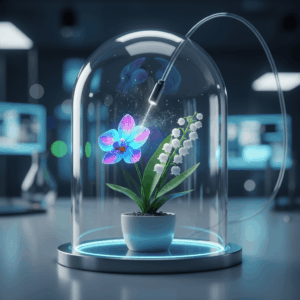
First of all, botanists harvest the flowers by imprisoning them in a large glass bell jar (the size of a head) equipped with a pump. In this way, the flower is not damaged, nor cut. Then, the gas spreads into the container, and accumulates in layers in a wick made of a confidential material, within a tiny closed tube.
For 24 hours, this process will absorb and analyze all the molecules emitted by the flower, which is still planted. These molecules will then be identified by the gas chromatograph and the mass spectrometer, which will dissect the smell of the plant, and list in order the identity of the constituents (there can be up to 80 different ones).
The technical perfumer will then choose the most interesting constituents and recreate the top note of this flower. They will, in a way, reproduce the fleeting notes that the plant would have lost if it had been cut or treated.
This process can also be carried out directly in the laboratory. The flower is then placed in a lukewarm glass flask, from which the air is absorbed. The molecules then find themselves “trapped”; they are condensed at low temperature then analyzed.
Some Head Space units are even more compact, and simply consist of a rod that will be placed in front of the material to be analyzed.
What Are the Advantages of Head Space?
1. The Scent of the Living Flower is Reproduced
This technique allows reproducing the scent of the living flower, as one could breathe it in the middle of nature, or in one’s garden. Indeed, from the moment the flower is cut, it will start to lose a little of its scent.
Similarly, the flower will be devoid of many odorant molecules as soon as it begins to be treated, especially if its scent is extracted by distillation, or by volatile solvent extraction. With these techniques, flowers are, indeed, subjected to certain temperatures, or their perfume is exhausted by slightly odorous gases.
The scents obtained by these different treatments are therefore very far from those of a living and fresh flower (the most successful and neutral scent will be obtained without dispute thanks to the CO2, or sofact, treatment).
2. New Raw Materials Discovered
Initiated by large perfumery industry groups (Givaudan, IFF – International Flavors & Fragrances), Head Space allows discovering and recording new raw materials. For example, this treatment allows reproducing the scents of rare flowers that cannot be cultivated on a large scale.
3. The Possibility of Analyzing Original Atmospheres
Furthermore, you should know that Head Space can analyze not only scents, but also more complex and original atmospheres such as those of a florist’s shop, or a “Civette” (tobacconist), a beach in Rio, an Amazonian forest, a banknote, a truffle, etc.
Head Space will notably be interesting to accentuate the naturalness and freshness of a perfume in the top note.
The Jungle Essence Extraction Process
“Jungle Essence” is a process for researching rare scents, created and patented by the Grasse company Mane. This technology offers an environmentally friendly solution by reproducing scent extracts of exceptional quality and purity, preserving the olfactory attractions of the original raw materials.
This process allows establishing scent samples which can then be recreated in a more industrial way.
Products are inserted into a sort of tube (it can be any materials, such as candies, a fruit, rare raw materials). The tube is then closed, a gas or a liquid is injected into it, and will capture the smell of the products. It is difficult to know the operation of this process in detail, because this technique is very confidential.
If the captured scent is judged interesting, it will then be reproduced in the laboratory, on a larger scale.
Conclusion
Head Space can in no way replace a natural product. If they are bewitching in their opening, the reproduced scents lose their charm after a few minutes.
However, the product of Head Space can be useful to accompany or sublimate a natural smell. For example, the top note of the rose is given by the essence, and followed itself by a heart note, provided by the absolute. This allows obtaining, from the flight to the base notes, the almost perfect reproduction of a living rose.