History of Perfume (Part 1): From Antiquity to the Renaissance
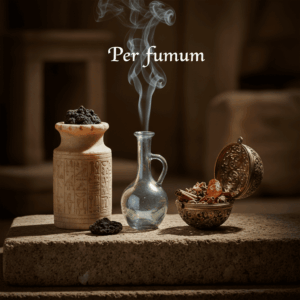
The word perfume comes from the Latin “Per fumum”, which literally means “through smoke”.
Ancient Egypt: The Cradle of Perfumery
Perfume as a link between heaven and earth
The history of perfume finds its origin in ancient temples where aromatic powders, balsams, and precious woods were burned to honor the gods. It accompanied prayers and numerous rituals, in order to ensure the protection of the gods.
If the Egyptians had a very special love for perfumery, it is first of all because they saw in this product an indisputable means of creating a link between men and gods. They also mastered embalming techniques.
Soon, perfume would have a profane use: mortals, men and women, would resort to the benefits of perfumes, for sacred virtues (purification, cosmetics, therapeutic, bewitchment, seduction).
The most famous perfume of Ancient Egypt was Kyphi, used in fumigation in religious contexts, but also medical and hygienic ones. The recipe includes:
- Turpentine resins
- Wine and honey
- Myrrh
- Saffron
- Cinnamon
- Raisins…
The recipes for scented products used for rituals were carefully guarded. They were only transmitted orally and were never written down so as to avoid their disclosure. While they did not master distillation, they were experts in the enfleurage technique.
The use of perfume as a weapon of seduction
Nevertheless, just like in our time, perfume was also used as a tool of seduction. Its fragrant and aesthetic power was highly appreciated by Egyptian populations. Thus, women and men did not hesitate to wear makeup and use the scented substances of the time to mask their body odors and display a certain elegance.
The Louvre Museum has a large gallery dedicated to Ancient Egypt. Among the many pieces exhibited there, a fragment of painted limestone represents a servant bringing a mirror and a kohl case to her mistress.
Incense and myrrh constitute the materials most used at the time. These were imported directly from Somalia and northern Ethiopia. However, other fragrant materials also arrived from Libya, Arabia, and the Near East.
The Egyptians also sourced pine oil, precious woods, and spices. They were already eager for discoveries, setting out in search of varied materials, endowed with olfactory, therapeutic, and medicinal properties. Furthermore, the Egyptians already perfectly mastered the art of aromatherapy.
All the essences created were then contained in sorts of enormous earthen jars similar to the three thousand examples discovered in the tomb of Tutankhamun, the smell of which still subsists today… Undeniably, the Egyptians are today considered to be the people who paved the way for great advances in perfumery.
The Bible and the Hebrew People
The sacred meaning of perfume
The Bible, beyond its religious character, constitutes a precious witness to the daily life of the peoples of the time. Thus, we know that 2000 years before Jesus Christ, the Hebrews already used perfumes and that bodily hygiene was paramount. Moses thus defined in the Bible the different uses of baths, both for women and for men.
Similarly, the Bible teaches us that the custom was to sprinkle oneself with perfume before each meal. Moreover, wines were flavored and aromatics were burned to embellish the feast halls with a delicate smell. Priests were also sorts of apothecaries who mastered the use of plants and aromas to perfection.
They thus created mixtures of ingredients whose recipe was carefully guarded and were situated at the border between medicine, cooking, perfumery, and magic. Nevertheless, among the many ingredients used, incense stood out as excellent. It was exclusively reserved for worship.
Finally, note that perfume also played a role in funeral rites. Although the Hebrews did not practice embalming like the Egyptians, they sprinkled the deceased with scented water and anointed their bodies with aromatic oils.
Plants used by the Hebrews
Several verses of the Bible highlight the fragrant ingredients used by the Hebrew people. “The Lord said to Moses: Take sweet spices, stacte, and onycha, and galbanum, sweet spices with pure frankincense (of each shall there be a like weight), and make an incense blended as by the perfumer, seasoned with salt, pure and holy.”
Myrrh, cinnamon (a tree spreading its smell via its bark), aloe, and nard were also very popular products among the Hebrews. Note that nard, a sort of small fragrant grass, also called Indian verbena, proved to be a very expensive perfume.
Furthermore, according to the Bible, certain smells are considered the smell of the righteous, others correspond to a sacrifice, still others serve to idolize, while the last ones are considered to be the perfume of knowledge.
To date, in-depth studies in terms of the history of religions have allowed us to establish that perfume was just as developed among the Hebrew people as in the time of Ancient Egypt.
Ancient Greece and the Sacred Meaning of Plants
Greece perpetuated the tradition and would largely enrich the palette of scented substances by improving the technique of enfleurage, notably by introducing balsams, gums, and resins into it. The use of perfume and scented substances took on importance in everyday life. Hygiene and grooming became increasingly important: baths, banquets.
If Egypt is considered to be the mother of perfumery, it did not fail to transmit its knowledge to the Greek people, as well as to the Cretans and the Phoenicians. This knowledge was transmitted via their maritime relations. We thus find strong similarities in the sacred meaning of perfume used in Ancient Greece as in the use made of it in Egypt.
Furthermore, in the Creto-Mycenaean era, around 1500 BC, the Greeks believed in the existence of divine beings revealed by aromatics and perfume. They were convinced that the many aromatic plants present in nature were of divine origin. Perfumes proved to be essential ingredients in the celebration of worship.
Offerings were thus made during each ceremony and many scented substances such as myrrh or incense were burned there. Similarly, the most important events in men’s lives were marked by the presence of smells. Each ritual was accompanied by fumigations and scented anointings.
Aromatics played a purifying role, notably during funerals, even favoring the passage into the afterlife. This is why the deceased in the time of Ancient Greece were wrapped in scented shrouds. They were then burned or buried with fragrant plants such as the rose, the lily, or the violet, considered to be symbols of eternal life.
Body hygiene for the Greeks
Beyond the sacred meaning of perfume, the Greeks were also very attached to bodily hygiene and the beauty of being. Thus, they used plants in the form of fumigations, frictions, or baths. Public baths, impregnated with flower smells, were very important places of socialization for the time, frequented by both men and women.
Similarly, as a sign of hospitality, it was customary to bathe the feet of one’s guests in scented basins and to offer them all sorts of fragrant products such as flower garlands, wallflower oil, or flavored wines.
Rome: Capital of Perfume and Excess
Rome was designated as the “capital of perfume”, which allowed for the increase of plant trade. The Romans looked for medicinal virtues in aromatic substances. They introduced glass containers which would replace the earthen containers, widely used by the Greeks. They developed ambient perfumes.
Nero used perfume excessively, notably to mask the scents of his orgies.
While perfume was hardly used in the time of archaic Rome, the contact of the Roman people with the Etruscans and the Phoenicians allowed them to increase their knowledge in perfumery. Perfume and fragrant materials were major products brought back by the Romans during their conquests.
The latter began to appreciate little by little the properties of various fragrances, notably those of myrtle, Spanish broom, labdanum, and pine. Thus, from the Republic to the Empire, perfumes experienced a tremendous boom, sometimes going to excess.
Just like their neighbors, the Romans began to use smells for their most important rites such as marriage or funerals.
Moreover, at the death of Pompey, the equivalent of a year’s production of incense in Arabia was burned! Similarly, the baths took on considerable magnitude, allowing all Romans to wash, including the poorest, and spreading the use of sapo, a foaming paste ancestor of soap.
In parallel, doctors wrote numerous works dealing with the curative virtues of certain plants. Thus, aromatics and plants became flagship elements of the medicine of the time. Certain fragrant products were used as skincare and served for the massage of athletes.
The religious value of perfume diminished little by little, while technical advances in perfumery and aromatherapy were considerable. Moreover, certain works attest that the Romans already used distillation…
Thus, the era of Ancient Greece and Rome is considered to be a key moment in the history of the influence of perfumery. Nevertheless, all the illustrious figures of the time were not necessarily totally favorable to it…
For Cicero: “No scent is a good scent!” while Pliny said of perfume: “Such is this object of luxury, and of all the most superfluous.” Never mind! If we believe the destiny of fragrant materials, it is clear that the fervent admirers of perfume were more numerous.
Islamic Culture and the Sciences of the Arab World
Muhammad once said: “Women, children, and perfumes are what I love most in the world.”
Arabia, a land favorable to perfumery
They learned the secrets of chemistry from the Greeks. They are the undisputed masters of the spice and fragrant powder trade.
If perfume is a very important ingredient in Eastern countries, it is first of all because the latter is located on land conducive to the cultivation of plants. Arabia is the land of aromatics par excellence.
Moreover, the Latin poet Propertius spoke of “Arabia of a thousand perfumes”. Similarly, the poets Hafiz and Saadi evoke in their writings the rose, whose smell is said to be the most prized in the Arab world along with that of animal musk.
Furthermore, rose water is used to scent the rooms of houses. Similarly, it is very often found in certain dishes such as sweets, sherbets, or Turkish delight. Coffee is regularly mixed with ambergris there, and custom dictates that the walls of cups used for drinking be impregnated with fragrant resins.
Similarly, the Arabs possessed a great scientific culture in the Middle Ages. Herbs were in this respect very much employed for medicinal purposes. While the Arabs are not the originators of the creation of distillation, they considerably improved this technique and spread it in Europe: Alembic is an Arabic word.
The sacred meaning of perfume for Arabs
In parallel, perfume is an integral part of religion and the Quran speaks of it many times. Thus, the Muslim paradise is said to be impregnated with numerous sweet smells. Similarly, women are said to be made from the “purest musk”. Just as for many civilizations, Islamic rites were thus accompanied by perfume.
Furthermore, men were invited to go regularly to public baths to purify themselves while women present in harems devoted most of their time to highlighting their natural beauty. Finally, note again that nowadays, it is permitted for Muslims to wear perfume during Ramadan, without invalidating the fast.
The Hindus and Attar
They possess a different approach: they build temples in sandalwood and take care to harmonize their perfumes (in the form of attar) with the different rooms of the temples. Attar is an alcohol-free perfume, whose first traces date back to the 2nd century BC in the region of Kannauj in India.
The Middle Ages in Europe: Between Decline and Revival
The first part of the Middle Ages was marked by a clear decline in perfumery. Indeed, the barbarian invasions led to the fall of the Roman Empire and limited the use of aromatic plants. However, the reopening of Roman trade routes from the 12th century allowed the rediscovery of numerous fragrances.
What’s more, Marco Polo’s travels as well as the development of the spice trade paved the way for new flavors. The introduction of perfumes in Europe was also done through the Crusades.
In France, in 1190, the privilege of perfume trade was attributed to glove makers. The first aromatic alcoholic composition, the famous “Hungary Water”, developed notably from rosemary, was born in the 14th century.
Perfume against the Black Death
During the Black Death epidemic (1347 – 1352), doctors recommended the use of perfumes containing notably spices. During quarantine, survivors washed with brandy added with cloves, salt, and iris powder, then inhaled aromatic vinegars whose recipe, for example, employed:
- Clove
- Violet flower
- Hyacinth
- Carnation
- Musk
- Ambergris
For the poorest, it was recommended to use mugwort, more affordable…
As prevention, one could inhale aromatic plants. Doctors, to protect themselves, wore a long, very enveloping black robe with a mask in the shape of a bird’s head with a long beak stuffed with aromatics. In private homes, perfumes were burned in cassolettes to purify the air; the stench was considered deadly.
Pomanders worn permanently on oneself were also highly prized by aristocrats and high-ranking ecclesiastics who inhaled the aromatics they contained several times a day.
Among the many waters supposed to fight against the plague, Damascus water, whose formula contained twelve aromatics as well as musk and civet, possessed an excellent reputation, just like the theriac of Venice and Montpellier. In the streets, to try to stop the progression of the epidemic, large fires supposed to purify the atmosphere were lit in the middle of crossroads.
Venice under the Renaissance
In Venice, in 1555, the first European treatise on perfumery was born. The Italians became masters in the art of treating leathers; it was they who initiated the fashion of scented gloves. The recipe for “Spanish Skin” (Peau d’Espagne) is known: the skin macerates in rose water, then fragrant materials such as lavender, neroli, clove, sandalwood are added. The whole is then kneaded with animal notes.