Lavender in Perfumery: The Blue Gold of Provence and Aromatic Notes
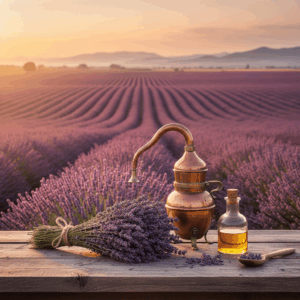
Lavender is so well known and familiar that quite often we no longer think about it. As if invisible, it is present in our vacation and childhood memories, often linked to memories of the South of France, sometimes linked to positive, almost cliché moments such as the smell of clean sheets in grandmother’s wardrobe or the evocation of Marseille soap and its clean smell.
Virtues and History of Lavender
Its medicinal virtues have been known since antiquity; lavender was a major ingredient used in embalming. It has been used for a very long time to scent linen; its name comes from the Latin lavare (to wash). Washerwomen used it abundantly. It had the virtue of eradicating diseases by scenting them; it was used during the plague.
The Legend of the Four Thieves Vinegar
This story dates back to the 17th century in Toulouse, ravaged by the plague, where 4 thieves robbed contaminated houses with impunity, shrinking neither from the dying nor from corpses and always emerging unscathed from their macabre incursions.
After being arrested and sentenced to death, they were offered a deal: their lives spared in exchange for the secret of the mysterious immunizing liquid with which they anointed their bodies.
The 4 brigands confessed and revealed the magic recipe: thyme, lavender, rosemary, sage, macerated in vinegar with the instruction to rub the whole body to pass intact through all the epidemics that the devil sends.
It was in the 19th century that a certain Maille, a vinegar distiller, patented this formula to launch it into the medicine trade, with a particularly targeted approach, a product recommended to nuns, priests, and doctors. Drink it on an empty stomach, a spoonful in a glass of water, rub the temples well and then you can quietly visit your patients.
Traditional and Medicinal Uses
Still used for its action on migraines, against colds because it naturally contains camphor, insect bites, snake bites. In the Alps, when their dogs are bitten by vipers, hunters pick lavender, crush it, and rub the bitten animals; the venom is immediately neutralized.
In internal use: antiseptic, healing, anti-rheumatic, anti-migraine, bactericidal dewormer, anti-bronchitis, diuretic, cardiac tonic, insomnia, effective against lice. In infusion, it promotes digestion and sleep. Its perfume seduces bees who load themselves with this nectar to give us lavender honey.
Botany: Lavender or Lavandin?
There is a major difference between fine lavender and lavandin, its hybrid.
Fine Lavender
Initially, lavender was established on wild lands, where no cultivation was possible. Already known to the Egyptians for its therapeutic virtues, it grows spontaneously on the dry lands of Upper Provence.
In the middle of the 18th century, thanks to the development of perfumeries in Grasse, the demand for aromas became increasingly important. Picking, which was then a side job for farmers (250kg to 300kg of lavender harvested per day by a worker), intensified to such a point that it was decided to cultivate it.
It is found on the Valensole plateaus in the Alpes-de-Haute-Provence, southwest of Digne in the Drôme, and also in the heart of the Roanne valley, so from 600m altitude. The harvest is done from mid-July and can go until mid-August.
Main constituents: Linalyl and geranyl ethers, geraniol, linalool, limonene, camphor, coumarin, pinene, butyric and valerianic ethers. Note that it is the percentage of linalyl that will give it its olfactory quality.
Lavandin (Hybrid)
Lavandin is a very different species of lavender because it results from a cross between lavender and spike lavender; it is therefore a hybrid (cross between Lavandula Vera and Lavandula Spica).
The creation of this hybrid plant, lavandin, was done around the 20th century; it is a variety that acclimatizes to a low altitude of 200 meters. The stem is taller, about 50 to 80 cm, and is characterized by two lateral branches, placed at the bottom. The flowers are generally larger than those of lavender.
Several varieties exist: lavandin super, grosso, abrialis, and sumian. The harvesting method is crushed green; the stems are collected with large tractors, the stems and leaves are treated in distillation the same day.
Olfaction: It is more camphorated than lavender, a bit woody, less chic and fine and refined than lavender, which is why lavandin is used in soaps and softeners. There are also in the same tonalities of aromatic notes but less noble: spike lavender, hyssop, and rosemary.
Production and Current Challenges
Lavender can be found in Russia, Bulgaria, Australia, but in larger quantities in Italy, Spain, and of course in France. France is one of the main suppliers of lavender.
Threats: Lavender is threatened and sometimes destroyed by phytoplasma, a very contagious disease; in the south, they call it decline. In three years, the lavender weakens and becomes hay. Some producers are affected and can lose up to half of their harvest; before, it was treated with very effective pesticides but since then, it is forbidden so as not to harm bees.
New methods exist now, with the help of Grieppam and the Givaudan Company; they have engaged in the creation in greenhouses of specific varieties, anti-insect, more resistant; the first tests were very conclusive, so let’s remain confident.
The essence or essential oil is obtained by distillation. One can also obtain lavender absolute by volatile solvent extraction. Lavender is harvested and then dried for two to three days before being distilled. This has the advantage of accentuating the coumarin side (which is contained in its composition) and soft amber side of lavender.
Lavender around the World
It is appreciated everywhere in the world, of course in England; on the other hand, it is totally unknown in Japan. For Japanese women, this smell is a very exotic UFO but they like to use it in misters or room nebulizers.
I learned that it was very appreciated in Brazil. Imported by the Portuguese, in 40% of Brazilian products one finds lavender, just as in Europe one finds it in laundry detergent, soaps, detergents, etc.
There is a very important religious festival called Lavagem do Bonfim in Bahia where its smell invades the whole city; the festival takes place in January, the Baianas are dressed in white and scented with lavender to go to church.
Lavender in Perfumery: Fougère and Modernity
Until now, it has been used abundantly in classic Eaux de Cologne as well as in Fougère or Chypre, or Oriental accords. Lavender could be a source of inspiration again if we dared other blends, such as the idea of marrying all purple flowers like iris, violet, heliotrope, and lavender and why not associate them with the chocolate, licorice, or almond note, or married to solar notes.
One could also really play it in a feminine version, whereas until now, it has rather been played masculine or unisex.
Perfumes that contain lavender
- Jicky by Guerlain
- Mouchoir de Monsieur by Guerlain
- English Lavender by Yardley
- English Fern by Penhaligon’s
- Agua Lavanda Puig by Antonio Puig
- Pour un Homme by Caron
- Azzaro pour Homme
- Héritage by Guerlain
- Lavender Palm by Tom Ford
- Encens et Lavande by Serge Lutens
- Gris Clair by Serge Lutens
- Le Mâle by Gaultier
- Luna Rossa by Prada
- Jersey by Chanel
- Florentina by Delacourte Paris