Orange Blossom in Perfumery: Origin, Extraction, and Symbolism
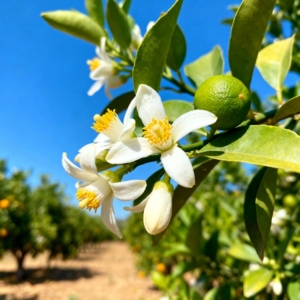
Orange blossom has many facets in perfumery. It was an enchantment during all of Sylvaine Delacourte‘s travels, whether in Seville, Spain, or Marrakech, Morocco, and inspired her Orange Blossom Collection.
Origin and Production of Orange Blossom
Originally, orange blossom comes from Asian countries, India and China. In the 9th century, the orange tree was established all around the Mediterranean thanks to the Arab conquests. First cultivated all around the Mediterranean basin, orange blossom is today mainly produced:
- In Tunisia, in the Cap Bon and Nabeul regions. Tunisia is the world’s leading producer of orange blossom.
- In Egypt, in the south of the Nile, where the land is conducive to its cultivation.
- In Morocco, in the northern regions, near Rabat and Fez.
Orange blossom is cultivated in each producing country on an area of about 600 hectares. Orange blossom for perfumery was cultivated in France from the beginning of the 19th century.
The decline in production began about fifty years later. Indeed, in 1956, the winter was very harsh for the crops, which were lost one by one. Only the farms of Vallauris, a small town in Provence, continue to cultivate the bitter orange tree today.
The Bitter Orange Tree: Botanical Description
The Bitter Orange tree (Bigaradier) is the tree responsible for the creation of neroli, orange blossom absolute, orange blossom water absolute, bitter orange essence, and petitgrain. Also called Seville orange, it is a tree of the Rutaceae family that can reach between 3 to 7 meters in height.
It has smooth, green, and oval leaves; the orange blossom is small and white. Its yellow heart exhales both the sweetness and beauty of childhood and the sensuality of a woman.
Harvest and Yield
It is at 15 years old that the orange blossom reaches full maturity. A bitter orange tree can produce up to 15 kg of orange blossoms. The harvest lasts 3 to 4 weeks. A picker harvests about 10 kg of flowers per day. Orange blossom is appreciated for its olfactory and medicinal powers, but also for flavoring dishes.
Its characteristic sillage is due to molecules such as limonene, linalool, linalyl acetate, indole, ocimene, neryl acetate, geranyl acetate, nerolidol, beta-caryophyllene, etc.
Yield and Price: One tonne of orange blossoms produces between 1.1 and 1.3 kg of neroli and between 1.2 and 1.4 kg of orange blossom absolute. While 1 kg of flowers costs between €1 and €3, 1 kg of neroli is worth between €3,000 and €5,000, and 1 kg of orange blossom absolute is worth between €4,000 and €6,000.
Symbolism and Beliefs
Thanks to its recognized benefits in aromatherapy, orange blossom relaxes, reassures, and awakens positive thoughts. The whiteness of orange blossoms evoked an ideal of purity and chastity during the Renaissance. A little earlier in the 15th century, orange blossom was perceived as a symbol of love, matrimonial longevity, and prosperity.
It is perceived in the Christian tradition as a symbol of Mary’s virginity. Indeed, the bitter orange tree is associated with the Virgin: Mary is a virgin and mother, just as the bitter orange tree bears flower and fruit. Through this association with religion, orange blossom remains the symbol of marriage even today.
Furthermore, orange blossom was very appreciated at the court of Louis XIV, the king who “smelled good.” Indeed, in addition to the vast orangery present outside the castle, many orange trees adorned the interior of the palace.
The Different Extracts in Perfumery
- Orange blossom produces neroli and orange blossom water through distillation.
- Through extraction with volatile solvents, it yields orange blossom absolute.
- Its twigs and leaves yield petitgrain through distillation.
- The zest of the orange fruit produces bitter orange essence.
There is also a little-known product obtained from orange blossom leaves called Eau de Brout; it is the water recovered from the distillation of petitgrain. Its scent possesses floral notes with slight animal facets. There is also Eau de Brout absolute.
A Pillar of Perfumery
These different extracts obtained from the bitter orange tree make this multi-faceted tree an essential pillar of perfumery. These essences and absolutes blend with many olfactory families, such as bewitching orientals and gourmands as well as musks and white flowers.
Each fragrant product extracted from the bitter orange can have fresh, green, aromatic, white floral, citrus, fruity, honeyed, leathery, and animal facets.
Sylvaine Delacourte’s Orange Blossom Collection
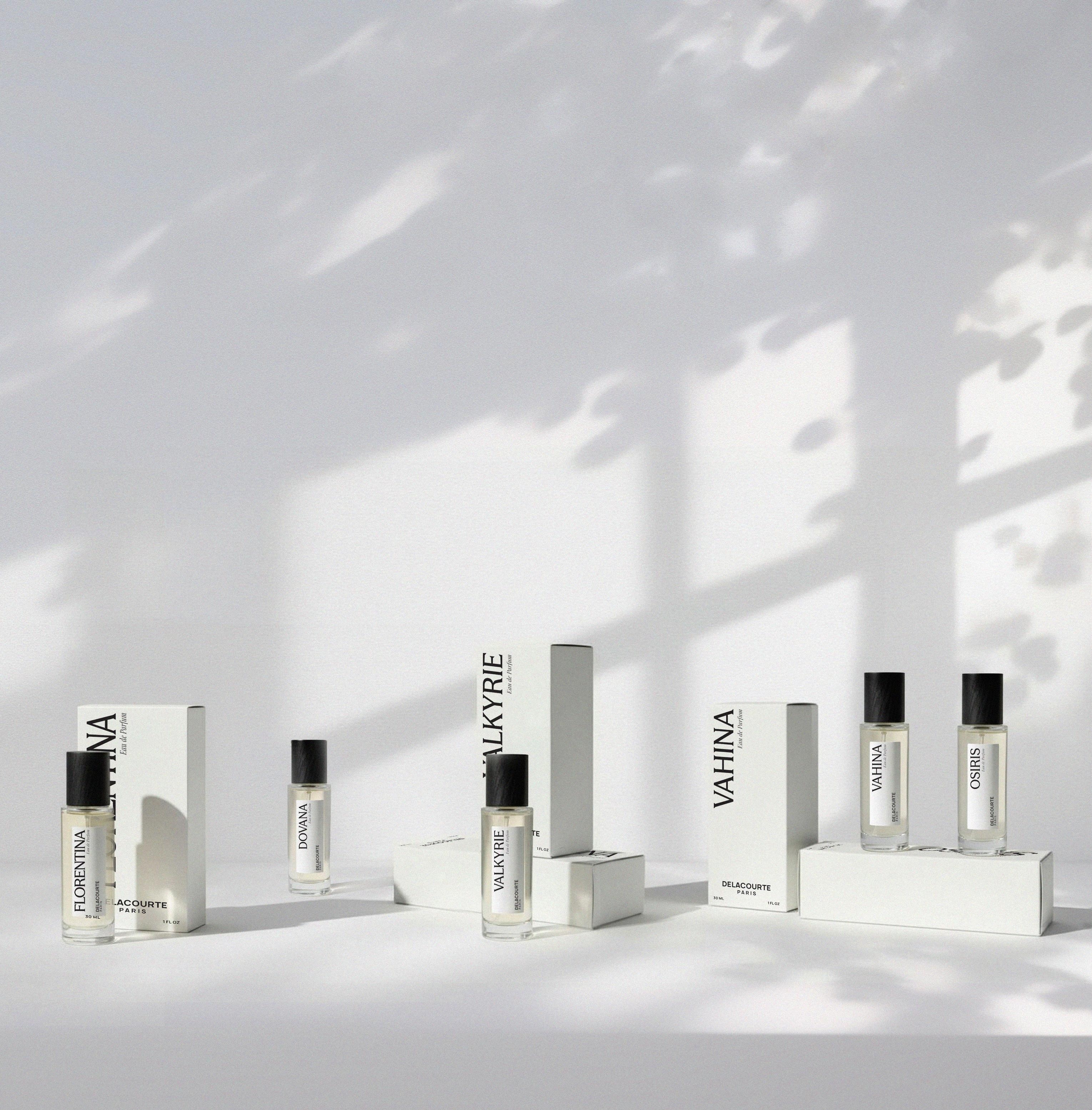
These facets are highlighted and worked on within Delacourte Paris perfumes:
- Osiris: king and god of ancient Egypt, conveys all the roundness of a delicious orange blossom confronted with sesame.
- Oranzo: an icy orange blossom, which glides on the skin like a fresh and rejuvenating waterfall.
- Oscarine: goddess of the northern forests, evokes a fruity and juicy orange blossom.
- Ozkan: Ottoman poet prince, leaves behind a sillage of leathery orange blossom.
- Olyssia: an Italian princess who reveals a floral orange blossom with velvety petals.
Selection of Perfumes with Orange Blossom
Eaux de Cologne
- Original Eau de Cologne – 4711 (1792)
- Eau de Cologne Impériale – Guerlain (1860)
- Cologne Come Together – Mugler (2001)
- Escale à Portofino – Dior (2008)
- Neroli Portofino – Tom Ford (2011)
- Cologne Indélébile – Editions de Parfums Frédéric Malle (2015)
- White Neroli – Mizensir (2015)
- Matin Blanc – Yves Rocher (2019)
Eaux de Parfum
- Narcisse Noir – Caron (1911)
- L’Heure Bleue – Guerlain (1912)
- Giorgio – Giorgio Beverly Hills (1981)
- Classique – Jean Paul Gaultier (1993)
- 24 Faubourg – Hermès (1995)
- Zagara – Santa Maria Novella (1996)
- La Chasse aux Papillons – L’Artisan Parfumeur (1999)
- Fleurs d’Oranger – Serge Lutens (2003)
- Fleur d’Oranger – Fragonard (2004)
- Pure Poison – Dior (2004)
- Néroli Blanc Intense – Au Pays de la Fleur d’Oranger (2005)
- Fleur d’Oranger 27 – Le Labo (2006)
- Divin’Enfant – Etat Libre d’Orange (2006)
- Armani Code Femme – Giorgio Armani (2006)
- Love, Don’t Be Shy – By Kilian (2007)
- Louanges Profanes – Pierre Guillaume (2008)
- APOM – Maison Francis Kurkdjian (2009)
- Infusion de Fleur d’Oranger – Prada (2009)
- Le Parfum – Elie Saab (2011)
- Guimauve – Reminiscence (2013)
- Love Story – Chloé (2014)
- La Fille de L’Air – Courrèges (2015)
- Nue au Soleil – Prada (2015)
- Perdizione – Nobile 1942 (2016)
- Eau de Néroli Doré – Hermès (2016)
- Guimauve de Noël – Parle Moi de Parfum (2016)
- Tomboy Néroli – Parle Moi de Parfum (2016)
- Néroli Outrenoir – Guerlain (2016)
- Eau des Sens – Diptyque (2016)
- Basil & Néroli – Jo Malone (2016)
- Une Amourette Roland Mouret – Etat Libre d’Orange (2017)
- Sale Gosse – Editions de Parfums Frédéric Malle (2017)
- Histoire d’Orangers – L’Artisan Parfumeur (2017)
- Comme une Fleur – Roos & Roos (2017)
- Parco Palladiano VIII – Bottega Veneta (2017)
- Zagara – Via dei Mille (2017)
- Berber Blonde – Sana Jardin (2017)
- Néroli Intense – Nicolaï (2018)
- Shalimar Souffle d’Oranger – Guerlain (2019)
- Libre – Yves Saint Laurent (2019)
- Osiris – Delacourte Paris (2019)