All About Perfume Concentration: EDC, EDT, EDP, Extrait (Pure Perfume)
Are you hesitating between an Eau de Toilette and an Eau de Parfum? The difference lies primarily in the concentration, which is the percentage of fragrant raw materials diluted in alcohol. This dosage directly influences the power, sillage (projection), and longevity of your fragrance.
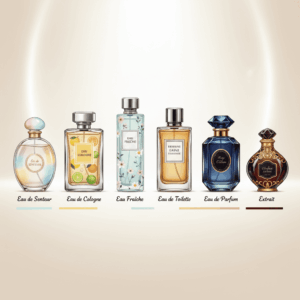
Sylvaine Delacourte deciphers the different categories for you, listed here from the freshest and most volatile to the most long-lasting and powerful:
- Eau de Senteur (for toddlers)
- Eau de Cologne (original freshness)
- Eau Fraîche (tonic and light chypre)
- Eau de Toilette (airy)
- Eau de Parfum (asserted sillage)
- Extrait de Parfum or Pure Perfume (the soul of the fragrance)
It is possible to adjust your concentration choice based on the seasons. Some adopt what is called a parenthesis perfume, a lighter choice for an olfactory break in the summer. Here are some recommendations for choosing a perfume for summer.
Eau de Senteur: Safety for Babies and Toddlers
Intended for children under 3 years old, Eau de Senteur is a very light fragrance. It may contain alcohol, but most often it is alcohol-free, replaced by a solvent mixed with the fragrant concentrate. This solvent can give it a slightly cosmetic and sometimes “sticky” texture.
Like any serious perfume, these waters must be dermatologically tested. It is recommended to check their safety on applications like Yuka or Clean Beauty. Spray them only on clothing, never directly on babies’ skin.
Among the first Eaux de Senteur: Baby Dior (1970), Bonpoint, Tartine et Chocolat by Guerlain, Petit Guerlain. They are very low in concentration: between 4% and 10%.
Regulations have tightened in recent years: very few natural ingredients are now allowed in infant perfumes, for understandable health reasons.
The challenge for the perfumer is to create a natural sensation with an extremely limited palette, often less than 10 authorized ingredients (Cf. Synthetic molecules).
Eaux de Cologne (EDC): The Heritage of Freshness
Used since its origin for hygiene, Eau de Cologne is synonymous with freshness and well-being. It is passed down through generations, is used generously (via “splash”), and provides an immediate invigorating effect after sports or bathing.
- Classic Eau de Cologne (appeared in the 18th century) contains up to 99% natural ingredients. Primarily composed of citrus notes (cf. Hesperide facet), it is very volatile. Its concentration ranges from 2% to 6% in 60° alcohol.
- Modern Eaux de Cologne maintain the classic structure (citrus, orange blossom) but use synthetic molecules to enhance longevity and projection. Examples: Eau de Cologne Blanche by Dior, Cologne du Parfumeur by Guerlain.
Eau Fraîche: The Light and Tonic Alternative
Inspired by Eaux de Cologne, Eaux Fraîches are appeared in the 20th century to offer more staying power. They incorporate chypre, woody, and floral notes, often including the molecule Hedione to boost their freshness and airy diffusion.
Among the pioneers: Eau Sauvage, Eau de Guerlain, Eau de Rochas. Today, modern and musky versions are available, such as CK One by Calvin Klein, or Thé Fragrance by Bulgari.
Eau de Toilette (EDT): Vivacity and Airy Sillage
An Eau de Toilette generally contains between 3% and 20% concentrate in 80° alcohol. It is lighter and more volatile than an Eau de Parfum, making it ideal for mornings or summer days.
Rich in top notes (the most volatile), it is sprayed generously on clothing and can be supplemented with an extrait de parfum or Eau de Parfum for added depth.
Eau de Parfum (EDP): Longevity and Depth
Concentrated between 7% and 30% in 90° alcohol, Eau de Parfum is the star of modern perfumery. It offers an excellent compromise between price, longevity, and projection. It generally lasts all day.
By analogy, if the extrait (pure perfume) is the original artwork, the Eau de Parfum is a limited edition, and the Eau de Toilette is a lithograph. It is the preferred choice for a noticeable olfactory signature.
Be wary of the current trend to overuse high concentrations (sometimes up to 50%), which can paradoxically harm the perfume’s subtlety and lift. Delacourte Paris creations (musk, vanilla, orange blossom) are Eaux de Parfum dosed between 15% and 20% for a perfect balance.
Extrait de Parfum (Pure Perfume): The Soul of the Fragrance
Considered the noblest form, the extrait is the most concentrated (20% to 40% in 98° alcohol). Just a few drops are enough to perfume the skin durably, as it evolves intimately with the skin.
One must not confuse power with concentration: traditionally, major houses (like Guerlain) achieved remarkable sillage with very low extrait concentrations (6% to 8%) thanks to the perfumer’s talent for orchestration.
Sometimes, the same fragrance is composed differently according to concentration. Example: Dior’s J’adore, whose Eau de Toilette contains more citrus top notes than the Eau de Parfum.
The specific case of Attars
In the Middle East, the culture of perfume is different. Attars are perfumes composed of 100% essential oils and absolutes, alcohol-free. They are extremely powerful and are applied by touch, offering a very intimate and long-lasting olfactory experience.