Sesame in Perfumery: A Gourmet and Roasted Note
Sesame is a word immortalized by the tales of the One Thousand and One Nights, “Open Sesame” in the story of Ali Baba and the Forty Thieves.
Even if its origin was highlighted in this tale, it means something quite different, namely an appropriate method, like a password or a letter of recommendation, to have a passage or a very restricted place opened. The link between the sesame seed and the key that opens the cave or secret places is quite obscure.
In the 6th century BC, it is reported that wealthy Assyrians used this oil for their skincare. Sesame seeds have played a daily role since ancient times. It is a plant that opens the door to our appetite and our nostrils.
Origin and Botany
Botanical Name: Sesamum indicum
Native to Central Africa and the Orient, sesame belongs to the Pedaliaceae family. Sesame includes 36 species and is found today in 60 countries; Indian sesame is the most used variety.
The plant measures from 60 cm to 2 meters in height and possesses numerous capsules that look a bit like snapdragons, enclosing the sesame seeds, about sixty small oleaginous seeds that resemble flax seeds. The flowers are white or wine-colored.
They can be consumed as they are, dehydrated, grilled, roasted, blond, brown, or black, or pressed into oil. Sesame oil can be cold-pressed for cosmetics or hot-pressed for industrial use.
Culinary and Traditional Use
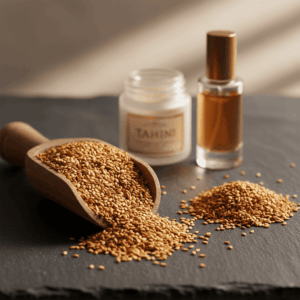
This plant is widely used in Southeast Asian cuisine to add flavor to dishes. In Japan, toasted sesame seeds are mixed with salt for Gomasio. In the Middle East, sesame is reduced to a purée to make the famous Tahini. Highly appreciated in the Middle East but also in India in cooking and also in their Ayurvedic medicine.
Sesame in Perfumery: A Hazelnut and Warm Bread Note
Its scent in perfumery is very faithful to the seed we consume. It is both exotic and spicy, with a non-sweet gourmet facet smelling of caramelized hazelnuts. Sesame possesses effects of warm bread, maple syrup, coffee, and peanut.
Its use is quite rare in perfumery. It is now available as a natural product. It blends particularly well with vanilla, woody, and oriental notes (cf. Oriental Facet, Woody Facet).
CO2 Extraction
To be used in perfumery, sesame is most often treated by CO2 extraction, a process that allows it to preserve its original scent (cf. CO2 Extraction).
Cosmetic and Health Benefits
It is a seed rich in lipids and unsaturated fatty acids. It can be used in cosmetics because it is very nourishing and brings softness to the skin.
- Rich in antioxidants like vitamin E, it fights against cell aging.
- Sesame lowers blood pressure, beneficial for cardiovascular and intestinal health.
- Sesame seed stimulates intellectual activity and memory; it is rich in lignans which play a role close to that of estrogens.
- The seed is a source of remineralizing minerals and trace elements and fiber; 60 ml of sesame seeds provide more calcium than 250 ml of milk.
- Sesame is rich in phosphorus, magnesium, zinc, manganese, copper, iron, and vitamins B1, B2, B6 & B3.
Sesame-Based Perfumes
Here is the list of sesame-based fragrances:
- Ambre Narguilé and Épices Marine by Hermès
- Pour La Fin Du Monde by État Libre d’Orange
- Florabellio by Diptyque
- Night Call by Ex Nihilo
- Ange Noir by Givenchy
- Désert Suave by Liquides Imaginaires
- Haramens by Pierre Guillaume
- Kedu by Memo
- Jade Leaf Tea by Jo Malone
- Pavillon Rouge by Jovoy
- Aqua Kenzo pour Homme by Kenzo
- Dolce Flore by Incalmo
- Trouble-Fête by Givenchy
- Osiris by Delacourte Paris