Smell Loss and Covid: Understanding Anosmia and Retraining Your Nose
Covid has turned the world upside down and caused numerous abnormalities.
This epidemic has disrupted the senses, shedding light on an often misunderstood handicap: anosmia.
Olfactory Symptoms of Covid-19
Anosmia, i.e., loss of smell, and loss of taste are the two major symptoms of Covid-19:
- Statistics: A study of 2500 patients shows that 60% of those who tested positive had lost their sense of smell. Not all “Covid positive” people lose their sense of smell, however.
- Duration: The return to normal is different for each individual. The majority recover 75% of their olfaction after one month. A few additional weeks, or sometimes a few months, will be necessary for a return to normality.
- Other causes: Anosmia can also be linked to a total or partial lesion of the olfactory nerve, which can occur outside of Covid, due to a viral infection, a stroke, head trauma, or an inflammatory disease. Depending on the case, smell can return after a few days, a few months or years, but it may also never return.
Glossary of Smell Disorders (Dysosmias)
- Hyposmia: Partial decrease in smell and taste.
- Hyperosmia: Olfactory performance superior to normal; one can say that perfumers have hyperosmia.
- Parosmia: Distorted perception of smell.
- Phantosmia: Olfactory hallucination.
Glossary of Taste Disorders
- Ageusia: Loss of taste.
- Dysgeusia: Distortion of taste.
Understanding Smell and Its Importance
A smell expresses the signal emitted by an element of our environment at a given moment, received by our senses and recorded in our memory. We are all bathed in the world of smells, some pay more attention to it than others, consciously or not, but no one escapes it.
On the other hand, perfume is a smell created by man. It is an artifact, a creation, a work of art, a product, depending on everyone’s perception. But it is always a formula developed by a perfumer. Jean Giono wrote: “Gods create smells, men make perfumes.”
Male / Female Differences
- In women: The female sense of smell is at its maximum on the day of ovulation; it is therefore fluctuating according to the hormonal cycle. Pregnancy, for example, due to the influx of hormones, significantly increases olfactory capacities. We can therefore speak of temporary hyperosmia in pregnant women.
- In men: The male sense of smell is more stable, but that does not mean it is necessarily more efficient. Men smell certain fragrant molecules differently, such as musks for example.
After 50 years of age, olfactory acuity may decrease slightly, but it is not the sense that weakens the most, especially if it is trained like that of perfumers.
The Vital Link Between Smell and Taste
Smell remains the main open door to our limbic and reptilian brain, that of emotions. When we smell a scent, memory and emotions are immediately solicited. The reptilian brain captures smells, the limbic brain interprets them.
The reptilian brain is also the one that brings us back to our instinct; it is the primitive and instinctive part of the mammalian brain of which we are humble representatives.
Eating with the Nose
Did you know that we eat first with our nose? Smell is, in fact, richer and more powerful than taste. Our taste buds can only detect 5 families of flavors: sweet, salty, sour, bitter, and the new taste sense, umami (pleasant taste between salty and sweet).
We can, on the other hand, capture up to ten thousand smells. Perfumers, thanks to memorization exercises and their hyperosmia, can recognize and memorize up to 1000 different scents. It is enough for a cold to come and paralyze our sense of smell for our gustatory capacity to be immediately put out of action.
The raspberry experiment: Do the exercise of pinching your nose when you eat a raspberry! You will only have the sensation of freshness and sweetness of the raspberry and nothing else, no raspberry taste.
Obvious for Gourmets
A person with an educated and curious palate necessarily has a developed sense of smell. They are used to tracking down flavors and dissecting scents. Perfumers are, all or almost all, fine gourmets, who love to eat, taste wines, and discover novel flavors.
Perfumers and oenologists often confront each other, and even if their specific vocabularies are slightly different, they manage to understand each other perfectly.
Tip: For perfume lovers, it is better to choose your perfume when you are hungry. In fact, as soon as the liver is active, which dulls the sense of smell, hunger exacerbates olfactory acuity.
The Psychological Impact of Anosmia
This is the reason why when one is affected by Covid, and when anosmia strikes, one can no longer, as a general rule, taste one’s food. Life becomes sadder and colorless.
When anosmia is permanent, it can be a real handicap. Anosmia deprives us of essential pleasures with the consequence of loss of appetite, anxieties, fear of smelling bad, with the impossibility of smelling danger like fire or gas leaks. Anosmia is an incredible feeling of loss of bearings.
A drop in libido has also been observed, love and smells being extremely linked, feelings of sadness, feelings of confusion, depression. The impression of being cut off from the world and being disoriented.
Retraining Protocols and Treatments
Recovering Your Sense of Smell After Covid
At the Nancy University Hospital (France), an olfactory retraining protocol is offered to Covid patients who do not recover their sense of smell.
- Anosmia is first treated with corticosteroids to quickly reduce inflammation of the olfactory clefts.
- If there is a persistence of smell loss (after 3 or 4 months), olfactory retraining is proposed, with stimulation of smell, where subjects are led to breathe a sampling of smells twice a day.
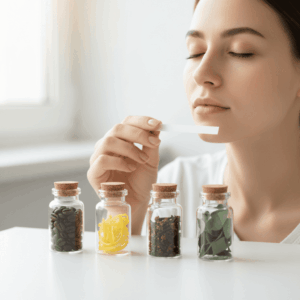
- For less severe cases, stimulation of olfactory nerves can also be done at home by smelling spices, household product scents, regularly and playfully.
Medical Research
At the Pitié Salpêtrière Hospital, smells are used to solicit the autobiographical memory of patients suffering from head trauma and memory disorders; research is also being implemented for Alzheimer’s disease. Repeatedly smelling scents could fix certain memories and limit memory loss.
In Belarus, neuropsychiatrist Olga Alexandre has developed a method that aims to treat psychological disorders through olfactory stimuli: the “Angel Perfume” project applies to sick children to help them improve their sleep, stimulate their appetite, and also reduce pain.
In the future, interesting prospects are emerging like that of Israeli professor Hossam Haick who is working on an electronic nose method, capable of detecting certain diseases through breath.
Poem: Anosmia, I Curse You!
Finally, a note of hope with this poem given to me by Nathalie Pichard, perfume expert, who wrote it when she was confronted with anosmia. It is dedicated to all anosmics.
ANOSMIA, I CURSE YOU!
My nose has never betrayed me
Yet the virus took it from me!
For almost a week
I was in quite a pique!
Spices no longer stung!
Perfumes were just refuse flung!
Like an ant without antennae
I cursed, oh, the hatred so many!
Even Bleach!
Powerless, out of reach?!
My head seemed empty
Everything became morbid aplenty…
But finally, was I lost?
In this void, everything paused
Blind of nose and brain
This nose was in tatters, in pain…
Anosmia is not a friend
It comes, muted, an enemy to contend!
Not lowering my arms,
I spoke to it yet in tears and alarms
Leave me; give me back the smells!
You would do so much for my happiness spells
Give me back my sun!
So that I marvel again, bar none!
My fox awaits me, tempts me…
Give me back my nose, so I can smell thee!
And without warning you departed…
Anosmia, I curse you, broken-hearted!Smell is life, let us protect it.
You can find more information on anosmia on the following sites: