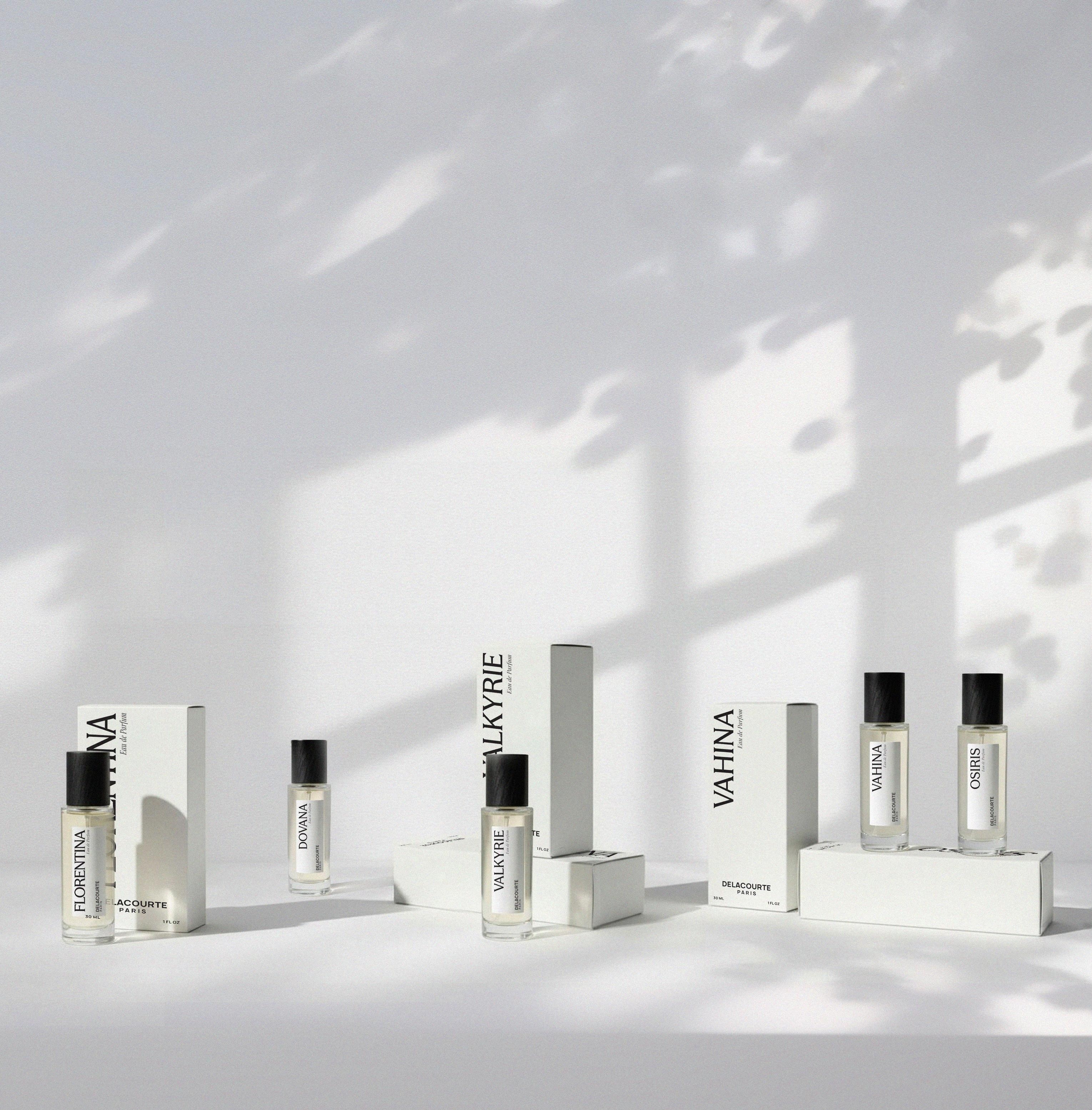
The Solar Facet: Guide to Exotic, Salicylated, and White Flower Notes
The solar accord is an accord that dresses an olfactory family. It particularly dresses the floral, vanilla, or oriental family.
A Story of Olfactory Reference
In Europe, the olfactory reference associated with sunny notes is L’Ambre Solaire by L’Oréal, built around benzyl salicylates, while the United States references the sun product Hawaiian Tropic, whose very opulent perfume is built around coconut notes (cf. The fruity note, coconut).
The Secret of the Solar Note: Benzyl Salicylates
L’Oréal used benzyl salicylate in its Ambre Solaire for its sunscreen properties. During its research, the company ended up developing much more effective sunscreens and removed this old filter. The consequence was a significant drop in sales of Ambre Solaire.
The formula was then reworked to reintegrate the famous benzyl salicylate, no longer as a sunscreen but for its olfactory effect, which had become a solar reference for the consumer. In short, it had to smell like sand or skin heated by the sun… like holidays if possible!
The Solar Facet and Solar Notes
There are natural or synthetic materials that allow this “solar” effect to be rendered in a perfume.
Salicylates
These are synthetic molecules: benzyl amyl and cis-3-hexenyl.
Bergamot, Mandarin
Bergamot, mandarin, and citrus fruits in general naturally recall the sun and freshness of Mediterranean countries, notably Calabria; they are almost indispensable notes to highlight the solar facet.
Marine Notes
These are synthetic notes also called aqueous notes obtained thanks to calone, or helional.
Jasmine
Grandiflorum jasmine which can come from Grasse, Egypt, India, or Italy.
Sambac jasmine from India with a more “orangey and solar” scent.
To harvest this natural material, pickers must get up very early.
The most skilled pick 500 to 700 kg of flowers per hour, and to obtain 1kg of flowers, 10,000 flowers are needed.
Tuberose
Tuberose is exotic and narcotic; it is found in South India and Egypt. It gives an intense side to the solar facet.
In India, it is harvested every morning from May to December.
The name of this flower, in Hindi, means “night fragrance.” Indeed, it decorates windows and the bridal chamber during the wedding ceremony period. For the first three days, the bride and groom do not see each other. They must wait until the fourth day to be able to get closer. That is when the tuberose comes into play to calm the anxiety of the newlyweds and stimulate pleasure.
Officially erotic, tuberose is, along with jasmine, the flower complicit in love.
Ylang-Ylang
The ylang-ylang flower comes from a tree and has the shape of a large disheveled star. For Indonesians, it is the “flower of flowers,” which is also the meaning of its name. Very exotic, it displays an exuberant and extroverted nature.
From volcanoes, in Madagascar or Mayotte, it has inherited an explosive floral side that gives a lot of color to perfumes. It is harvested when the tender green flower has turned yellow, a sign that it has reached its olfactory maturity.
Its scent is halfway between jasmine and tuberose. Ylang-ylang, with its creamy and carnal notes, is reminiscent of solar monoi. It has a sensual, lascivious, and intoxicating dimension while being wild and narcotic. It is the flower that best illustrates the solar facet.
Frangipani Flower
The frangipani flower is a sacred flower in India, whose abundant flowering is called upon by fervent prayers. Like jasmine sambac, the whiteness of the flower symbolizes the purity of the soul. This sacred and delicate flower does not yield its perfume. Perfumers must resort to “a laboratory flower,” proceeding with “a reconstitution” (cf. How to store perfume?), that is to say, a formula integrating about ten components.
Tiare Flower
The tiare is a tropical shrub on which the white tiare flower grows, the national symbol of Tahiti. It is now available as a natural product, but it is used sparingly, as its scent is ultimately quite disappointing and far from faithful to the original suave and intoxicating scent of the flower. Reconstituted, it evokes exoticism and tropical softness. Examples:
- Tiaré – Chantecaille
- Bronze Goddess – Estée Lauder
Pittosporum
This little-known flower, from a shrub also called “Australian laurel,” originates from Southern China, Korea, and Japan. It is also found in the Mediterranean rim, including near Grasse, and in Croatia. This shrub with dark green and shiny foliage can reach 4 to 5 meters.
Pittosporum blooms in May-June. The flowers are then white to yellow. Its scent lies between orange blossom and jasmine. Here again, the perfumer must settle for reproducing its scent using a formula.
Mimosa
Mimosa absolute is a natural product obtained by volatile solvent extraction from the yellow balls of the mimosa. But these small golden flowers are often treated with mimosa leaves. This is why mimosa absolute, despite its powdery, floral, and rich scent, also has a green tonality due to the presence of leaves.
Gardenia
This white flower does not yield its soul, as we have seen, like the frangipani flower and pittosporum. Its creamy and delicious scent has a very slight fresh mushroom facet, just added with a “coconut” facet. The perfumer will therefore make a reconstitution with natural and synthetic materials.
The Foul
The foul is a flower very close to gardenia, very appreciated and found in the Middle East. It must also be reconstituted in the laboratory by the perfumer.
Magnolia
Native to China, magnolia has an interesting and very singular scent. This flower is very little used in perfumery because its extract does not have the same scent as the plant but can help create a solar effect, and it will not be the determining element.
Immortelle
The immortelle flower, sometimes forgotten in the solar facet, also evokes holidays by the sea, the beach, the scents of the Corsican maquis. Its scent is natural; it is a spicy flower very little used in perfumery because this flower is difficult to tame.
Coconut (Fruity Note)
It also evokes holidays in the Tropics through memories of exotic cocktails, like pina colada. In perfumery, it is worked from a molecule, aldehyde C18; it also exists as a natural product. This note is also the essential note for the solar facet, but be careful with the dosage, which must be subtle.
Exotic fruity scents like mango, pineapple, banana are possible thanks to synthesis.
Some Examples of Solar Perfumes
- Mayotte (Mahora) – Guerlain (discontinued)
- Quand vient l’été – Guerlain (discontinued)
- Ylang vanille – Guerlain (discontinued)
- Mimosa Tiaré Aqua Allegoria – Guerlain (discontinued)
- Coco Fizz, Aqua Allegoria – Guerlain
- Parfum Terracotta – Guerlain
- L’Instant – Guerlain (cf. The oriental or amber family)
- Cruel Gardenia – Guerlain
- Dune – Dior
- Ombre bleue – Jean-Charles Brosseau
- L’eau ensoleillante – Clarins
- Beyond Paradise – Estée Lauder
- Sable – Goutal
- Vanille Galante – Hermès
- L – Lolita Lempicka
- Moheli – Diptyque
- Songes – Annick Goutal
- Bronze Goddess – Estée Lauder
- Replica (beach walk) – Martin Margiela
- Ylang – Le Labo
- Sabbia Bianca – Profumum Roma
- Soleil Blanc – Tom Ford
- Essences insensées – Diptyque
- Bosca Vanilla Aqua Allegoria – Guerlain
- Paris Riviera – Chanel
- Nuxe Le parfum
- Sur ma Peau – Dries Van Noten
- Ilio – Diptyque
- Eden Rock – Dior
- Libre L’Eau Nue – Saint Laurent
- Osiris – Delacourte Paris