Yuzu in Perfumery: The Multifaceted Japanese Citrus
I first encountered yuzu, this small yellow fruit, in Japan on various occasions — atop sashimi, in teas, or in the most elegant finger bowls.
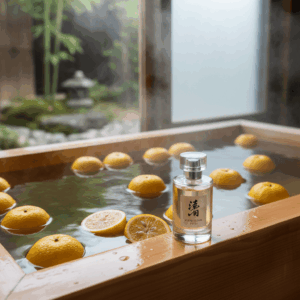
It can also be found in ryokans, traditional Japanese inns, in baths carved from stone, in onsen (natural hot springs), or in square bathtubs, always with the distinctive presence of five or six halved yuzu floating on the water.
Its delightful, multifaceted scent captivated me so thoroughly that upon returning to France, I was tempted to work with it in various fragrances. I chose to wait for the creation of my perfume house to use it as a top note in Smeraldo from the Muscs Collection.
Origin and Botany
Botanical family: Rutaceae
It is a hybrid of wild mandarin and Citrus ichangensis, the Ichang lemon.
Yuzu is a fruit that grows on a tree bearing the same name. It originates from Asia, specifically China and Tibet. It arrived in Japan and Korea during the Tang Dynasty (616 to 907) and has since become firmly rooted in Japanese and Korean culinary culture. It is readily found in the mountainous region of Japan, principally in Kochi. This city cultivates half of Japan’s yuzu crop.
The yuzu tree is cold-resistant, of moderate size but capable of reaching up to 4 metres in height. It has the distinctive characteristic of bearing many thorns and being slow to produce fruit. Its fruits and leaves are highly fragrant, diffusing their scent for miles around.
The star-shaped flowers appear between April and May; the harvest takes place from October to December. This is why, even in Japan, this citrus commands a very high price for everyday consumption — it is an exceedingly premium fruit, sold individually.
The fruit passes from pale green to yellow as it ripens. It is small in size, with rather rough skin. Its flesh is sparse and contains numerous seeds. It is not a fruit one eats like an orange. Primarily its zest and juice are used.
Yuzu in Perfumery
It is a small yellow citrus whose price per fruit is considerable, approximately 6 euros in Japan. In France, it can be found in luxury grocers or specialist Japanese shops.
Production is limited, and only a select number of niche houses can use it in its natural form within their fragrances. Japanese production could not sustain a major international launch, which is why certain brands can only use a reproduction.
Its essence or essential oil is obtained by cold extraction (cf. Expression), as with all citrus fruits.
Olfactory Description
Its scent is multifaceted, giving the impression of a blend of citrus notes (cf. Hesperidic facet) with mandarin as the dominant note, yet with accents of lemon, grapefruit, green notes, and finally floral facets. It is used as a top note because it is a striking citrus in a composition, much like lime.
Its scent pairs with all olfactory facets, serving as a top note in eaux de Cologne, fresh waters, eaux de parfum or eaux de toilette — whether oriental, floral, chypre or musky.
Health Benefits and Cosmetics
It is a fruit rich in vitamin C, contributing to immune defences, with antioxidant and anti-inflammatory properties, and the ability to heal wounds. Yuzu helps to beautify and strengthen both hair and skin, thanks to its flavonoids and vitamin C. In Japan, yuzu is widely used in cosmetics.
During the winter solstice, the longest night of the year, tradition holds that one should take a yuzu bath to ward off colds for an entire year.
It strengthens the immune system and is an ally against cardiovascular disease. It is said to be effective against platelet aggregation. It aids digestion and promotes the absorption of iron and calcium. It also has beneficial effects against fatigue and chills, and improves blood circulation.
Perfumes Containing Yuzu
Here is a list of eaux de parfum that contain yuzu:
- Eau de Yuzu by Patricia de Nicolai
- Note de Yuzu by Heeley
- Yuzu Fou by Parfum d’Empire
- Yuzu Man by Caron
- Yuzu Signature by Acqua di Parma
- Yuzu Solinotes by Bottle Designer
- Eau d’Issey pour Homme by Issey Miyake
- Yuzu Ab Irato by Pierre Guillaume