Aromatics in Perfumery: Lavender, Mint, Basil, and Fresh Notes
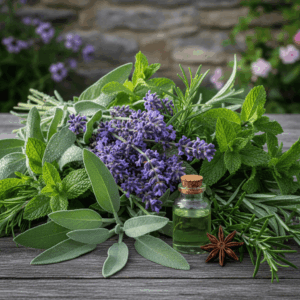
While they mainly evoke gastronomy, aromatics are also part of the raw materials used in the composition of perfumes. They are always present in perfumes belonging to the Fougère olfactory family. In perfumery, aromatics are fresh, energizing raw materials, often associated with rituals related to grooming.
Aromatics are classified into three main groups:
- Lavender notes
- Minty notes
- Anise notes
Aromatics with Lavender Notes
Certain aromatics possess lavender notes. This is notably the case for the following raw materials: lavender, lavandin, rosemary, thyme, sage, and mugwort.
Lavender
Origins: The south of France is the main producer of lavender. The term “lavender” comes from the Latin “lavare” which means “to wash”. There are many different varieties of lavender, such as Lavandula stoechas, Lavandula officinalis, Lavandula spica. Lavender is a symbol of purity and tranquility.
Processing and manufacturing: It is possible to obtain lavender essence by steam distillation, or lavender absolute by volatile solvent extraction.
Olfactory description: Lavender possesses a herbaceous, camphorated, medicinal, and fresh scent. It also exhales a bergamot note, slightly floral, with woody tones. It is a powerful note that evokes gardens, summer, and the South of France.
Some people may also find it has a vintage side, because it tends to recall shaving soap, classic Eaux de Cologne, or even grandmother’s wardrobes, where small lavender bags were placed to scent the linen. Note that it is the percentage of linalyl that will give it its olfactory quality.
Use: Traditionally linked to the fougère family, lavender is also typical of Eaux de Cologne or masculine perfumes, but it is also found in the composition of chypre or oriental perfumes, and now in certain feminine fragrances.
Main constituents: linalool, linalyl acetate, geraniol, coumarin, camphor, and thymol.
Perfumes containing lavender:
- Jicky, Shalimar, and Mon Guerlain by Guerlain
- Mouchoir de Monsieur by Guerlain
- Pour Un Homme by Caron
- Azzaro Pour Homme
- Kouros by YSL
- Eternity for Men by CK
- Brin de Réglisse by Hermès
- Bleu and Boy by Chanel
Lavandin
Origins: Native to the Mediterranean basin, lavandin is a variety of lavender, and the result of a cross between Lavandula Vera and Lavandula Spica. Harvested mainly in the south of France, there are 3 varieties of lavandin: Lavandin Grosso, Lavandin Abrial, and Lavandin Super. It is Lavandin Grosso that is cultivated the most.
Processing: Like lavender, lavandin essence is obtained through steam distillation.
Olfactory description: More camphorated than lavender, lavandin is fresh, a bit woody, spicy, and possesses a less chic side than true lavender. Its scent is herbaceous and somewhat close to soap.
Use: Lavandin is mainly used for detergents and soaps, and generally in industrial perfumery.
Rosemary
Origins: Rosemary takes its name from the Latin “rosmarinus”, which means “dew of the sea”, because this plant was impregnated with the exhalations of the sea. Rosemary is native to the Mediterranean region.
Processing: Rosemary essence is obtained by steam distillation of its leaves and flowers.
Olfactory description: Rosemary is aromatic, fresh, herbaceous, camphorated, and woody in its evolution. Its scent is powerful, lavender-like, and bitter. This note is somewhat reminiscent of incense (cf. Balms and resins) with a slightly animalic accent.
Use: Rosemary is essentially used for aromatic perfumes, Eaux de Cologne, or masculine perfumes. It is also found in citrus fragrances and in fresh notes more generally (cf. New freshness facet). This aromatic can also refresh certain more oriental perfumes, in top notes.
Perfumes containing rosemary:
- Jicky, Eau de Guerlain, Eau du Coq, Tonka Impériale by Guerlain
Thyme
Origins: Native to Europe, thyme grows today in France, Spain, Algeria, and Yugoslavia. Formerly, thyme was used by the Egyptians for funeral ceremonies. The Greeks added it to incense (“thymos” meant “I perfume” in Greek).
There are many varieties of thyme: lemon thyme, wild thyme, German thyme. In the south of France, thyme is called “farigoule”, from the Occitan “farigola”.
Processing: Thyme harvest takes place from spring until the end of summer. The branches are dried then steam distilled to obtain thyme essence.
Olfactory description: Thyme possesses a camphorated, herbaceous, spicy, even medicinal scent. Its notes are also very fresh and intense.
Use: Thyme is frequently used for Eaux de Cologne and aromatic perfumes. It is also found in certain spicy orientals.
Perfumes containing thyme: L’Eau Noire by Dior, Eau de Parfum by Gucci, For Him by Narciso Rodriguez, Pour Homme by Van Cleef & Arpels, L’Heure Bleue by Guerlain.
Sage
Origins: Sage is an aromatic plant of the Lamiaceae family. It takes its name from the Latin “salvare”, which means “to save”. There are two main varieties of sage that interest us here: clary sage and common sage (officinalis). It is clary sage that is most used in perfumery.
Processing and manufacturing: Two processes allow obtaining sage in perfumery, the most common being steam distillation (sage essence). However, it is also possible to obtain absolute from it, by volatile solvent extraction.
Olfactory description: Clary sage possesses an aromatic, animalic, woody, and earthy scent, but also floral, lavender-like, green, minty, and camphorated.
Use: Sage allows bringing an aromatic and tonic note to perfumes, often masculine. It possesses extreme tenacity and is part of the base notes. Sage is notably used to obtain Ambrox, which allows replacing ambergris in perfumes.
Perfumes containing sage: L’Heure Bleue by Guerlain (top notes), Polo by Ralph Lauren, Pour Homme by Van Cleef & Arpels, Dior Homme by Dior.
Mugwort (Armoise)
Mugwort is an atypical, perennial herbaceous plant. Its Latin name is Artemisia, and it is native to North Africa and the Mediterranean basin. There are 300 different species. Mugwort possesses a herbaceous, fresh, camphorated, bitter scent, and a slightly poisonous note.
It is essentially present in masculine perfumery. Mugwort is actually present in Déclaration by Cartier and in L’Eau d’Armoise by Serge Lutens.
Aromatics with Anise Notes
Among aromatics used in perfumery, some possess anise notes. This is notably the case for basil, tarragon, and star anise.
Basil
Origins: Native to India and Lebanon, basil was introduced to Europe in the 16th century. “Basil” originally means “royal”. There are at least 6 different varieties of basil, each of which has a very distinct smell.
Processing: Basil essential oil comes from the fresh leaves of the plant. They must be dried before proceeding to steam distillation.
Olfactory description: Basil possesses a herbaceous, aromatic, fresh, but also food-like, green, spicy, very anise-like, and minty scent (sometimes leaning towards lavender). The large-leaved variety exhales a smell of jasmine, licorice, and lemon. Purple basil has, for its part, peppery accents.
Use: Basil essential oil mainly serves fresh or fougère compositions. It is often associated with lemony or spicy notes.
Perfumes containing basil: Aqua Allegoria Mandarine Basilic by Guerlain, L’Eau d’Hadrien by Annick Goutal, Eau Sauvage by Dior, Pour Homme by Azzaro, Euphoria for Men by CK.
Tarragon
Origins: Native to Russia, the Orient, and the Himalayas, tarragon was introduced to Spain by the Moors. In old French, tarragon was first called “tarcon” then “targon”. This word comes from the English “tarragon” which means “dragon herb”.
Processing: Tarragon essential oil is obtained by distilling its leaves with steam.
Olfactory description: Tarragon possesses a green, aromatic, herbaceous, spicy, and anise scent.
Use: Tarragon essence is used in fresh fragrances, as a top note, often in association with citrus. One of the most common uses remains the aromatic family or to reinforce the effect of hedione.
Perfumes containing tarragon: Eau de Guerlain, L’Heure Bleue, Après l’Ondée by Guerlain; Infusion de Vétiver by Prada; Cerruti 1881; Eau Sauvage by Dior.
Star Anise (Badiane)
Origins: Star anise, or badiane, comes mainly from China or Vietnam. This variety is easily recognizable by its 8-pointed brown star shape. It is, moreover, the only dry aromatic note.
Processing: Anise essential oil is obtained by the distillation of seeds with steam.
Olfactory description: Star anise and badiane have a similar smell, namely anise-like, spicy, strong, aromatic, fresh, and liquor-like. However, badiane is noticeably more spicy, herbaceous, and liquor-like, while the traditional anise note is greener, acidic, and aromatic.
Use: Most often, anise essential oil is used in top notes, for its freshness and green accents. This aromatic is often present in aromatic or chypre perfumes, as well as in masculine fragrances.
Perfumes containing anise: L’Instant pour Homme by Guerlain, Lolita Lempicka, Hypnose pour Homme by Lancôme, Mandragore by Annick Goutal, Le Mâle by Jean-Paul Gaultier.
Aromatics with Minty Notes
Besides aromatics with lavender and anise notes, we also distinguish aromatics with minty notes, among which peppermint and spearmint.
Peppermint
Origins: Peppermint comes from a cross between Mentha aquatica and Mentha spicata. According to legend, the Greek god of the Underworld, Hades, fell in love with the nymph Mintha. His wife, out of jealousy, transformed the nymph into a plant.
Olfactory description: Peppermint is a cold, aromatic, fresh, slightly camphorated note. Its scent is also powerful, green, and minty with balsamic nuances.
Use: It is used in fresh perfumes (cf. Top notes), and is often associated with masculine perfumes.
Perfumes: Homme by Guerlain, Géranium pour Monsieur by Frédéric Malle, Green Tea by Elizabeth Arden.
Spearmint
Origins: Spearmint (Mentha spicata) is another variety of mint used in perfumery. It is mainly cultivated in the United States and Italy.
Processing: Spearmint leaves are steam distilled to obtain essence.
Olfactory description: Spearmint exhales a minty, herbaceous, slightly spicy, fresh, and green scent. It also possesses a smell of chlorophyll, acidic, with a note evoking cut grass a bit, and slightly fruity (melon).
Perfumes: Aqua Allegoria Herba Fresca by Guerlain.
Absinthe (Wormwood)
Origins: This powerful herb is endowed with a broad rhizome and leaves of gray-green color. It takes its botanical name from a legend according to which the goddess Artemisia adored this plant.
Processing: Absinthe essence is obtained by steam distillation (a technique discovered during Antiquity and still perpetuated in Grasse).
Olfactory description: Absinthe is an aromatic that can be fresh, minty, bitter, anise-like, and slightly woody.
Use: Absinthe is mainly known for being a popular drink of the 19th century, which Verlaine and Rimbaud adored. Banned for a long time due to thujones, it is today authorized again. In perfumery, absinthe is used mainly for perfumes of the fougère or aromatic family.
Perfumes containing absinthe: A Taste of Heaven by By Kilian, Fou d’Absinthe by L’Artisan Parfumeur, Douce-Amère by Serge Lutens.