Bergamot in Perfumery: The Green Gold of Calabria and Queen of the Hesperides
Before delving into the details of bergamot — its history, its olfactory description — let us return to the fundamentals of perfume to fully understand how this fruit is used. A perfume is complex, refined, delicate, but above all it is an ensemble of notes chosen for their ephemeral or tenacious character.
The Place of Bergamot in the Olfactory Pyramid
Perfume is very often represented in the form of an olfactory pyramid whose apex is formed by the top notes, the middle section by the heart notes, and the base by the base notes.
The hesperidic facet is present in almost every perfume. It dresses a fragrance at the top, is volatile and therefore short-lived, and lends a smile to the perfume. It features in eaux de toilette, eaux de parfum, feminine and masculine fragrances alike.
Naturally, it is found in greater quantity in eaux de Cologne or fresh waters, where it becomes the principal theme and thus defines the hesperidic family, which encompasses lemon, bergamot, orange, grapefruit and lime.
Bergamot: A Brief History of the Tree and Plant
The bergamot tree was brought from the Canary Islands to Spain by Christopher Columbus. It is said that its name derives from the Turkish beg-armudi, meaning “the lord’s pear”, or alternatively that bergamot takes its name from the city of Bergamo, where it was first cultivated.
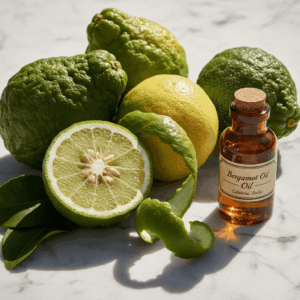
Bergamot comes from a tree, the bergamot tree Citrus Bergamia. The fruit is initially green, then turns yellow. It has been cultivated for 600 years in Calabria, in southern Italy, with a production of approximately 100 tonnes per year.
Bergamot is also found in the Ivory Coast and South Africa. The harvest is done by hand, as the fruits are extremely fragile. Harvesting begins in November and concludes in January.
Cultivation and Botany
It is a hybrid of the lemon tree and the bitter orange tree, cultivated for the essential oil of its fruit and its petitgrain (essential oils from the leaves). The fruit weighs between 80 and 200 grammes. This shrub bears fruits whose pulp is not consumed, as it is too bitter.
Nevertheless, in Calabria one finds local products made from bergamot, such as the liqueur known as Limoncello, in which lemon is replaced by bergamot. Only the zest is used for perfumery, cosmetics and certain food products.
Extraction: Bergamot Essential Oil
It is cold-extracted using enormous machines called pellatrices. The fresh bergamots are stored for two to three days to allow the fruits to warm and the zest skin to soften.
The essential oil expelled from these presses is dark green, with a delightful and powerful scent, but this essence is subsequently processed to become golden to transparent in colour. It is then known as rectified essential oil.
Among other things, the phototoxic components such as bergapten are removed — a substance that in the past caused numerous skin stains (particularly when it had been incorporated into suncare products such as Bergasol).
Nowadays, these bergaptens are removed from all citrus oils.
Olfactory Description and Uses
Two hundred kilogrammes of fruit are required to obtain one kilogramme of essence. It is called the “finest of the hesperides” for its supremely elegant, multifaceted note: tonic, nervous, fruity, green, slightly floral, acidic, bitter, yet also sweet and rounded. The scent of bergamot is a perfume in its own right. Its constituents, linalyl acetate and linalool, confer an exceptionally fresh and lavender-like note.
The communelle: In order to achieve consistent quality, suppliers blend several grades of bergamot, at varying stages of ripeness, from different parcels in Reggio di Calabria. This is called a communelle. The quality of citrus fruits depends on the period of harvest, yielding a more floral or fresher character depending on the month.
Other uses: Of note are the speciality of Nancy — bergamot sweets — and the flavouring of Earl Grey tea, both of which benefit from this delightful aroma. The skin of this citrus was widely used in the 18th century for the creation of sumptuous decorated boxes, which may be admired at the museum in Grasse.
Properties and Bergamot Perfumes
Bergamot essential oil possesses calming, antiseptic and antispasmodic properties. It is also effective against insomnia. Finding a fragrance in perfumery that is principally built around bergamot is rather difficult, since by definition bergamot is a scent with very limited longevity.
Perfumes featuring bergamot as the principal note:
- Bergamote Calabria – Guerlain
- Bergamote 22 – Le Labo
- Bergamote Soleil – Atelier Cologne