The History of Chanel N°5: The Legend of the Most Famous Perfume in the World
The story of Coco Chanel is singular and intriguing. An extraordinary destiny, she lived a thousand lives guided by a great feverish nonconformism.
A journey that has caused much ink to flow, generating numerous books and films recounting several facets of her singular destiny: from her talent as a creator and pioneer, her romantic or dangerous love stories, her determination in business and her conflicts with the Wertheimer family, to her attitude during the war.
She would launch a perfume in the midst of the Roaring Twenties, of incredible modernity, a manifesto of emancipation and a timeless icon.
The Story of Coco Chanel
Coco Chanel had an extraordinary journey that began as an orphan and led her to become the couturier celebrated worldwide, making her one of the richest women in the world after the war.
Chanel N°5 perfume would be her first perfume and a stroke of genius: it is a myth, a legend, and a perfume that is still among the best sellers worldwide.
The Creation of Chanel N°5
Many stories circulate about its creation. It was created in 1921; no one can doubt Mademoiselle Chanel’s great talent, her avant-gardism.
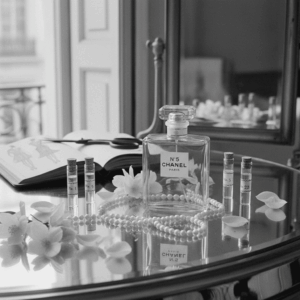
She created an aesthetic counter to that of the time. In the idea of a laboratory bottle or a whisky flask of her former lover? A square, sober, minimalist, yet luxurious bottle. Was the design of the bottle really inspired by Place Vendôme in Paris? Black edges outline the immaculately white boxes, packaging almost unchanged today, a tour de force!
In 1920, the name Chanel was on everyone’s lips. Elegant women flocked to the Rue Cambon boutique, after having been to the Deauville one, to treat themselves to Coco Chanel’s creations, refined, elegant, and stamped with the famous double C.
A year later, they would discover Coco Chanel’s first fragrance sold initially in one size and limited edition. Gabrielle Chanel first offered her perfume to her loyal customers. Mademoiselle Chanel, with her sense of marketing, perfumed the fitting rooms of Rue Cambon.
Her customers, having become addicted to her fragrance, asked her for more; she replied that it was a small unpretentious perfumer who had created this fragrance for her but that she didn’t know if she could get more.
Meeting with Perfumer Ernest Beaux
Chanel N°5 was also born from a meeting with a perfumer, Ernest Beaux, whom she met in the circle of many Russian emigres, notably in that of Grand Duke Dimitri (who allegedly killed Rasputin), cousin of Tsar Nicholas II of Russia and brother of Grand Duchess Maria Pavlovna, owner of a fashion and perfume house.
Coco Chanel was greatly inspired by the splendor of the Russian aristocracy (jewelry, gems, Russian haute couture). Grand Duke Dimitri would become her lover and give her the idea of launching her own perfume.
Ernest Beaux, of French origin, born in Russia and having always lived in Russia, a chemist by training, was the creator of numerous perfumes for the court of the Tsars of Russia; he started his career in the Rallet company.
Several Stories Clash over the Creation of the Fragrance
The Official One: The Lucky Number
Ernest Beaux presented Coco Chanel with a series of samples numbered 1 to 5, and 20 to 24. Coco Chanel chose sample N° 5. Why, she was asked?
“Because I am launching my collection on May 5th, the fifth month of the year, my lucky number.”
Number 5 representing for her the quintessence of alchemists. This number 5, which would become the name of the fragrance, effectively brought her luck and is one of the most worn perfumes in the world. She wanted, in her words, “a woman’s perfume with the scent of a woman”.
Gabrielle Chanel recommended perfuming oneself with perfume extract “where one wishes to be kissed”. Her sense of smell would match her flair.
The Unofficial One: The Bouquet de Catherine
In the unauthorized biography by Marie Dominique Leliève, she reveals that Ernest Beaux proposed to Coco Chanel a fragrance that had already been launched under the name Bouquet de Catherine in 1913. It had been a flop at that time but would nevertheless have seduced Mademoiselle Chanel.
Marilyn Monroe and Chanel N°5
Interview in 1953: What do you wear to sleep? A pajama, a pajama top, a nightgown?
She replied “I wear nothing in bed, just a few drops of Chanel N°5. Don’t say I was naked, it’s the truth I wear Chanel N°5!”.
These short sentences she uttered would help propel sales of Chanel N°5 and make it a legendary perfume. Later Catherine Deneuve, Carole Bouquet, and even Brad Pitt would be the muses of this fragrance.
The Fragrance: An Aldehyde Revolution
Coco Chanel fell under the charm of the fragrance because it was floral (cf. Floral Family) but not a heavy and stiff floral, far from the soliflores of the time, on the contrary, an abstract and signed floral bouquet. This perfume was launched on May 5, 1921.
Very beautiful raw materials sign this perfume: Centifolia rose, jasmine Grandiflora from Grasse, orange blossom and neroli, vetiver from Haiti, tonka bean from Brazil, ylang-ylang, iris Pallida, vanilla.
These precious ingredients are highlighted and sublimated by aldehyde notes (cf. Aldehyde Facet) which give it this clean (cf. Perfumes that smell clean), abstract, nervous, and airy side. It is not the first time that these aldehydes were used in a perfume; her creativity was to play these notes in overdose.
These aldehydes that exalt perfumes, like lemon reveals strawberry, notes that have the power to make flowers sing. Aldehydes evoke at the same time snow, clean linen, the smell of a hot iron, or the scent of soap.
Creation of the Chanel Perfume Company
Coco Chanel wanted her perfume to be launched at Galeries Lafayette. The Perfume company was founded on April 4, 1924, with the Wertheimers, owners of the Bourgeois company, who manufactured Chanel N°5 perfume, which allowed deploying and distributing Chanel N°5 worldwide. Ernest Beaux was the technical director.
The contract was distributed as follows: the Wertheimers had 70% of the shares because they took all the risks, the director of Galeries Lafayette, Théophile Bader, was part of this company at the time as a business bringer, he took 20% of the shares and Coco Chanel only 10% of the shares.
From the 1930s, Coco Chanel, under the influence of her lover Paul Iribe, a great Artistic Director, was convinced that the Wertheimers were swindling her. A terrible struggle opposed them from 1939, and for several years. Nevertheless, they negotiated with her and even saved her after the war.
Coco Chanel, during her exile in Switzerland, took advantage to bluff: she relaunched her improved fragrance: Super Chanel 5, which caused confusion with the original and pushed the Wertheimers to stop this war with her, which allowed her to find an agreement, making her extremely wealthy.
Without the Wertheimer family, there would not have been the creation of this beautiful perfume house. Without Gabrielle Chanel, who embodied this Chanel N°5 perfume, there would not have been this international success. It is Chanel N°5 Perfume that made her extremely rich.
Her last stroke of genius: a return to the top of the bill, thanks to her famous tweed suit, which was sold by the thousands and adopted by celebrities and “first ladies”. 3 bottles of Chanel N°5 perfume were offered to American GIs.
The Chanel Fashion House, moreover, illuminated by the genius of Karl Lagerfeld, became an empire. In 1971, Coco Chanel passed away in her room at the Ritz.
The Legacy of N°5
In 1959, the bottle of number 5 entered the permanent exhibition of the MOMA in New York. Chanel N°5 was dressed by artists including the famous series in homage to Andy Warhol in 1985. Next year in 2021, Chanel N°5 will celebrate its 100th anniversary of creation.
In the line of Chanel N°5 Perfume, considered the leader of floral aldehyde perfumes, many perfumes were launched:
- Arpège by Lanvin 1927
- Liu by Guerlain 1929 (the closest olfactorily)
- Fleurs de Rocaille Caron 1933
- Calèche by Hermès 1961
- Madame by Rochas 1969
- Calandre by Paco Rabanne 1969
- Rive Gauche by Saint Laurent 1971
- First by Van Cleef 1976
- Courrèges in Blue 1983