Chocolate: From the Mayan Sacred Bean to Gourmand Notes in Perfumery
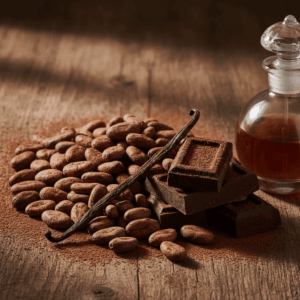
Why chocolate? I love its scent and I love tasting it. I have of course appreciated those from La Maison du Chocolat, but I have a soft spot for those from Pierre Hermé. I also love the smell of cocoa in perfume (see at the end of the article).
I took a class at La Maison du Chocolat: very interesting, it made me want to go even further. Here is the result of the research.
The History of Chocolate: Mayans and Aztecs
The Mayans lived in the Yucatan, Mexico, and were the first true cultivators of the cocoa tree. They used cocoa beans as currency in exchange for food and clothing. It was real bartering.
On the other hand, they used cocoa beans to prepare a bitter drink, Xocoatl, which has little to do with today’s chocolate. The crushed beans are boiled with pepper, powdered chilies, and annatto (coloring pigments).
The Legend of the Plumed Serpent (Quetzalcoatl)
In Mexico, in the 10th century, around the village of Tolla, extended a marvelous garden where “cotton grew already dyed” and where ears of corn were so “big that one could not get one’s arms around them”. In this ancient Toltec city reigned Quetzalcoatl, the bearded god with an ugly face and a long head.
It was said that he possessed all the riches of the world, in gold, silver, and precious stones, and also a large number of cocoa trees whose cultivation he had taught his vassals.
All was for the best in the best of all possible worlds, but there came a time when Quetzalcoatl’s fortune ended. Three sorcerers, envious of his happiness and wealth, came to meet Quetzalcoatl.
One of them, the magician Titlacauan, took the form of an old man and said to him: “Lord, I bring you a drink that is good and intoxicates the one who drinks it; it will soften your heart, cure you, and let you know the route of your next journey to the land where you will find youth again.”
Quetzalcoatl drank, became intoxicated, and lost his head. He had all his houses of silver and shells burned, and his treasures buried in the mountains and riverbeds. He transformed the cocoa trees into another species that bore no fruit. He left for the land where he thought he would find youth again, towards the rising sun, to the east.
He embarked, adorned with feathers, on a raft made of intertwined snakes, promising to return one day, during a year placed under the sign of the reed. He would bring back to his people all the treasures of Paradise.
1519, the Mirage of the Plumed Serpent and Cortés
Could the discovery of chocolate be the consequence of a case of mistaken identity as legend has it? In the Aztec calendar, 1519 was a year placed under the sign of the reed and Moctezuma, King of the Aztecs, was impatiently awaiting the return of Quetzalcoatl.
And then arrived men glistening in their armor like snake scales, wearing feathers, and whose leader wore a beard…
In Moctezuma’s mind, there was no doubt: it was He whom he was waiting for! He welcomed him and handed over his kingdom to him. The one he believed to be Quetzalcoatl was actually named… Hernán Cortés and his intentions turned out to be much less peaceful than those of Christopher Columbus.
They offered him the famous Xocoatl: a thick porridge of cocoa beans, chili, ginger, and honey. Once again, chocolate is not liked. But rather than throwing it away, someone had the good idea to replace the chili with vanilla and add sugar and milk to neutralize the bitterness.
Thus Hernán Cortés, having set out to conquer New Spain, found himself covered in gold and at the head of what was worth, for the Aztecs, all the treasures of the world: a plantation of cocoa trees.
Arrival in Europe
Hernán Cortés very quickly understood the economic value of cocoa and had a first cargo of cocoa sent in 1524 to Charles V, sovereign of Spain. Four years later, he brought him the beans and the foods necessary for preparing chocolate (the recipe had meanwhile evolved): cinnamon, peppercorns, cloves, vanilla, musk, and orange blossom water.
Very quickly, the Spaniards discovered the energizing and euphoric virtues of chocolate and attributed aphrodisiac effects to it; this would allow its expansion throughout Europe. Unfortunately, the cultivation of cocoa and sugar would encourage planters to slavery.
Indeed, needing labor, they would go look for it in Africa, thus encouraging the slave trade. Cocoa was then introduced to Italy by the Duke of Savoy, in 1559. In Turin, chocolate makers became experts and managed to produce nearly 350 kg of chocolate per day. This chocolate was then exported throughout Europe.
Chocolate in France: A Royal Affair
However, it was not until 1615 that chocolate made a noticeable entry into France, with the arrival of Anne of Austria, daughter of the King of Spain Philip V. Anne of Austria married Louis XIII and arrived at Court with a cohort of servants who knew perfectly how to prepare chocolate, enough to seduce many followers, especially since they saw in it a rare eccentricity, reserved for a few.
It was however only after the death of Louis XIII, in 1643, that the Queen, having become Regent, imposed her taste for chocolate. Cardinal Mazarin himself employed a personal chocolate maker recruited in Italy.
1660 is the year cocoa was introduced to Martinique by another Spanish princess, Maria Theresa of Austria, wife of Louis XIV. It is whispered that she has two passions: the King and… chocolate. The King, for his part, considers it “a food that deceives hunger but does not fill the stomach” and tries to communicate his aversion to the Queen but in vain.
At Versailles, chocolate becomes the great fashion: it is served every Monday, Wednesday, and Thursday in the salons of the Court. Louis XIV allows sieur David Chaillou to open his first shop in Paris, where he can sell a composition named “chocolate”.
Industrialization (19th Century)
In 1847, in England, the first chocolate bar appeared in a London chocolate factory. Chocolate remained for a long time a drink reserved for nobles and its manufacture remained artisanal. Large chocolate factories were born in the 19th century (1800-1899), thanks to technical progress.
Historical Note: Christopher Columbus (1502). Christopher Columbus was the first European to discover cocoa, when he reached the island of Guanaja, near Honduras, in 1502. It was then that he became acquainted with cocoa beans transported by the natives and used as currency in exchange for the ship’s goods.
The navigator being perplexed about the market value of cocoa, the Indians prepared for him, to convince him, a red, bitter, thick, frothy, and spicy beverage: the drink of the gods, Xocoatl, whose bitterness he did not appreciate.
He nevertheless kept the bag of beans in exchange for a few trinkets but never again took an interest in this precious and still mysterious commodity, thus missing out on a real “treasure”.
The Cocoa Tree: Botany and Cultivation
It is a tropical tree cultivated in a hot and humid climate, mainly in regions around the equator. Its country of origin is Venezuela and Mexico, but today, it grows in many hot countries such as Madagascar, Ghana, Java, Trinidad, and Brazil. Africa produces two-thirds of cocoa and Ghana is the world’s 2nd largest exporter.
From beans cultivated in Santo Domingo, the taste is woody; that of Ghana is round; in Sao Tome, flowery aromas are found; in Tanzania the scent of vanilla; New Guinea a bit spicy.
Barry boys travel the equatorial world in search of new plantations and novel flavors. The largest producer is Barry Callebaut in Switzerland (1.2 million tons of chocolate per year, 3 billion in turnover in 2007) is undoubtedly the king of chocolate.
A triple-star chef REGIS MARCON created a complete menu with Alto el Sol chocolate, a “grand cru” of chocolate and says “chocolate is like wine, depending on the rain and sunshine, taste fluctuations can be significant and give particular flavors”.
This tree does not like direct sunlight, so it is planted next to very tall trees that can provide it with shade such as the banana tree or the palm tree. The average lifespan of a tree is 50 years.
Flowers and Pods
The cocoa tree only blooms after 4 years. The flowers grow in clusters on the trunk and on the main branches, but never on young twigs. The cocoa tree produces several thousand flowers per year. They are odorless, white or pinkish-yellow in color. The flower measures less than a centimeter and is pollinated by insects, also small, to give the fruit of the cocoa tree, the pod.
But be careful, not all flowers give fruit; most dry up and die. Out of thousands of flowers, about 1% will become pods. Cultivated cocoa trees produce about 80 pods per year. It takes about 4 to 6 months for them to ripen. Their color varies depending on the varieties and the degree of maturity.
Each pod contains 30 to 50 cocoa beans. The beans are surrounded by an abundant and sweet pulp, the mucilage, from which jams can be made. Pod breaking is done 2 to 4 days after picking, using a knife or a stone; a man can break 1500 per day. The cocoa bean consists of 55% cocoa mass and 45% cocoa butter.
The 3 Varieties of Cocoa Tree
- Criollo: Represents 5% of world production and gives a very fine and delicate cocoa. It produces the best vintages but is endangered. Its pods are green-orange when ripe and its beans are large and light.
- Forastero: Represents 70 to 75% of world production. Its vigorous plant earns it the name Robusta of cocoa. Its pods are green and yellow when ripe and its beans purple.
- Trinitario: Represents 20% of world production; a hybrid of Criollo and Forastero, it gives a fine cocoa with high fat content.
From Cocoa Bean to Chocolate: The Process
Once the beans are recovered from the pods, they are placed all together and ferment for 6 days at a temperature of 60°C. During this stage, the mucilage melts and impregnates the beans. When the mucilage has completely melted, fermentation is stopped by drying the beans (a bean that has fermented contains 70% humidity).
Once dried, ready to travel, the beans are placed in jute bags. They arrive in France, in Tain-l’Hermitage, where they will be roasted. (This for French producers, but the largest producer is Swiss, see above.)
1. Roasting
The beans pass through a basin at 140°C for 18 to 20 minutes (smell of vinegar). Roasting completes the drying of the beans and develops their aroma. The beans, once roasted, are crushed: a large machine separates the shell from the bean and crushes the bean into small pieces.
What is obtained is called nibs (found at 58 rue Tiquetonne in Paris in the 2nd arrondissement, at Monsieur G. DETOU). Nibs have a toasted taste and a chocolatey smell; one can taste them on certain tile cookie recipes. The blending of nibs is done by a chocolate oenologist. Is he an artisan chocolatier? We do not know his name.
2. Grinding
The nibs are then finely ground between 2 cylinders, a kind of heated press, to obtain cocoa liquor. Cocoa butter is separated from cocoa liquor here.
3. Mixing Ingredients
- Dark Chocolate = cocoa mass + sugar + cocoa butter (35% minimum cocoa)
- Milk Chocolate = cocoa mass + powdered milk or condensed milk + sugar + cocoa butter (25% minimum cocoa)
- White Chocolate = cocoa butter + milk + sugar + flavoring
Cocoa butter is a vegetable fat resulting from the pressing of cocoa beans to obtain cocoa powder.
4. Refining
The paste thus prepared is once again ground into microscopic particles.
5. Conching
Conching was formerly practiced in shell-shaped vats (concha in Spanish) hence its name! The paste is heated and kneaded for several hours to eliminate all humidity and acidity. It is conching that determines the smoothness and final aroma of the chocolate. The chocolate thus prepared is stored at 50°C (degrees centigrade) in tanks.
This recipe was found by accident, by Monsieur Lindt, by leaving the machine stirring the chocolate too long (72 hours instead of 2 hours). He finally found that, in this way, the chocolate was much smoother.
6. Tempering
To prepare the chocolate for molding, the temperature of the paste must be lowered to about 30°C. Finally, the chocolate is then molded and wrapped. All that remains is to taste it!
The Art of Tasting and Ganache
What is ganache?
In its simplest form, ganache is a mixture of fresh cream and chocolate (in roughly equal quantities, generally 1.2 kg of chocolate for 1 liter of whipping cream). It is obtained by pouring boiled whipping cream onto chocolate and stirring with small oscillations in the center of the container.
Be careful not to stir too hard because air would be added to the ganache, which would make it less melting. The more chocolate there is relative to cream, the more solid the ganache is. For example, the same percentages are not used to glaze an “Opéra” cake as to fill a chocolate candy.
It is possible to flavor a ganache, for example vanilla ganache. Simply infuse a split vanilla bean in hot whipping cream for a few minutes, then boil the cream again and finally pour it over the chocolate. Other infusions are possible such as mint, cinnamon…
How to recognize good chocolate?
A good chocolate must be mahogany brown, slightly shiny
- It must not be too black, nor dull
- It must be tasted at a temperature of about 20°C
- It must not crunch, but melt in the mouth
- It must be tasted in small pieces
- It must not be acidic, nor astringent, nor acrid
- If it is flavored, the flavor must not cover the smell of the chocolate
- A chocolate must be long on the palate, to salivate better
- It must be very fresh because it loses its aromas easily
Chocolate in Perfumery
A good patchouli can have a cocoa facet.
Some Cocoa Notes and Molecules
- Cocoa absolute from Firmenich: alcohol prune note, syrupy, liquor-like, and chocolate.
- Clear absolute from Robertet: smell of “Van Houten” cocoa powder.
- Isobutavan (or Chocovan): molecule smelling of a pear, hazelnut, and chocolate note.
Some Perfumes with a Chocolate Facet
- L’Instant de Guerlain pour Homme: which I worked on with Béatrice PIQUET (IFF). Anise note in the top: the idea started from Arak liqueur. Base notes: “patchouli fraction” and other woods, and the chocolate note which blends well with patchouli.
- Iris Ganache: which I worked on with Thierry Wasser and who, at the time, was a perfumer at Firmenich. Now, he is our house perfumer, the successor to Monsieur Jean-Paul Guerlain. I was lucky enough to smell an iris that smelled like chocolate, that was the idea that was the starting “click”. The idea was therefore to associate an iris note (very Guerlain) which has a dry woody facet and soften it with a very mellow white chocolate note. A little thought for a superb perfume Iris Gris by Jacques Fath that I had the opportunity to smell, at the Osmothèque in Versailles, and which gave me the idea of an “ambergris” note. Here, we used Cetalox.
- Elixir Charnel Gourmand Coquin: worked with Christine Nagel when she was at Givaudan and Aurélien Guichard. Dark chocolate note, rum, black pepper, black tea.
- Very Irresistible by Givenchy for Men: green, a fougère accord on a chocolate note.
- Dior Homme Intense: perfume that I appreciate very much. A very chic iris for men, on a chocolatey note.
- A*Men by Mugler: which, worn in small doses, is also a perfume I like very much. Here, it is rather caramel and coffee than chocolate.
- And certainly others.
Perhaps you already know that chocolate is an anti-depressant, but do you know that the Acticoa variety is a product rich in polyphenols, renowned effective for preventing cancers and promoting blood circulation? If you are really “addicted” to chocolate, you can also treat yourself to choco-therapy, in the Sensation Chocolat institute at 5 rue Saint Maur 75011 Paris.