Communelles in Perfumery: The Secret of the Guerlain Signature
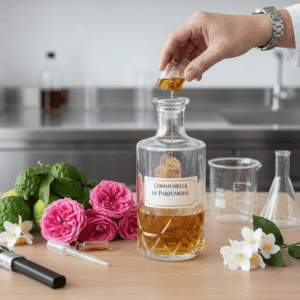
The word “communelle” is intriguing but known in the field of wine. What is really hidden behind this term when it comes to perfumery? First of all, here is the definition of a communelle: it is a judicious blend of different batches of natural essences.
The Principle of the Communelle at Guerlain
At Guerlain, we have always blended different essential oils, of the same botanical origins, from different producers or countries, presenting different facets. All this to create a “Guerlain standard” with a very precise smell.
This allows, first of all, to have a strong identity, to participate in the olfactory seal of Guerlain perfumes and also to ensure, from one year to another, a constant and homogeneous quality.
I had already explained a bit in my article “Guerlinade” the explanation of these communelles. Here I have lifted the veil a little more on some manufacturing and blending secrets that contribute to giving the Guerlain olfactory seal, this unique signature.
1. The Rose Communelle
At Guerlain, we have always loved the rose. It takes one of the first places in Guerlain’s favorite components. We have always associated the Damascena rose, which can come from Bulgaria, Turkey, or Morocco, with the May rose which comes from Grasse.
- The Damascena Rose: has a very precise smell, fruitier, a bit green, spicy.
- The Centifolia Rose (May Rose): with its characteristic honey smell, the latter is round, suave, almost animalic.
From Nahéma to Idylle
Note that the first perfume to have overdosed on rose was Nahéma, created by Monsieur Jean-Paul Guerlain, with the association of rose essence and absolute of different origins, as well as the addition, for the first time, of a molecule found in the rose, damascone, which allows giving an even greater tenacity to the rose scent but, above all, adding a fruity note.
Moreover, I am convinced that if Nahéma had not been created, we would not have had perfumes such as Paris by YSL or Trésor by Lancôme on the market. Nahéma was truly the leader of a new family: the fruity roses.
In Idylle, Thierry Wasser favored a communelle of Bulgarian rose, a rose that was chosen this year with Monsieur Jean-Paul Guerlain for its lychee fruity facet to which they added a garden rose accord (created by Monsieur Jean-Paul Guerlain), an “old-fashioned” accord.
A velvety and voluptuous rose called Plessis Robinson rose whose name comes from the garden of the same name, where Monsieur Jean-Paul Guerlain discovered it.
2. The Bergamot Communelle
At Guerlain, we have other communelles like that of bergamot: there has always been a standard of “Guerlain bergamot” at Guerlain whose secret is preserved. It is a blend of bergamot from different producers chosen by the Guerlains, from the Calabria region, in southern Italy, to give a unique bergamot that will not be everyone else’s!
Thierry Wasser is now in charge of choosing raw materials, so this year he selected, for the first time, bergamots from different producers in Reggio di Calabria, Italy, as the Guerlains have done for five generations.
This selection was made, like every year, late January early February, so that the bergamots are gorged with sun and therefore give their fruitiest perfume! Nevertheless, these very fruity bergamots will always have fresh and green floral facets.
The Limoncello Anecdote
I had the chance to participate, a few years ago, in the expression of Bergamot essence. The skins of citrus fruits or zests release the essence, which out of the machine is dark green in color. Then, it will be treated to get rid of all the undesirable components which give, among other things, brown spots.
Its color will change from dark green to light yellow; I even tasted a limoncello, where the lemon had been replaced by bergamot, this is quite unique since I really had the impression of drinking perfume!
3. The Jasmine Communelle
For jasmine, a very precise communelle is used in our classics. It combines jasmine of the grandiflora botanical variety coming from Grasse, India, and Egypt. In certain perfumes, like L’Instant de Guerlain, feminine, we experimented with the quality of Sambac jasmine with a truly different smell, more orange-like and more solar.
You should know that, for the same botanical variety, depending on the quality of the soil, the sunshine, or the rain received, the smell of the essence or absolute obtained after processing the plant can vary quite significantly, as for grapes.