Solvent Extraction: From Flower to Absolute, Manufacturing Secrets
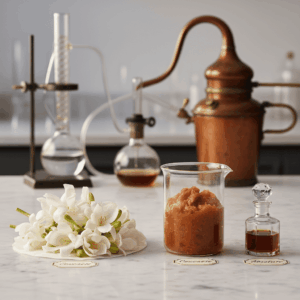
Volatile solvent extraction is one of the extraction processes used in perfumery. It consists of dissolving the plant’s perfume in a solvent which is then evaporated. This method allows obtaining very noble and rich products.
Raw Materials on the Perfumer’s Organ
Let’s recall that there are 1000 natural raw materials and 3000 synthetic raw materials available to the perfumer. Depending on their tastes, they will select about 1000 raw materials, synthetic or natural, for their perfume organ, the furniture allowing the professional to store and classify their bottles of essential oils.
New raw materials are discovered and marketed each year, while others disappear, due to increasingly strict legislation. Natural raw materials come from flowers, leaves, roots, seeds, fruits, trees, or barks.
Different Extraction Processes in Perfumery
- Distillation
- Volatile solvent extraction
- Expression
- Enfleurage
- Head space
- CO2 or sofact extraction
History of Extraction: From Enfleurage to Solvents
In the early 18th century, fragile raw materials were treated by cold enfleurage, or hot enfleurage, a technique highly developed in Grasse. Today, volatile solvent extraction has replaced the enfleurage technique.
Cold Enfleurage
It was used for flowers that could not withstand being heated like jasmine, daffodil, or tuberose. This method consisted of spreading a layer of fat in which the flowers were placed by hand for about 24 hours. The fat has the ability to absorb the scents of the flowers; the operation was repeated several times.
The flowers were then removed one by one by hand, until the fat was saturated with their perfume. The fat impregnated with the scent was then washed with alcohol in beaters, and separated from the odorous molecules, allowing obtaining, after evaporation, the precious absolute.
Hot Enfleurage
Also called maceration, this process allowed flowers or other plants to be infused in oils and fats heated to 40 or 50 degrees. After 24 hours, the fat was recovered by draining using large strainers, then filtered through cloth fabrics.
The product was then washed with alcohol in beaters. This hot enfleurage was used for May rose and orange blossom (cf. Flowers). The final product was called “absolu des pommades” (pomade absolute).
This method, which required significant labor, was very expensive. This old technique was therefore abandoned and replaced by volatile solvent extraction and CO2 extraction.
What is Volatile Solvent Extraction?
Volatile solvent extraction aims to dissolve the fragrant components of the plant in a solvent, which will then be evaporated. This technique was practiced from the 18th century but with products that were then unsuitable, because flammable.
This extraction method, which became truly operational in the 19th century, consists of immersing flowers in a large tank called an extractor. They are arranged on plates stacked at different levels, and pierced with a multitude of small holes, which allows not crushing the plants.
The extractor is then closed, and the content immersed in a solvent (ethanol, hexane, benzene, or other naturally very volatile solvent), which carries the molecules of the plants. Three washes will be necessary to capture as many olfactory compounds as possible.
The Choice of Solvent
Depending on the fragility of the raw material, the solvent can be used cold or hot.
- Hexane: Privileged for fresh raw materials, such as flowers (orange blossom, rose, jasmine, mimosa).
- Ethanol: Used preferably for dry raw materials, gums, resinoids, or beeswax.
Once the operation is finished, the compartments in which the flowers and plants are placed are spun dry, then removed from the extractor. The solvent is then recovered and heated under vacuum; it will also be recycled at the end of the process.
Concrete and Absolute: Noble Products
The evaporation of the solvent will reveal a sort of liquid which, upon drying, will turn into wax. This very fragrant paste is called the concrete.
At the end of the process, the flowers, which are then exhausted of their perfume, are taken out of the extractor and used as fertilizer. The concrete contained in the tanks will then be washed and purified with alcohol. This wax will also be separated from the odorous bodies and then filtered.
This will result in a liquid product called absolute. Thus, the term rose absolute will necessarily mean that the flowers have been treated by volatile solvents.
Absolutes are present in heart notes and in base notes, and are therefore generally richer, rounder, and more enveloping than essences (cf. Distillation), which, present in top notes, will therefore be fresher and more volatile.
Absolutes do not reflect the exact identity of the plants. Indeed, the raw material being heated, certain olfactory molecules disappear. This extraction technique is more technical, and often more expensive than distillation.
Raw Materials Treated by Volatile Solvents
Volatile solvent extraction treatment allows treating certain flower petals, leaves, as well as roots (cf. Woods). Here are the main raw materials treated with this process:
- Jasmine
- Tuberose
- Daffodil
- Rose
- Orange blossom
- Tree moss
- Violet leaf
- Sage
- Mimosa
- Broom
- Tonka bean
- Vanilla
- Resinoids (benzoin, opoponax, incense) (cf. Balms and resins)
Conclusion
The volatile solvent extraction technique has allowed obtaining precious, noble, and rich products. There is now another extraction technique, supercritical CO2 extraction, or sofact, which allows obtaining even purer products.
Indeed, the solvent used, which is here carbon dioxide, is odorless. Furthermore, the raw material is less heated, and therefore even more respected. The scent obtained is therefore much closer to that of the fresh raw material, however the cost of this method is very high.