History of Perfume (Part 3): From the Industrial Revolution to the 21st Century
At the turn of a dawning century, new lifestyles and new mores animated a society guided by faith in technological progress and the improvement of living conditions and the art of living. Perfumery, profiting from the evolution of processing and manufacturing methods for raw materials, moved from the status of craftsmanship to that of industry.
Unprecedented progress in organic chemistry saw the introduction of synthetic components into creations. These new materials multiplied the perfumer’s palette and also allowed for lower costs and increased production capacities.
Perfumers gradually abandoned the reproduction of traditional floral bouquets to devote themselves to the creation of complex, sophisticated, abstract, and mysterious works, conducive to sparking dreams and emotion. New players, old ones renewing themselves and reinventing their art; perfumery, at the end of the 19th century, began an unprecedented turning point.
A Market in Upheaval at the End of the 19th Century
At the end of the 19th century, Paris was the European center of the perfumery trade. Many luxurious shops opened their doors and sought to capture a wealthy international clientele. The majority of businesses were concentrated in the 8th and 9th arrondissements of the capital.
Each House targeted a very specific clientele. For Guerlain and Caron, the aristocracy and the upper bourgeoisie constituted the flagship target, while the middle bourgeoisie perfumed themselves more at Lubin, Roger & Gallet, Houbigant, and L.T. Piver, and minor notables at more accessible brands like Bourjois.
French perfumery industrialists bet on exploiting the high-end image of French perfumery and capitalized on the name “Paris”, as a guarantee of quality and excellence.
The Arrival of Synthesis
The perfumer’s talent still consisted of their ability to copy the elements of nature. This involved the increasingly massive use of synthetic elements discovered over the previous decades.
The 1880s saw the flourishing of the heliotrope fashion, the 1890s that of lilacs, lilies of the valley, carnations, as well as the clover accord, like Trèfle Incarnat by L.T. Piver (1898), a great success of the time.
At the same time, perfumes with new, more abstract forms, moving away from academic norms, emerged. However, they remained a minority and appeared as avant-garde. At the dawn of the First World War, among perfumers, the debate on the superiority of natural products over synthetic components no longer existed.
Their technical, aesthetic, and economic interest was recognized by all. However, there was still no question of mentioning these synthetic bodies to customers, who suffered from a bad reputation, in terms of their quality but also on a health level.
Organization of the Profession and Nascent Marketing
In 1890, the birth of the National Syndicate of French Perfumery, chaired in its early days by Aimé Guerlain, brought a sense of cohesion to the profession. The first president was none other than Aimé Guerlain.
The syndicate mobilized notably to fight against tax pressure. Small artisan perfumers, no longer able to follow the new requirements and standards of the trade, gradually tended to disappear.
Advertising campaigns became widespread and often featured a woman in an evening gown in front of her dressing table. They sketched an imaginary portrait of the type of woman for whom the perfume was intended. People spoke of perfumes for blondes, for brunettes, for redheads… Perfume revealed the personality of the woman wearing it.
In the perfumers’ catalog, alongside extracts, one could find numerous toiletry items, such as eaux de cologne, soaps, oils, lotions, creams, and hair pomades. It was above all clothes, and certain accessories like gloves or handkerchiefs, that served as olfactory supports.
It was prescribed to avoid mixing smells. Each woman must have a unique scent, which by dint of being worn, would impregnate her personal objects and her home. But perfume had to remain discreet, so as not to disturb and not be imposed on those around.
It should not show itself off, but unveil itself modestly and stemmed above all from a hedonistic spirit: to be worn for personal pleasure. Tenacious and powerful perfumes were the prerogative of demi-mondaines, of courtesans.
French perfumery was already being exported, not only to Europe but also to the United States. The House of Lubin (created in 1798) had built an international network of correspondents, allowing the brand to acquire worldwide renown and to achieve most of its turnover abroad.
1889: The Jicky Revolution
1889: Jicky would be one of the first to use a few synthetic essences (vanillin, coumarin, linalool) mixed with a large proportion of natural raw materials. It is the first product called “perfume”. A “trompe l’oeil” juice which, like art, no longer imitates nature, but metamorphoses it by becoming abstract.
“A revolution”, a confusing, highly faceted, aromatic perfume, gradually revealing warm and oriental notes that would, later, inspire Shalimar, at the time when Gustave Eiffel (1889) was erecting his iron tower for the Universal Exhibition (which was originally intended to be ephemeral!). Jicky, the first “unisex” perfume in perfumery, even though it was originally created for women.
- 1904: Mouchoir de Monsieur by Guerlain
- 1904: La Rose Jacqueminot by Coty
- 1905: L’Origan by Coty
- 1906: Après l’Ondée by Guerlain
- 1911: Narcisse Noir by Caron
- 1912: L’Heure Bleue by Guerlain
- 1919: Mitsouko by Guerlain
Mitsouko 1919 by Guerlain: the first chypre perfume with the first fruity notes (synthetic: aldehyde C14).
20s – 30s: Couture and Aldehydes
In the 1920s, perfume became increasingly associated with the luxury industry: Couture Houses established themselves as leaders in perfumery and many fashion designers emerged like Paul Poiret who created the Parfums de Rosine range, in homage to his daughter in 1911, and who was thus the first couturier to launch his perfume.
In 1921, Ernest Beaux created No. 5 for Chanel, the prototype of aldehydic florals, marked by the massive use of these synthetic components which allow giving radiance to the floral bouquet, while making it abstract. Note that L’Heure Bleue, in 1912, was the first to use them, in minimal quantity.
Great masterpieces would appear, rich in precious essences, all the more precious as they were rare. There was a real need for luxury and opulence after the years of restriction felt during the “Great War”.
The Lampe Berger would be featured in living rooms. Papier d’Arménie (created by Frenchmen and produced in the Parisian suburbs) would experience great success until the 50s (beginning of the candle). However, it is still sold today.
The Roaring Twenties
The orientalist wave would sweep over Paris in the 20s. In those years, women emancipated themselves and began to work; they cast their corsets aside and smoked, drove, and cut their hair in a bob like Coco Chanel and Mistinguett.
Creation of Shalimar in 1921, with for the first time ethylvanillin, launched later, on the occasion of the Exhibition of Decorative Arts in 1925 where it received the first prize. What creativity! Picasso and Braque explored cubism, Marcel Proust finished “In Search of Lost Time” and Satie improvised. Speed records were broken, the Charleston was danced, but the euphoria would stop.
The 30s, worry returned. In the United States, it was the stock market crash, years of the depression which hit billionaires and precipitated modest people to soup kitchen counters. It was mass unemployment.
Note: the collaboration with prestigious glassmakers: Lalique and Baccarat highlighted the importance of the aesthetics of the bottle. Perfume became a luxurious object and a collector’s item.
Habanita – Molinard 1924, it is the era of flappers smoking Havana cigars. Cuir de Russie – Chanel 1924, without forgetting the creation of Cuir de Russie by Guerlain in 1890.
At that time, women were more emancipated and appreciated perfumes with bold names and original compositions. François Coty in his collaboration with the glassmaker Lalique created an innovative perfume with a mixture of raw materials from natural sources and synthetic notes. This is the case of L’Origan in 1905. Coty was also the first to use the tool of “marketing”.
- Arpège 1927
- Soir de Paris – Bourjois 1929
- Joy 1935
- Je Reviens – Worth 1932
- Vol de Nuit – Guerlain 1933
- Pour un Homme – Caron 1934
- Shocking – Schiaparelli (first female bust created by Leonor Fini)
30s – 40s: The Glamour Image
During the 1930s and 40s, perfume was strongly associated with Hollywood celebrities and had a glamorous image.
40s – 50s: Chypre and Democratization
Coming out of the Second World War, women rediscovered chypre notes, even if the precursor was Mitsouko, in 1919. Femme by Rochas 1944, Miss Dior 1947. Blue jeans and rock and roll, Europe dreamed of America. Estée Lauder launched her first perfume in 1952: Youth Dew and perfume began to democratize.
In floral notes, with sometimes a certain conformism, but with a lot of chic, we find:
- 1947: L’Air du Temps – Ricci
- 1947: Le Dix – Balenciaga
- 1947: Vent Vert – Balmain
- 1949: Jolie Madame – Balmain
Global perfumery was at its peak.
From the 1950s, the market for men’s perfumes developed strongly like Monsieur by Givenchy, Pour Monsieur by Chanel. Perfumes based on vetiver Carven – 1957 and that of Guerlain – 1959. Men dissociated perfume and aftershave.
60s: The Revolution of Freshness
Teenagers intoxicated themselves with sandalwood, incense, and patchouli with the hippie movement born in San Francisco, which spread to Europe. Revolution in perfumery, youth ran wild in the clubs of the Left Bank. Jacques Chazot led the debutantes’ ball. People read Sagan and went to see Bourvil play in “Le Corniaud”.
For young people, the style evolved towards floral and fresh chypre scents, less stiff, likely to please a large number. Then, perfumes with surprising effects arrived on the market, like a wind of rebellion: discovery of hedione used for the first time in Eau Sauvage created by one of the great noses of the century, Edmond Roudnitska, which would fix freshness.
Then followed all the “Fresh Waters” like Ô de Lancôme, Eau de Guerlain, etc. 1965: Habit Rouge – Guerlain, first oriental for men.
70s: Women’s Emancipation
Emancipated women wore mini skirts by Mary Quant and André Courrèges, and perfumes with the scent of sexual revolution and women’s liberation: 1969 Chamade by Guerlain, first work on the hyacinth note and first use in perfumery of blackcurrant bud – 1971 Rive Gauche – Yves Saint Laurent.
Women wanted to prove they could succeed in the professional world, they sought equality with men, threw push-up bras to the nettles, the fashion of the YSL pantsuit look was launched.
- 1970: No. 19 – Chanel, birth date of Coco Chanel
- 1976: First – Van Cleef, first jeweler’s perfume
- 1977: Opium – Yves Saint Laurent, scandal perfume
- 1978: first descent of a perfume to the supermarket (Monoprix): Anaïs Anaïs – Cacharel
80s: Exuberance and Power
After having emancipated themselves sexually, women tended to assert themselves professionally, in very masculine universes. It was the fashion of shoulder pads, flashy makeup, massive blow-drys. American scents entered the olfactory field, escalation of launches, marketing sometimes prevailed over creation.
These were the years of yuppies, cash is king, the cult of individual success, the cult of the body with bodybuilding. Perfumes displayed themselves with presence:
- 1982: Drakkar Noir – Guy Laroche, for men, a phenomenal success
- 1981: Giorgio – Beverly Hills and Must – Cartier
- 1983: Paris – YSL and Diva – Ungaro
- 1984: Ysatis – Givenchy and Coco – Chanel
- 1985: Poison – Dior
- 1987: Loulou – Cacharel
- 1989: Samsara – Guerlain
In the 80s, perfumes were more exuberant and more powerful. Oriental, sensual perfumes were popular like the famous Poison by Dior, Samsara. Women did not go unnoticed. Perfumes deemed too strong and opulent were even banned in certain restaurants.
90s: Return to Authenticity and Indulgence
Nevertheless, after this period of “overdose”, consumers wanted more authenticity and sincerity in the 90s, in order to reconnect with themselves, to fulfill themselves emotionally. It was the era of yoga, Zen, New Age, the beginnings of organic.
Many spontaneous and floral creations, soft and comforting like Trésor by Lancôme and like Envy by Gucci marked their era.
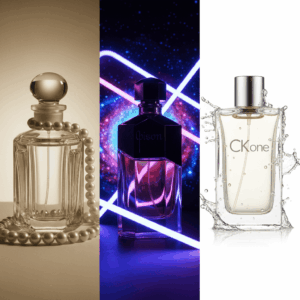
In 1995, a counter-current phenomenon appeared, perhaps in relation to the threat of AIDS. People aspired to a purer world with “clean”, asexual perfumes (Chrome – Azzaro, CK One by Calvin Klein).
It was the New-Age wave, people perfumed themselves with ozonic notes evoking the open sea like that of Aramis, New West. Without forgetting Parfum d’Elle – Montana 1991. In the same register, success of L’Eau d’Issey – Issey Miyake and Kenzo Homme in 1992.
Return to absolute femininity with Amarige – Givenchy 1991, Jean-Paul Gaultier 1993. Gourmand and sweet smells also made their appearance with, in 1992, Angel – Mugler which would pave the way for a slew of perfumes based on the scent of cotton candy, licorice, caramel etc. Then came Lolita Lempicka and many others.
As Malraux said: “The 21st century will be spiritual or it will not be!” In 1989, Samsara really embodied this return to oneself and to essential values. It would be one of the leaders of the wave of “woody” scents: 1990 Egoïste – Chanel. Previously, there was Bois des Iles – Chanel in 1926 and, in 1987, Bois Noir – Chanel. Then, in 1992, Féminité du Bois – Shiseido which preceded Dolce Vita – Dior 1995.
Perfumery “recolored” itself, regained texture and colors with the wave of “rustic” or “solar” perfumes. 1996: Champs-Elysées – Guerlain and Pleasures – Estée Lauder, etc.
2000s: Urban and Porno Chic
Era of start-ups, the urban universe was rehabilitated, as in Flower by Kenzo. Nature made an incursion into the city.
The events of September 11, 2001, then the war in Iraq created an electric shock with, as a consequence, the search for immediate pleasure, porno chic, provocative bad girl. Gourmand and fruity perfumes arrived on the market: Dior Addict Dior 2002.
Since 2001, Coco Mademoiselle – Chanel, a new trend showed its nose, the new chypres, where oakmoss is replaced by patchouli (often fractionated, to remove the earthiest facets) accompanied by floral, fruity, gourmand, or musky effects: Miss Dior Chérie, Narciso Rodriguez, and many others.
Appendix: Jacques Edouard Guerlain
“I felt something intense, which I could only express in a perfume”.
Jacques Edouard Guerlain was born on October 7, 1874, in Colombes. He was a French perfumer, the third and most famous of the Guerlain family.
His uncle, the perfumer Aimé Guerlain, taught Jacques from the age of sixteen as his apprentice, his successor. In 1890, Jacques created his first perfume: “Ambre“. He then taught organic chemistry in Charles Friedel’s laboratory at the University of Paris, before being officially employed in the family business in 1894.
At the Universal Exhibition of 1900, Jacques Guerlain presented the floral perfume “Voila pourquoi j’aimais Rosine” in homage to Sarah Bernhardt, a friend of the Guerlain family.
Six years later, he met his first commercial success with “L’Ondée”, a perfume with variations of heliotrope, violet, and aldehyde. It was considered a major work, notably by perfumer Ernest Beaux. “L’Ondée” is the perfume that later inspired “L’Heure Bleue”.
According to his grandson and successor Jean-Paul Guerlain, Jacques said he had a premonition of what would happen in Europe. “I couldn’t put this emotion into words, I wanted to capture these last moments of beauty and calm before calamity and war” “I felt something intense, which I could only express in a perfume”. He later created “L’Heure Bleue”, in 1912.
“Mitsouko”, created in 1919, expresses Jacques Guerlain’s considerable attraction to Asia and particularly Japan. An impressive chypre was also considered the archetype of the new post-war woman, an emancipated woman in contrast to pre-war perfume.
In 1925, Jacques Guerlain presented his magnificent opus “Shalimar” at the International Exhibition of Modern Decorative and Industrial Arts. The perfume was an homage to the Mughal gardens of Northern India. It was the completion of 4 years of work; he was fifty years old. “Shalimar” became the oriental archetype of perfumery, and remains the House’s best-seller!
Here are the words of a famous perfumer: “Who does not know the intoxicating sillage of Shalimar?”. The bottle was created by Raymond Guerlain in collaboration with the designer Baccarat: Mr. Chevalier received the first prize for this international exhibition.
In 1933, Guerlain created “Vol de Nuit”, a rather dark work. The perfume bears the name of the novel “Night Flight” (1931) by Antoine de Saint-Exupéry.
He continued to work for the last 18 years of his life, despite the gradual slowing of the rhythm of his creations. Little by little, he began to retire to his home in Les Mesnuls and devoted his time to his flowers, his orchard, and his Japanese garden.
Jacques Guerlain died on May 2, 1963, and was one of the most political and influential perfumers of the 20th century: “a genius who knew how to evolve with the times while embracing traditions”.
More than 110 perfumes by Guerlain are well known, but some estimates suggest that he created more than 300.