Ylang-Ylang in Perfumery: The Solar Flower of Comoros and Mayotte
On an olfactory blotter, ylang-ylang essence does not please me that much, but when I smell it in a composition, I find it unique, complex, unrestrained, hypnotic, very colorful, solar and exotic. It takes me into a lush, intoxicating nature and makes me dream of holidays in the tropics.
History and Botany
Botanical Family: Annonaceae
Ylang-ylang means flower of flowers in Indonesian. Ylang essential oil is indeed from Cananga odorata, but has little or nothing to do with cananga essential oil, which is another essential oil with its own specificities. These 2 products are indeed Cananga odorata but one is from the subfamily macrophylla and the other guenina.
The constituents are different even if we find some in common; moreover, cananga is found only in Java, while ylang is harvested mainly in the Comoros, Madagascar, and a little in Mayotte. Ylang-ylang blooms all year round. It is a plant of the magnolia family.
Geographical Origins
Ylang-ylang comes to us from Southeast Asia, Indonesia, and also the Philippines. This rainforest tree was introduced to the Indian Ocean at the beginning of the 20th century under the impetus of French religious figures and colonists.
Ylang-ylang is of Indonesian origin. Indeed, the flower comes from the Moluccas archipelago, in eastern Indonesia. The first distillation laboratory was created in the Philippines in 1860 by Albertus Schwenger, a German sailor who fell in love with the precious flower. From 1860 to 1950, the quintessential ylang-ylang oil was sold and recognized in perfumery in Europe.
It was in the 19th century that it took up residence in Mayotte. Mayotte’s production represents about 85% of total production. After being established in Reunion Island, ylang-ylang production is now developing in Madagascar and the Comoros archipelago (Grande Comore, Anjouan, and Mohéli).
The Tree: Cultivation and “Torture”
Humans torture it by pruning it severely from its second year so that its branches do not shoot straight up into the sky; the branches look like witch’s fingers. If it is pruned, it is to better produce flowers and so that picking is easier, because it grows very fast.
The ylang-ylang tree can reach 30 m high without constraint and live up to 50 years while still being productive, even if its production declines from 25 to 30 years. This tree is not resentful; the more flowers are removed, the more it produces, 5 kg per year on average. When the tree is pruned to human height, its production increases in 6 months from 50 kg to 200 kg.
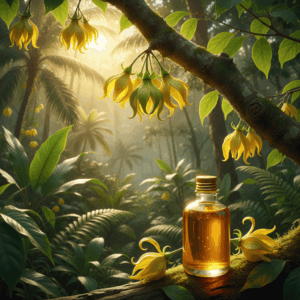
There are several species of this kind of tree, but the right one is identified by its numerous small yellow flowers, with a red heart and a very fine perfume.
Harvest and High-Quality Distillation
The flowers in the shape of large stars, with a disheveled look grouped in clusters, turn from tender green to bright yellow which obviously signifies olfactory maturity.
Flowers are harvested from dawn until 9 am, when the flower’s perfume reaches its peak. A picker can harvest up to 20 kg per day. They place the ylang flowers in openwork baskets, made with coconut palms, to prevent them from spoiling before being distilled. They will be distilled very quickly because of their fragility.
A Unique Fractional Distillation
Ylang-ylang essence is obtained by distillation; the flowers are immersed in a closed tank filled with water then brought to a boil by direct fire. The steam charged with essence rises towards a swan neck pipe, then takes a coil immersed in the tank. Thus cooled, the mixture becomes liquid again. It flows into a Florentine flask, a system that separates oil from water.
Ylang-ylang produces 5 fractions of essential oils which are released little by little according to density. 40 to 50 kg of ylang-ylang are sufficient to produce 1 kg of flower essence.
- The Super Extra: collected during the first two hours. It is the densest, the richest, the most fragrant, very rich in benzyl acetate, it is fruitier than the other fractions.
- The First, Second, Third…: Some fractions are lighter and fresher; they better translate the scent of the fresh flower. The less interesting ones are reserved for soaps, cosmetics, and detergents.
- The Complete: a mixture of each fraction which is used in aromatherapy.
For this flower, the distillation process can last from 12 to 20 hours. There are about 600 stills in Mayotte, on an exploited area of 1000 hectares.
The Revival of Mohéli (Givaudan)
Nowadays, the Givaudan company, in order to restore excellent quality essential oil, sources from a tiny island in the Comoros, Mohéli: the most virgin and remote island of the archipelago. The staff throughout the production chain has been educated and sensitized to seek optimal quality.
Firstly, by picking only the mature flower, by heating the flowers much less, going from 60°C to 30°C, the flowers are distilled within two hours of picking. The result gives a huge difference from one essence to another and above all real added value on this Mohéli quality.
Olfactory Description
Ylang-ylang essential oil has a powerful and elusive smell; it smells different from the fresh flower. It has a spicy facet (cf. The Spicy Facet) like a wallflower or a carnation, a white flower smell, halfway between jasmine, narcissus, and tuberose.
Ylang-ylang is creamy, floral, exotic, reminiscent of solar monoi, a bit animalic, carnal, fruity, and deep. It is a sensual, lascivious, wild, narcotic, lush, poisonous, and intoxicating note.
It has some slightly less pleasant notes like its methylated, camphorated, medicinal facet; some of its notes are reminiscent of nail polish or celluloid, or even overly ripe banana.
Use and Traditions
Ylang-ylang essence is often used for floral bouquets, and more particularly for white flower bouquets. This flower brings sensuality and character to a perfume but also has a creamy aspect.
It is also an ideal note to work on a solar or exotic aspect. It can also be found in oriental floral perfumes, as it blends well with vanilla notes for example.
Culinary Uses and Rituals
- In Southeast Asia: ylang serves to flavor candies, ice creams, chewing gums, and drinks. I was lucky enough to taste a ylang-ylang ice cream created by Thierry Marx, an absolute treat.
- In Indonesia: ylang-ylang flowers are spread on the bed of newlyweds.
- In the Philippines: they are braided into hair mixed with other flowers, and are transformed into necklaces worn around the necks of women or holy images.
Main Constituents
Methyl benzoate, linalool, benzyl salicylate, and benzyl acetate.
Perfumes Containing Ylang-Ylang
- Mayotte by Guerlain
- Cruel Gardénia by Guerlain
- Samsara by Guerlain
- Terracotta by Guerlain
- Embruns d’Ylang by Guerlain
- Loulou by Cacharel
- Songes by Annick Goutal
- Organza by Givenchy
- Amarige by Givenchy
- Ysatis by Givenchy
- Eau de Moheli by Diptyque
- N°5 by Chanel
- Coco by Chanel
- Bois des Iles by Chanel
- Diorissimo by Dior
- Poison by Dior