Violet and Iris in Perfumery: Powdery Notes and Chemistry of Ionones
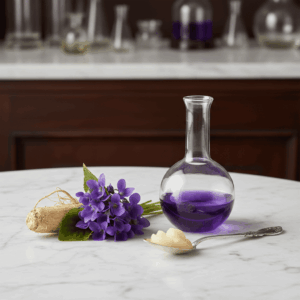
I imagine that the enfleurage technique was attempted many times on the violet flower, a technique widely practiced in the 19th century which consisted of macerating flowers in purified animal fat. When this fat was saturated with the fragrant molecules by the flowers, the perfume was separated from the fat with alcohol to obtain the absolute from pomades.
This process was certainly abandoned for the violet flower, probably for reasons of yield, either too low or perhaps nil, as for the lily of the valley flower.
The violet leaf, on the other hand, is easier to extract thanks to volatile solvents, but its smell is radically different from the flower: violet leaf absolute has a green, intense, powerful, vegetal smell with a slight scent of hay.
History and Legends of the Violet
Zeus, then in love with Io, commanded the Earth to create in her honor the most beautiful of flowers: the violet. Because he loved this flower (in ancient Greek: IOV or Ion, hence the name ionone).
Napoleon was sometimes nicknamed “Corporal Violet”. It then became the emblem of the Napoleonic imperial party. In England, its smell was among the most popular in the Victorian era. Virtuous, violets are often associated with simplicity and modesty.
Chemistry: The Discovery of Ionones (1898)
It was supposedly Tiemann and Kruger who succeeded in 1898 in the synthesis of ionone, the result of a chemical reaction between citral isolated from litsea cubeba or lemongrass with acetone. These ionones were a precious contribution to the history of Perfumery in the 20th century.
Synthetic alpha-ionone allowed the perfumer to recreate the scent of the violet flower and iris thanks to its soft, floral, powdery side, and violet candy scent thanks to its fruity aspect. There are 2 isomers in the ionone family: alpha and beta.
Perfumes containing ionones:
- Violette De Parme 1880
- Violette Ambrée 1890
- Prima Violetta Bourgeois 1890
- Vera Violetta (Roger Gallet) 1892
Methylionones
A little later, the synthesis of methylionones was discovered. Methylionones are easier to use in a composition; they have more faceted notes: more iris-like, softer powdery than ionones. Methylionones also have 3 isomers: alpha, beta, and gamma.
There are bases also called specialties giving this violet effect:
- Parmanthème: cucumber effect + violet
- Iralia: a very iris-like methylionone
- Bouvardia
- Violettine
Perfumes containing both ionones and methylionones:
- L’Origan by Coty 1905
- L’Heure Bleue by Guerlain 1912
- La Violette de Toulouse by Berdoues 1936
- Violetta di Parma by Borsari 1970
- Detchema by Revillon 1953
- Masculin by Karl Lagerfeld 1978
- Paris by YSL 1983
- Eternity by Calvin Klein 1988
- Trésor by Lancôme 1990
- Tocade by Rochas 1994
- Aimez-Moi by Caron 1996
- Verte Violette by L’Artisan Parfumeur 2001
- Flower by Kenzo 2000
- Lolita Lempicka 2004
- Insolence by Guerlain 2006
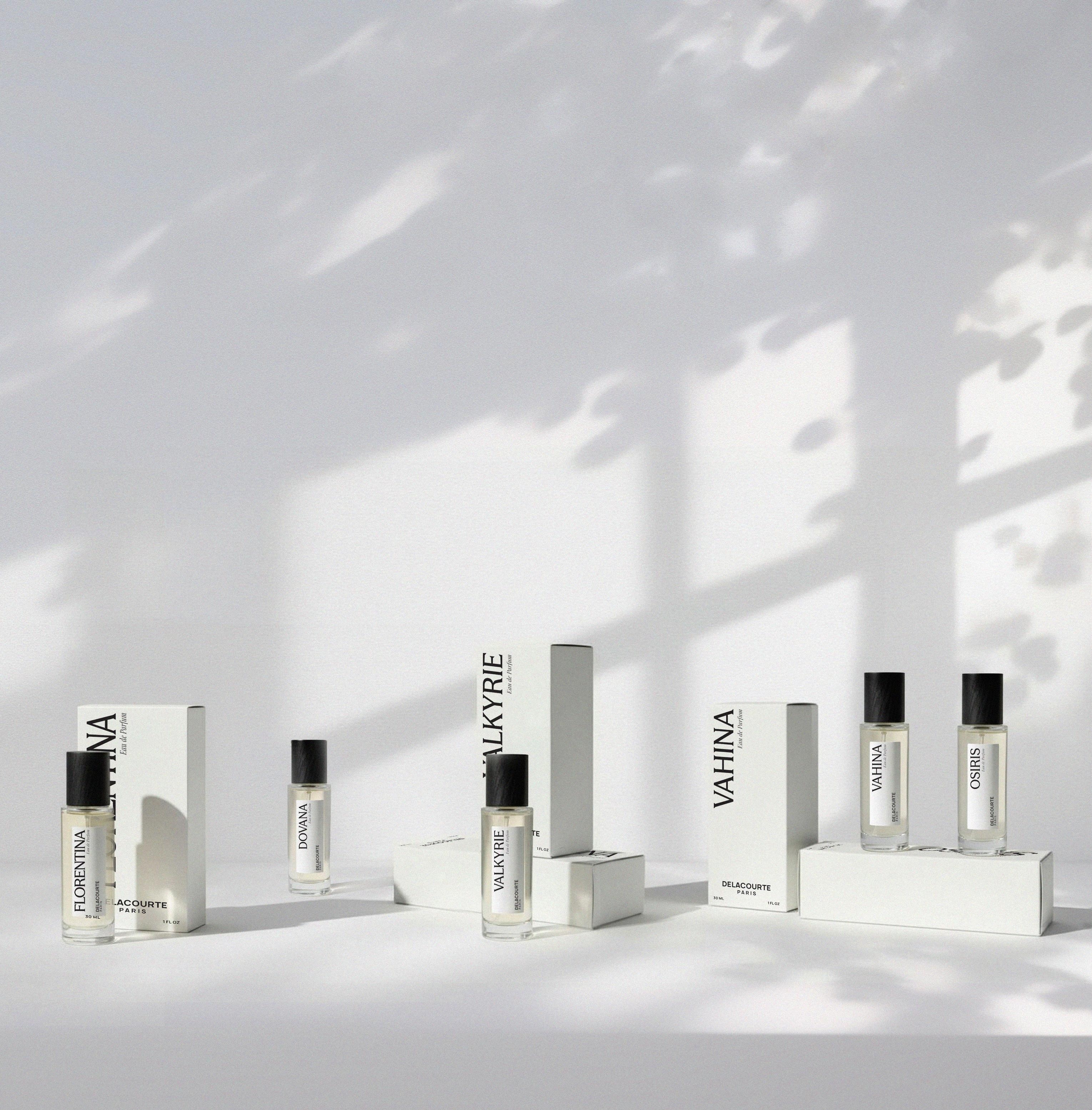
- Florentina by Delacourte Paris 2016
Iris: The Messenger of the Gods
“Iris is the messenger of the gods, notably Hera, to whom she brought good news. Blue Irises have this same meaning: good news, while purple irises give a more romantic turn to the message.”
Iris Pallida vs Germanica
Iris Pallida, of Italian origin and more specifically from Tuscany, is the most sought after in perfumery. Iris Pallida butter which comes from the root (rhizome) is very expensive, because it takes about 6 years to obtain its precious perfume. Iris Germanica, another botanical variety (Morocco), has a scent totally different from Pallida, and personally, I appreciate it less.
It is one of the most expensive raw materials in perfumery and it is one of my favorite raw materials.
- Iris Pallida butter (considered an essence) = approximately €12,000 per kg.
- Iris Pallida absolute: approximately €120,000/140,000 per kg is very little used, given its exorbitant price.
Irones: The Soul of Iris
In the same olfactory family as ionones and methylionones, we find irone, one of the natural constituents of iris and therefore much more expensive. It is an exceptional product; one could say it is the soul of the iris. The essence contains up to 15% of it. But there are also synthetic irones: alpha, beta, and ironal.
Ionones and methylionones blend wonderfully with even more iris-like notes: natural or synthetic irones or iris absolute. It should be specified that iris essence or concrete comes from the rhizome and not the flower.
Perfumes containing very iris-like notes:
- Après l’Ondée by Guerlain 1906
- Iris by Jacques Fath 1947
- Iris Silver Mist by Lutens 1994
- Infusion d’Iris by Prada 2007
- Florentina by Delacourte Paris 2016
Thanks to Maurice Roucel, a perfumer I admire greatly, one of the rare perfumers with a background as a chemist with whom I developed the perfumes L’Instant by Guerlain, Insolence by Guerlain, and Valkyrie.
He gave me the desire to make this post, during his very specialized and technical conference on ionones: a complex subject that I attempted to transmit to you more simply and hope for the best.