Carla Lavender, Lavandin and Aromatics in Perfumery
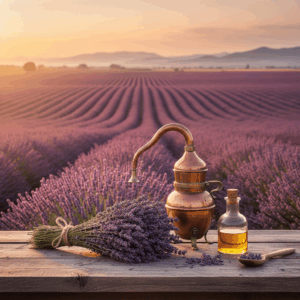
Do you think you know lavender? Yet it is often confused with lavandin. Evocations are of course our grandmothers’ wardrobes, the holiday road, shaving soaps, or soaps of yesteryear.
Carla Lavender: The Organic Exception
Mon Guerlain, the new perfume by Guerlain, has showcased this new Carla lavender thanks to a process that allows obtaining an essence very close to the flower.
This lavender is exceptional, organic, and edible. It tastes like its smell; it was discovered following a meeting between Guerlain and Maison Le Nôtre.
It is much more expensive than classic Lavender (about 10 times the price). It is more floral, light, fine, and above all fruitier. It does not have the hay side that classic lavender might have. To my knowledge, only Guerlain and Chanel use this beautiful lavender.
I already wrote an article a few years ago on Lavender and Lavandin. But since it is very present in perfumery lately, it seemed interesting to me to talk about it again, along with rosemary and thyme.
Classic Lavender (Lavandula Angustifolia)
Botanical Name: Lavandula Angustifolia
Botanical Family: Lamiaceae
Native to the Mediterranean basin, lavender is today cultivated in Bulgaria, Russia, or in southern European countries such as Spain and Italy. But it is the south of France that remains the main producer.
French production really took on another dimension with the cultivation of lavender in the South of France in Grasse, due to the beginnings of perfumery. Lavender is always cultivated above 1000m altitude.
There are many different varieties of lavender (Lavandula Stoechas, Lavandula Officinalis, Lavandula Spica…), and this plant has always been used, both by the Romans to scent their baths, and in the Middle Ages for medicinal purposes. It symbolizes purity and tranquility.
Extraction and Olfaction
In perfumery, lavender can be used in the form of lavender essence by steam distillation, or lavender absolute by volatile solvent extraction, with a scent very different from that of the essence.
This very aromatic and powerful note evokes southern gardens, summer, and even, sometimes, a somewhat vintage side (reminiscent of classic Eaux de Cologne). It is also herbaceous, camphorated, and medicinal. Its fresh scent includes a note of bergamot, slightly floral, with woody tones. The percentage of linalyl will give lavender all its olfactory quality.
Use and Perfumes
Generally associated with the fougère family, lavender is also characteristic of eaux de Cologne and masculine perfumes. However, it is also present in the composition of chypre or oriental perfumes, and today in certain feminine fragrances.
Main constituents: Linalool, linalyl acetate, geraniol, pinene, coumarin, camphor, thymol.
Perfumes containing lavender:
- Mon Guerlain by Guerlain
- Jicky by Guerlain
- Mouchoir de Monsieur by Guerlain
- Shalimar by Guerlain
- Héritage by Guerlain
- Jersey by Chanel
- Pour un Homme by Caron
- Kouros by Yves Saint Laurent
- Eternity for Men by CK
- Belle en Rykiel by Sonia Rykiel
- Brin de Réglisse by Hermès
- Bleu by Chanel
- Lavender Palm by Tom Ford
- Encens et Lavande by Serge Lutens
- Le Mâle by Gaultier
- Luna Rossa by Prada
Lavandin: The Hybrid Cousin
Botanical Name: Lavandula Burnati
Botanical Family: Lamiaceae
Cousin of lavender, lavandin is a hybrid lavender variety obtained by crossing Lavandula Vera and Lavandula Spica. Mainly harvested in the south of France, and cultivated since the 1930s, lavandin is widely used nowadays and often serves to replace lavender.
Indeed, lavender cultivation encountered some difficulties (decline in production since the second half of the 20th century). However, lavandin is more productive in terms of essential oil quantity, even if it yields an essential oil of lesser olfactory quality than lavender. There are 3 varieties of lavandin: Lavandin Grosso, Lavandin Abrial, and Lavandin Super. Lavandin Grosso is the one most cultivated.
Olfactory description: Just like lavender, lavandin essence is obtained through steam distillation. This aromatic is more camphorated than lavender, fresh, a bit woody, spicy, and offers a less chic and less refined side than true lavender. This slightly soapy note is mainly used in detergents and soaps, and generally in functional perfumery.
Rosemary
Botanical Name: Rosmarinus Officinalis – Lamiaceae
Olfactory Family: Aromatic
This aromatic is today cultivated in Spain, Morocco, and Italy. It needs arid and rocky soils to develop. Numerous phytotherapeutic virtues are attributed to it, and it is also widely used in cooking. In the Middle Ages, rosemary was said to be used to ward off evil spirits. It was also the wedding flower in the time of Charlemagne.
Rosemary in Perfumery
The use of rosemary in perfumery is very ancient (proof is with L’Eau de la Reine de Hongrie, in the 17th century, which contained a lot of it). Rosemary essence is obtained by steam distillation of its leaves and flowers.
Olfactory description: Aromatic note, rosemary is fresh, herbaceous, camphorated. It is also woody in its evolution, powerful, lavender-like, and bitter, and possesses accents of incense and animal notes.
Eaux de Cologne, perfumes for men, perfumes of the citrus family, as well as fragrances with fresh notes, tend to contain rosemary (this can also be the case for oriental perfumes in top notes).
Use: Rosemary is obviously used in Eaux de Cologne; there is certainly some in Jicky and L’Heure Bleue, but the perfume that contains the most to my knowledge is Tonka Impériale (Guerlain exclusives), a contrast between an overdose of rosemary and tonka bean.
Main constituents: Camphor, cineole, borneol, eucalyptol, terpenes.
Thyme
Botanical Name: Thymus Vulgaris
Botanical Family: Lamiaceae
Used by the Egyptians and Greeks in the form of incense, thyme comes from Europe and today originates from France, Spain, Algeria, and Yugoslavia. Lemon thyme, wild thyme, and German thyme are among the many varieties of this aromatic.
Thyme in Perfumery
In spring and summer, thyme branches are dried, then steam distilled. This process allows obtaining thyme essence. This aromatic offers a camphorated, herbaceous, spicy, very intense medicinal note. It is very present in Eaux de Cologne, aromatic perfumes, and certain spicy oriental perfumes.
Main components: Borneol, linalool, geraniol, terpineol, thymol, pinene, camphene, cymene.
Use: It is also used in Eaux de Cologne; it can also be found in spicy oriental or chypre accords.
Perfumes containing Thyme:
- L’Eau Noire by Dior
- L’Heure Bleue by Guerlain