Lilac in Perfumery: The Silent Flower of Spring
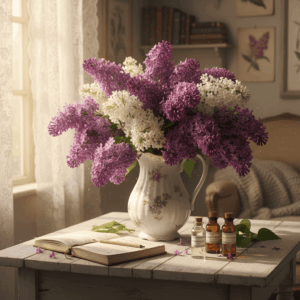
Lilac evokes memories of my grandparents’ garden; I loved burying my face in its colorful clusters. Its scent alone is enough to evoke the arrival of sunny days; I also remember sometimes nostalgic songs like Les Lilas by Georges Brassens, Le Temps des lilas by Barbara, or Le Poinçonneur des Lilas by Serge Gainsbourg.
History, Poetry, and Symbolism
Like all flowers in France, lilac has a romantic meaning: white is innocence, mauve is budding love. Lilac is also a symbol of the Christian religion; it is a flower that was assembled into rosaries to accompany pilgrims.
Its delicate scent has also inspired many poets:
“In my father’s gardens,
The lilacs are in bloom
All the birds of the world
Come to build their nests
The quail, the turtledove, and the pretty partridge”
Botany and Origins
Botanical Name: Syringa vulgaris
Botanical Family: Oleaceae
It originates from Central Europe, Eastern Europe, and the Balkan Peninsula. Its name comes from the Persian Lîlak or Nîlak which means mauve or blue. There are no less than 30 varieties of lilac that are planted from November to March with flowering in May.
Lilac is a tree whose colors match the colors of spring; it is sometimes mauve, violet, or white. Lilac develops on neutral or chalky soils. Its flowers grow in clusters and prefer mild and temperate regions.
A “Silent Flower”: Reconstitution and Technique
It is impossible to extract the scent of lilac by conventional processes. It is therefore not possible to obtain lilac essence (cf. Distillation) or absolute (cf. Volatile solvent extraction).
It is a silent flower (or mute flower), like lily of the valley, honeysuckle, sweet pea, mock orange, violet, and lily. We are obliged to reconstitute its smell through an accord based on natural and synthetic raw materials (cf. Synthesis).
Nowadays, it is also possible to use the headspace technique (cf. Headspace) which will add naturalness to the top notes (cf. Top notes).
The Lilac Accord
To reconstitute a lilac, the perfumer will use many notes common to those of lily of the valley, but instead of adding the animal note (cf. Animal notes) of indole (isolated from jasmine) to the composition, the perfumer will rather add the animal note of paracresol.
Main chemical constituents: Linalool, cis-3-hexanol, terpineol, lilial, hydroxycitronellal, citronellol, iso eugenol, PEA, heliotropin.
Olfactory Description and Use
The perfume of lilac is delicate, tender, and belongs to the fresh and spring-like floral notes of perfumery. Lilac possesses a facet that is reminiscent of lily of the valley and another of mimosa. It evokes pastel colors.
Lilac is fresh, floral, powdery (cf. Powdery facet), soft, creamy, cosmetic, spring-like, romantic, almondy, and green.
It is not a note very frequently used in perfumery as a solinote (single note) because the exercise is not easy. It is generally associated with other flowers (cf. Floral family). It is a difficult note to work with because as it is widely used in home fragrances, candles, and shower gels, it is not perceived as an elegant note; it allegedly lacks sophistication.
Perfumes Containing Lilac
Here is a list of perfumes that contain lilac:
- Idylle, Chants d’Arômes, Champs Elysées by Guerlain
- En Passant by Éditions de Parfums Frédéric Malle
- White Linen by Estée Lauder
- Love by Chloé
- Lilac Path by Aerin
- Lilas Exquis by Jacques Fath
- Parco Palladiano VII by Bottega Veneta
- Ceci n’est pas un flacon Bleu 1.2. by Histoires de Parfums
- Rue des Lilas by Phaedon
- A Lilac A Day by Vilhelm
- Guilty by Gucci
- Lilac Love by Amouage
- Désarmant by La Parfumerie Moderne
- Lilas Mauve by Yves Rocher
- Amour Amour by Jean Patou
- Fleur d’Interdit by Givenchy
- L’Air du Temps by Nina Ricci
- Fleur de Portofino by Tom Ford
A honeyed lilac exists; it is the butterfly bush called Buddleia, in an accord that accompanies the mimosa of Champs-Élysées, the first perfume I developed at Guerlain.