Perfume Extract: Definition, Concentration, and the Art of Perfuming
In perfumery, there are different variations around a fragrance which possess a different olfactory concentration: Perfume Extract (Extrait de Parfum), Eau de Parfum, Eau de Cologne, Eau de Toilette, Eau Fraîche, Eau de Senteur.
Perfume Extract or “Parfum” is the richest and most concentrated product currently available.
Attars from the East complete this list; they are composed of 100% essential oils, therefore without alcohol.
What is Perfume Extract?
In the early 20th century, perfume was often conceived in the form of an extract, a substance in which essential oils are weighed, combined, and diluted in alcohol to form a product particularly rich in essences called Perfume Extract.
Thanks to its very high concentration, Perfume Extract allows revealing the true soul of the fragrance.
The raw materials of the Perfume Extract are orchestrated in such a way as to obtain very intense heart notes and base notes.
Most Perfume Extracts contain 20% to 40% of concentrate, in 98% vol. alcohol.
However, there is no specific regulation and each brand is free to name its product “extract” if it wishes.
The only condition is that the Perfume Extract be powerful and tenacious.
Perfume Extract possesses, indeed, a lot of volume and presence; a few drops are enough to give perfect, lasting, and stable perfuming.
Perfume Extract is often applied directly to the skin.
Perfume Extracts are increasingly rare today, but they still exist in major Perfume Houses (recently Guerlain launched a line of extracts in tribute to the Guerlinade).
How and When to Apply Perfume Extract?
To perfume yourself with a Perfume Extract, you simply need to apply a very light touch.
Indeed, a small dose of this fragrance will be more present, but also more intimate and discreet than a large spray of Eau de Toilette.
Perfume Extract, when well chosen, will be difficult to identify even by specialists; indeed with extracts, the alchemy with the skin can be particularly harmonious and surprising.
The Morning Ritual
You will generally be advised to perfume yourself with Perfume Extract in the evening. However, do not hesitate to use it also at the beginning of the day.
Perfume Extract is also a very good alternative if you wish to smell your perfume all day long and share it with people close to you.
For this, you simply need to wear your Perfume Extract from the morning. The elixir will thus unify with your skin in an inimitable alchemy, and exhale a unique scent all day long.
If used correctly, Perfume Extract will never be too strong or heady. Consequently, one should not deprive oneself of it nor reserve it solely for the evening.
Application Tips
If you own a large bottle of Perfume Extract, the ideal is to decant it into a spray bottle to preserve it intact.
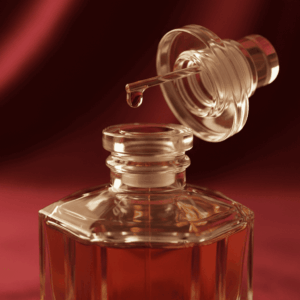
Otherwise, simply apply the Perfume Extract with the stopper directly to the skin (on pulse points).
For your sillage to be perfect, you can also, after applying the Perfume Extract, spray yourself with Eau de Parfum, or Eau de Toilette, forming a large triangle with the fragrance, or by spraying a cloud.
Do not forget to apply other beauty products (cream, body lotion…) which will contribute to good lasting power.
Comparison: Extract and Other Fragrances
Perfumers usually say that Perfume Extracts are generally denser in natural raw materials that “vibrate more with the skin” than other fragrances. Indeed, Perfume Extracts are particularly rich and more concentrated in noble natural materials and base notes.
If an Eau de Parfum contains very expensive materials like iris, rose, or jasmine, the Extract may contain them in larger quantities. Ambergris will be reserved only for the Extract for example. Woody notes like cedar, vetiver, or patchouli can be found in all concentrations.
The orchestration of raw materials can be different depending on the different concentrations, so you may prefer the Extract to the Eau de Parfum or Eau de Toilette and vice versa.
Usual Concentrations
- Perfume Extract: concentrated from 20% to 40%, it remains discreet and is only smelled by the person wearing it or people close to them.
- Eau de Parfum: concentrated from 7% to 30%. It therefore offers both good tenacity and great sillage.
- Eau de Toilette: concentrated from 6% to 20%, will be less tenacious, but more extroverted, and often better perceived by those around in the wake.
Why is Perfume Extract Different on Each Skin?
You should know that Perfume Extract acts differently depending on each person. Indeed, the scent of your skin mingles with the base notes of the perfume to create an almost magical fusion.
However, each skin has its own scent, which will vary depending on many factors (its pH, diet, activity). Each skin is therefore truly unique (cf. Choosing a perfume by skin type).
Conclusion
Perfume Extract can therefore be applied from the morning, on the skin, and on pulse points, where one wants to be kissed.
A Perfume Extract will never be too strong or too aggressive, quite the contrary.
It is very intimate for oneself and for one’s entourage, while being more tenacious than other types of fragrances.
Finally, Perfume Extract is to Eau de Toilette what Haute Couture is to Ready-to-Wear, a work of art in its own right.