Mimosa in Perfumery: The Powdery Flower of the Riviera
Mimosa is a difficult flower to work with in perfumery. The first time I smelled it as an absolute, I found its scent far removed from the smell of blooming mimosas at my parents’ holiday home in the Var.
And that is certainly why, many years later, I wanted to rediscover in a perfume the delicious smell of those fluffy yellow balls, caressed by the wind; the exercise was difficult! And even if Champs Élysées was much criticized, I am proud of this first co-creation of my career.
History and Origins
It was Captain Cook who, won over by the perfume of these little yellow balls, brought back in 1770, during one of his voyages to the ends of the earth, plants of this shrub native to Australia where fossilized traces prove that it was already growing there some 250 million years ago.
Mimosa very quickly seduced aristocratic salons in Great Britain and then in France. Empress Josephine had already attempted to plant mimosas in the greenhouses of Malmaison. But its acclimatization in the South of France dates back only about 150 years.
Mimosa shrubs were reportedly brought back from Mexico by Napoleon III’s troops and, since the end of the 19th century, it is a flower that symbolizes the French Riviera.
Mimosa is essentially cultivated in the South of France, in India, Egypt, and Morocco.
Extraction and Olfactory Description
In perfumery, it is treated by volatile solvent extraction; one then obtains an absolute. But one can also treat the concrete (1st product resulting from extraction) by molecular distillation, thus obtaining a molecular distillation absolute, olfactorily different and almost colorless.
Olfactory Description: floral, powdery, honeyed, almondy, it has a quite pronounced green facet, because the leaves are distilled at the same time as the yellow balls. For me, there are very slight accents of cucumber or even melon in the mimosa note.
Approximate price: Mimosa Absolute India 560 Euros/kg.
Perfumes containing a marked mimosa note:
- Mimosa pour Moi L’Artisan Parfumeur
- Champs Elysées Guerlain
- Summer Kenzo
- Pour Femme Bulgari
- Amarige Mimosa Givenchy
Gourmand and Cultural Anecdotes
- It is said that if the mimosa blooms in winter on the French Riviera, it is because it thinks it is in Australia where its congeners flourish at the same time? So in summer!
- In Spain, it is said that its flowers symbolize reunions.
- Mimosa is the flower offered on Grandmothers’ Day (in France); Marcel Pagnol said: “Grandmothers are like mimosa: it’s sweet and it’s fresh but it’s fragile…”
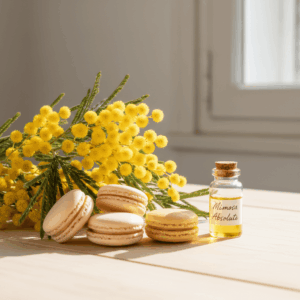
- Mimosa is edible: mimosa balls are reconstituted in sugar and flavored with mimosa. However, it is not possible to crystallize the flowers directly; it is unfeasible because the flower is too fluffy.
- There is a mimosa syrup; a few drops in champagne, it’s great!
- Not to be missed: the latest macaroon from Ladurée with mimosa.
Cassie: The Mysterious Cousin
It is a flower of the same family as mimosas (acacias), difference: there are thorns on the branches. Like mimosa, it is a rather difficult flower to work with in perfumery; its smell is denser, more mysterious with animal notes close to those of ylang-ylang, sulfurous effects, and aldehydic accents.
It enters into the composition of Après L’Ondée by Guerlain. There is also a lot of cassie in Une Fleur de Cassie by Frédéric Malle with 4% cassie absolute.
Powdery Synthetic Products
Methyl Ionone
The first ionone was discovered in 1890. Ionones in perfumery have allowed perfumers to reproduce quite faithfully the perfume of the violet flower. Because, as you know, the violet does not yield its soul.
Olfactory Description: floral, violet, powdery, raspberry, woody.
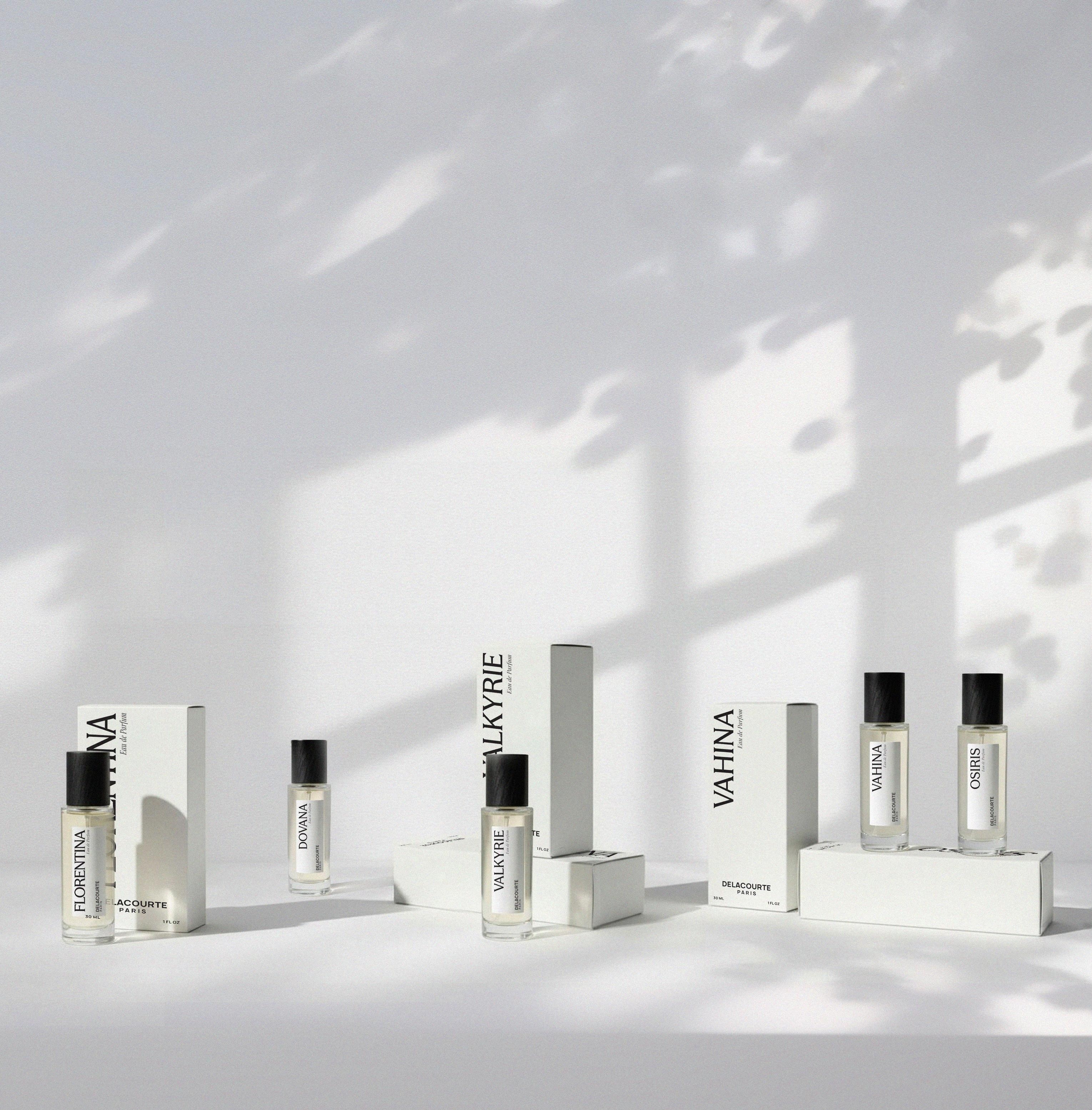
Après l’Ondée was one of the first perfumes to contain these molecules, then L’Heure Bleue, Météorites, Vol de Nuit, and Insolence by Guerlain, Florentina and Dovana by Sylvaine Delacourte.
Heliotropin
Heliotrope does not yield its perfume but fortunately its smell was discovered in 1869 by Fittig and Mielk; this raw material is synthetic but can also be obtained from vanilla (tahitensis).
Olfactory Description: floral, almondy, mimosa, heliotrope, lilac. Here again present in Après L’Ondée, L’Heure Bleue, Insolence by Guerlain, Florentina and Dovana by Sylvaine Delacourte.
Vanillin
It is the odorous principle of vanilla pods (planifolia); it is very widespread in the vegetable kingdom but always in small proportion. It exists in benzoin from Siam and Sumatra, in clove essences. It is therefore mainly obtained by oxidation of isoeugenol (thus from clove).
Present in many Guerlain perfumes in the company of the majestic natural vanilla in the form of absolute or tincture which it “sweetens”: natural vanilla being very little sweet.