Resins and Balsams in Perfumery: Myrrh, Incense, Styrax and Benzoin
Myrrh
Greek mythology maintained the myth of the transformation of Myrrha, the incestuous one, into a myrrh tree, before giving birth to Adonis.
Botany and Origin
Several species of Commiphora from Arabia and Abyssinia, all of reduced size, are at the origin of Myrrh with its prodigious past. There are more than 100 species of Commiphora.
The 3 that we mention (Commiphora myrrha Nees, Commiphora abyssinica, Commiphora schimperi) are those that contribute most to the production of oleo-gum-resin in the form of natural exudations, true tears, whose color fluctuates from light yellow to fairly dark red.
These fragile, almost crumbly, shiny tears give off a strong aromatic odor. Myrrh is composed of 60% gum, 30% resin and essence and, in addition, a bitter principle.
History and Use
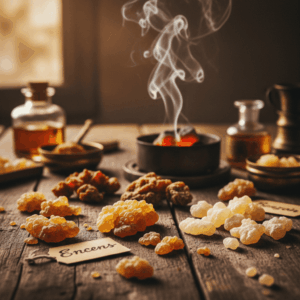
Myrrh, considered the most exquisite, most precious perfume, experienced supreme use throughout antiquity: The Cult of the Gods. In turn, the Magi associated it with incense.
But beyond these sacred uses, Myrrh has known and still knows an important use in perfumery. Indeed, perfumers use Myrrh essence obtained by steam distillation of the gum harvested from the tree.
It presents an intense and uplifting balsamic odor: licorice facet, woody, almost fruity and incense.
Incense (Frankincense)
Incense is, like Myrrh, a gum. It is collected on incense trees. Indeed, the notion of an incense tree has a collective meaning. It includes a certain number of species of Boswellia originating from various countries: Somalia, Yemen, Sudan, Ethiopia, and India.
Botany and Harvest
The most frequently used tree is Boswellia carteri Roxb. They are all shrubs of 4 to 5 meters from the mountains of the Middle East and Africa. Incense trees possess a trunk and branches whose gray bark peels off easily.
In perfumery, the gum harvested after incision of the tree trunk is steam distilled to obtain the essence. This essence is a very powerful, dark, aromatic base note with a camphorated, resinous, smoky effect.
History and Sacred
The uses of incense throughout the centuries have always corresponded to a certain ceremonial: worship of the Gods, remedies, or perfumes. Ancient Egyptians used it to heal themselves, to embalm their dead, and especially for fumigations in places of worship. Religions have never ceased to resort to it. Far Easterners devote almost sacred attention to it in their private lives.
Styrax
Like the balsams of Peru, Tolu, benzoin, or even myrrh or incense, styrax balsam is secreted in the bark of two species of trees called liquidambar and which are found in Syria, Asia Minor, and South America.
Composition and Olfactory Description
Liquid styrax is composed of a small proportion of resin, a benzine-smelling essence named styrol, cinnamic acid, and styracin.
Styrax essence is obtained by distillation of the balsam. Its smell is strong vanilla, balsamic, floral, animalic, leathery tar.
Benzoin
Benzoin is a balsam that flows naturally or by incision from the trunk of a tree of the Styracaceae family: Styrax benzoin. It comes to us from Siam and Sumatra. This exudation is actually a pathological reaction of the tree. It is also called benzoin gum or tear. It is white when liquid and turns yellow upon drying. When harvested, it is already semi-solid.
Varieties of Benzoin
- Siam: Siam benzoin is the variety most sought after by perfumers. It is the rarest and therefore the most expensive. It possesses a very present vanilla facet.
- Sumatra: Sumatra benzoin includes 2 varieties such as amygdaloid benzoin which is the officinal benzoin used in fumigation or tincture and common benzoin which only serves for the extraction of benzoic acid.
Use and Olfactory Description
Benzoin tears develop a very sweet perfume, highly appreciated in Buddhist temples where it is used like our incense. Indeed, benzoin has long been considered a variety of incense or myrrh and as a precious substance. It also played its role in the treatment of lung and skin diseases.
In perfumery, the gum is treated by volatile solvent extraction to obtain benzoin absolute.
Olfactory description: sweet vanilla, almondy, roasted coffee, honeyed, floral (carnation), rich, liquorous, medicinal.