
Sandalwood: A Sacred Wood with Milky and Enveloping Notes
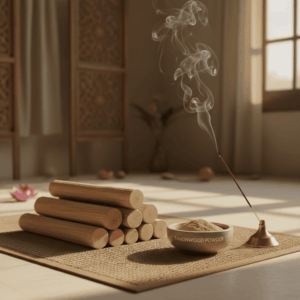
Where does Sandalwood come from?
Contrary to what its name might suggest, sandalwood (scientific name “Santalum spicatum“) is not actually a tree but a parasitic plant. It grows by attaching itself to the roots of other trees, thus being able to reach up to 10 meters in height.
Several centuries ago, Arab perfumers were seduced by the spiritual softness of its perfume. In the form of powder, oil, or bark, it has for centuries formed the basis of many types of incense and perfumes. Today, the best quality on the market is found in India.
Its essence is extracted there by a traditional technique using steam. After being grated, shavings are actually put under pressure and oil is distilled from them. If you ever come across pieces of sandalwood, the effect will be quite simply magical: provided it has been well preserved, a light sanding will be enough to make it release a little of its scent.
Victim of its success
You will have understood: this is a highly appreciated product. However, due to this extremely high demand, production via the traditional method is no longer sufficient.
Worse still, this plant species has been declared endangered in India; its production has therefore naturally become much more regulated. To meet demand, more industrial plantations have therefore sprung up abroad, notably in New Caledonia, Australia, and Indonesia.
Although cheaper, sandalwood (and the products derived from it) coming from these regions is not necessarily considered to have fewer virtues or a less pleasant smell.
Strong measures taken, for a long time
In 1798, the Sultan of Mysore declared that sandalwood would be considered a royal tree. Even today, each individual of this plant species present on Indian soil is officially considered to be under government protection.
Unfortunately, this has not prevented trafficking and a juicy smuggling business from being set up. Due to increased demand for the production of medicines, perfumes, and cosmetics, smugglers have started cutting down trees and exporting them illegally.
Their price has skyrocketed in recent years. It may make you smile, but at present, it is illegal to export wood from India, although oil export is almost unregulated.
Sandalwood in Buddhism
Cultivated throughout Asia, it was originally used there as a lucky charm during Buddhist funeral ceremonies. It was actually burned because local populations thought its smoke helped transport the souls of the deceased to the afterlife.
This oh-so-mystical aroma comes from the wood itself rather than the leaves or flowers. The warm and soothing scent of sandalwood helps the mind to relax and helps open the heart to love. In the ancient Buddhist tradition, it has moreover been used as a meditation aid for thousands of years.
It is widely accepted that the scent of this plant has many benefits as a lucky charm. Here are a few:
- Stimulation of sensuality
- Increased feeling of self-awareness
- Tranquility of the mind
- Promoting connection to the divine
- Sensation of deep relaxation
It is also interesting to note that its combustion can help the unfolding of many rituals by promoting a state of relaxation in practitioners.
Sandalwood in Ayurveda
Ayurveda is a traditional Indian medicine that gives pride of place to this product. According to it, it would stimulate the root chakra. Among the 7 chakras, this is the one that is notably supposed to improve the sense of identity and self-confidence.
Its bark would also promote energy and enthusiasm in general. Burning a little in a house would therefore help leave bad energies on the doorstep. It is also thought that incense made from sandalwood helps to have truly restorative sleep by attenuating aggression and irritability.
As it also promotes open-mindedness, this type of product can also be an effective ally for the practice of meditation. It is said to help “soothe a buzzing mind”. In certain rituals, its oil is used as a lucky charm and is applied to the forehead, temples, and rubbed between the eyebrows. It can also be used in addition to incense to enter a meditative state and in communion with the rest of the world.
An explanation: its mesmerizing smell
It is surprising, to say the least, that a simple plant can serve as a lucky charm, isn’t it? In fact, all these benefits can be explained in a more down-to-earth way. Sandalwood and its smoke release a scent whose soothing aroma promotes feelings of serenity and inner peace.
If you are interested in the world of perfumery, you should undoubtedly have already heard of it. Very popular for the production of masculine perfumes, it is however increasingly used to create feminine fragrances that demand more power and roundness.
What does sandalwood smell like?
You will probably not be surprised to learn that it has very woody notes. But be careful, it would clearly be insufficient to describe it only in this way! Perfumery specialists often describe it as sweet, powerful, earthy, rich, and exotic. If it is used so much, it is not for nothing. Although its marked character can make it a dominant aroma, it possesses notes that are sometimes meant to be soft and subtle.
It therefore works wonderfully as a support for other ingredients. Some perfumes succeed moreover in creating extremely intense depth by mixing aromas with woody or earthy touches. Among those with whom sandalwood will blend well, we can cite cedar, rosewood, rose, patchouli, vetiver, or even vanilla.