The Sensory Language of Perfume: Are You Visual, Auditory, or Kinesthetic?
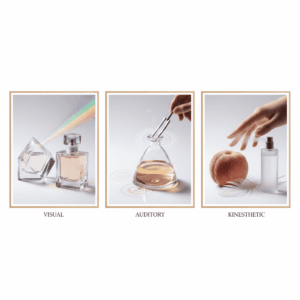
The words a person uses give us information about their sensoriality. Identifying the mode a person is using at a given moment is precious; it allows us to know their preferred sensory channel and to adapt to it for better communication.
Identifying Sensory Channels Through Words
Here are the keywords commonly used according to the dominant profile:
Visual Channel
- See, look
- Show, perspective
- Image, hide
- Clear, clarify
- Visualize, illuminate
Auditory Channel
- Hear, speak
- Say, listen
- Dialogue, question
- Rhythm, musical
- Ring, noise
- Shout, scream
Kinesthetic Channel (Feeling)
- Feel, touch
- Connected, relaxed
- Sensitive, excited
- Solid, firm
- Concrete, pressure
Neutral Words
- Understand
- Think
- Know
- Believe
- Remember
Tips for Improving Communication Around Perfume
- Listen to the sensory words a person uses.
- Communicate with them by choosing words belonging to the same channel.
Preferred Channels and Influence on Purchase
We all have one or two preferred channels; it is truly rare to possess all three!
- A visual person will be more influenced by the aesthetics of a bottle, by its color, by its advertising.
- An auditory person will be sensitive to the name of the perfume, to the story told to them.
- A kinesthetic person is attracted above all by the fragrance itself.
Perfume Vocabulary According to the Sensory Channel
For perfume, here are specific words for each sensory channel that you can use or spot:
- Visual Channel: clear, dark, colorful, architecture, transparent, balanced, bouquet, facet, faceted, line, green, transparent, organ, shiny, structured, roundness, curves, sunny.
- Auditory Channel: composition, note, accord, high-pitched, deep, vibrant, melodious, sparkling, harmonious, cacophonous, harmony.
- Kinesthetic Channel: soft, tonic, caressing, cold, icy, hot, warm, enveloping, sweet, tender, touching, emotional.
What are your two preferred sensory channels?