Silent Flowers in Perfumery: The Art of Reconstitution
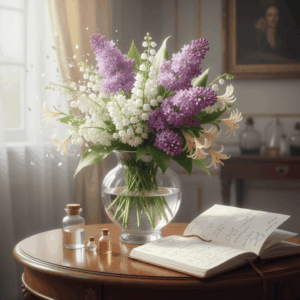
It is the despair of perfumers; some flowers, although very odoriferous, like the lily, do not deliver their soul. It is impossible to have a natural scent of lilac, lily of the valley, carnation, buddleia, gardenia, honeysuckle, pittosporum, mock orange, sweet pea, violet, wisteria, heliotrope, or hyacinth.
Whatever the extraction process, steam distillation or volatile solvent extraction, nothing works.
It will require the work of the perfumer to reconstitute the smell of these flowers; this is called a reconstitution and each perfumer has their own way of perceiving and restoring it. A reconstitution is a mini-perfume which consists of about ten constituents, both synthetic and natural.
Without this work, we would not have been able to obtain a perfume like Diorissimo by Dior in 1956.
1. Lily of the Valley (Typical Recipe)
I give you an idea of a typical scheme for a reconstitution of lily of the valley: (knowing that one now exists claimed by Firmenich but I find that we are far from the smell of the flower).
- We start with some constituents of the rose of choice:
- phenylethyl alcohol (green leaf side of the rose)
- rose essence (richness of the rose)
- hydroxycitronellal (green lily of the valley side of the rose)
- rhodinol (geranium and minty side of the rose)
- citronellol (fresh and lemongrass side of the rose)
- linalool (fresh side of the rose)
- Lilial: a green note
- Indole: an animal note contained naturally in white flowers
- Heliotropin: a powdery note
- Ylang-ylang essence
- If we want it to be greener: more vegetal, we add triplal or violet leaves
This is an example, nothing is fixed, and everyone can arrive at a result fairly close to the smell of lily of the valley with other components. In addition to this reconstitution, the talent of the perfumer then intervenes. In the case of Diorissimo, it was Edmond Roudnitska who gave this lily of the valley accord its own story and unique signature.
At Guerlain, they also had lilies of the valley. The first was created by Jacques Guerlain in 1908 and revisited by Jean-Paul Guerlain in 1998. It has been reissued at the Maison Guerlain since 2005, for a single day, namely May 1st, with the same fragrance but in a different bottle each time. In the Aqua Allegoria, Lilia Bella (now discontinued), had the same scent. The oldest lily of the valley would be that of Floris in 1847.
2. Carnation
There is a natural product, Egyptian carnation absolute, quite little used because it does not smell of the spicy carnation we all have in memory. Formerly, it was used because it smelled good, although deemed a bit “old-fashioned” by perfumers; they may rediscover it one day. Not to be confused with the marigold called tagetes, it is also natural but does not smell like carnation either.
To create a carnation, one must combine: a rose note or a real rose, clove or eugenol note, vanillin, heliotropin, a jasmine effect, and balsams. Then, all nuances are possible, greener, more honeyed, or more orange-tinted.
Carnation Perfumes: L’Origan by Coty, L’Air du Temps by Nina Ricci, Opium by YSL, Bellodgia by Caron, Tabu by Dana, L’œillet by Prada. At Guerlain you will discover it in Après L’Ondée, L’Heure Bleue, Quand vient l’Eté, and Metallica.
3. Tuberose
Tuberose exists naturally but at a very expensive price (about €5000 per kg of absolute). Formerly, it was treated by enfleurage but now we can say that it is over, except on special order. It is now obtained by volatile solvent extraction.
This tuberose, native to India, has a narcotic smell, a bit medicinal at first but after a few seconds, it offers a phenomenal scent between honeyed nectar, exotic, poisonous, candied, gourmand, and erotic. It truly has a unique perfume.
The Reconstitution of Tuberose
Some brands cannot afford natural tuberose. So, we can always resort to reconstitution which will be, whatever the flower, always a little different from the smell of the natural flower.
It is a mixture of different notes: natural jasmine or a jasmine composition, ylang-ylang, indole, coconut, orange note (like methyl anthranilate), heliotropin, mimosa, and still other trace elements.
We will especially not forget Tubéreuse Criminelle by Serge Lutens in 1999 and Tubéreuse by Caron. Would the oldest be that of Santa Novella in 1939? No, there was also one from Floris in 1870. You also have in more floral bouquet perfumes: Fracas by Piguet in 1948, Chloé in 1975, Poison by Dior, Jardins de Bagatelle by Guerlain, and Mahora (now called Mayotte at Guerlain).
4. Other Examples: Sweet Pea and Violet
Sweet Pea: mixture of spicy honeyed notes, salicylates, lily of the valley type notes (lilial), aldehyde, cyclamen, with lots of green notes such as styrallyl acetate or pipol acetate. Mignonette was a reconstitution as well as pink bouvardia.
Violet: we have synthetic molecules called ionones. In this particular case, it is not a reconstitution since the molecule itself already smells very much like violet.
Furthermore, in natural, we have violet leaf essence available which does not smell like violet, but has a very singular green smell.
Synthesis has offered us molecules that have enriched the perfumer’s palette, which has allowed them to recompose smells of flowers unobtainable in the natural state.