Olfactory Memory: Why Perfume is the Seat of Emotions
According to Patrick Mac Leod, a world-class neurophysiologist, we do not become “addicted” to our perfume by chance: the taste and disgust we have for smells are in no way innate.
From birth until the end of their first year, a baby has no preconceived notions against anything under their nose. They can like everything, from a flower to the smell of garlic or even worse.
The Construction of Olfactory Taste
Everything will change with the influence of the parents’ own appreciation, then that of a wider circle who will tell them, and thus influence them, “that’s good, that smells bad”.
Our more personal interests will form during “odoriferous” adventures linked to happy events. Suppose the grandfather you adore took you for a walk on your 10th birthday (it was beautiful, he gave you a superb gift, lunch was delicious) and, as a lover of the countryside, introduced you to the smell of lilac.
It is very likely that all your life you will keep the moved memory of this said lilac.
Smell or perfume is the most intense form of memory. “We should be faithful to a perfume so that our little boys are faithful to our memory,” wrote Marie Claire Pauwels a few years ago.
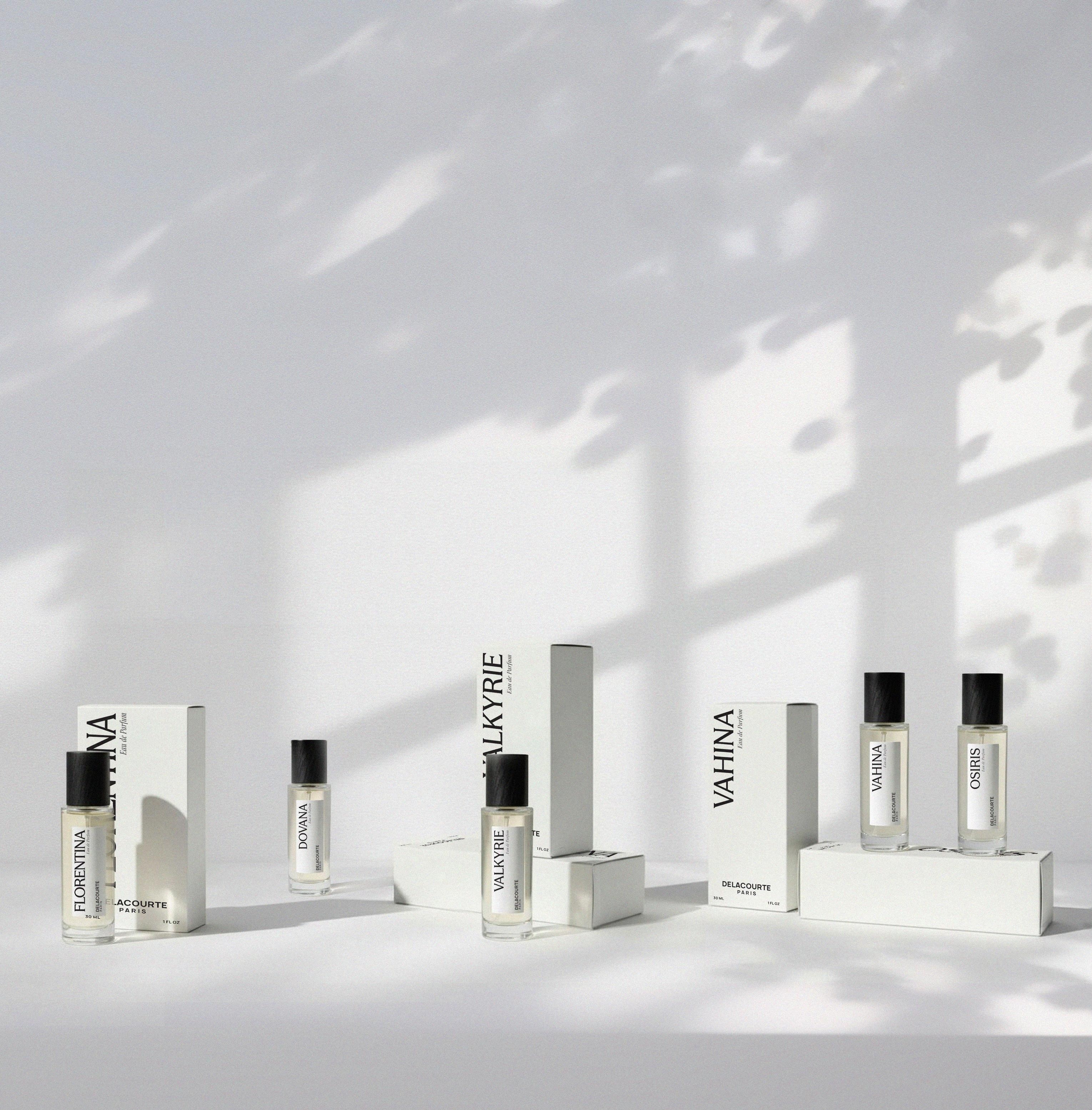
Perfume Consultations by Sylvaine Delacourte
This is the approach I have in my perfume consultations. In a lounge conducive to confidence, I take people on a journey through memory to find and relive happy moments, from the oldest time to the present time, based on the fact that olfactory heritage is determined in childhood, before the age of 10, and that human beings seem to spend their lives searching for it.
I collect, for about two hours, all the positive smells associated with moments of happiness, recorded in “the very secret black box”. I therefore determine the olfactory heritage. Then, I validate with notes or olfactory accords that I put under the nose, to provoke a reaction and thus validate my choices.
I am ready to start the work of bespoke perfume. For about 2 years, we have created about fifteen perfumes: as many masculine as feminine.
Psychology and Neuroscience: The Limbic System
Smell is the only one of our five senses to directly access memory, in other words, our black box.
A fragrance, an aroma emanating from the kitchen, the sweet perfume of summer rain, and here we are propelled into the past. A memory resurfaces: the colors, the lights, the precise place where the action took place. “One day, entering a house, I burst into tears.
I had just found the smell of my childhood home,” remembers Christiane Samuel, co-author of the book Êtes-vous au parfum ?.
This is because smell allows access to emotions and sensations stored since early childhood, adds Patty Canac, perfumery expert. “No other sense can stimulate memory so powerfully.”
The Scientific Explanation
If the experience may seem irrational, there is however a very scientific explanation. The nose captures odors which reach the olfactory bulb, connected to the limbic system. The limbic system is somewhat our black box, the seat of emotions and memory. Strangely, smell is the only sense to be in direct contact with this precious black box.
Result: emotion precedes information. That is to say, what is perceived will arouse pleasure, anxiety, or nostalgia even before the brain can identify it.
“Our sensitivity to smell begins at a very young age. In the search for the maternal breast, the infant is attracted by an odor secreted by the nipple,” confirms André Holley, professor of neuroscience in Lyon and author of Éloge de l’odorat. Until the age of 12, the child records a very large number of pleasant scents and unpleasant odors.
Lastingly inscribed in memory, they form the individual’s olfactory heritage. It is these memories which, throughout life, will, among other factors, influence their taste for this or that fragrance.
The Personal Link with Perfume
If we appreciate an Eau de Toilette, it is often because we find our past in it. For my part, if I love L’Heure Bleue, it is because it reminds me of the white glue of my childhood, vanilla waffles, and the lipsticks I used to steal from my mother.
Odors like perfumes play an important role in social life. They reveal information about the other: their hygiene (body odor), their health (mouth odor), and their personality (seductive or discreet, simple or sophisticated). “Odor is the body, and perfume, the garment or makeup which is there to advantage us”.
In my opinion, it is even more than a garment or an adornment; it must correspond to the olfactory heritage and therefore reveal the deep personality. It is connected with our identity!
Odor and Social Relations
“Odor is situated on the side of the intimate, while perfume is inscribed on the social side,” underlines Samuel Socquet-Juglard, author of various works on perfume. But sometimes body odors have a link with culture and civilizations.
For example, the Japanese call Westerners “butter-stinkers”, given the quantity of dairy products they consume. It seems that we emit for them a smell of curdled milk.
The nose is a guide. “It can attract us to someone or, on the contrary, push us away. ‘I can’t stand him’ (literally in French: ‘I can’t smell him’) means we smell him too much,” analyzes Christiane Samuel. Loving someone whose smell you cannot stand is in fact extremely difficult, even impossible.
“One can get used to an unsightly physique but not to an odor that indisposes. At a pinch, one can be friends, but lovers, no,” adds Samuel Socquet-Juglard.
For perfume, it is less categorical – the loved one just has to change it, after all. “If it causes nausea, it is interesting to understand why,” he continues. By tracing back one’s own olfactory history, one can discover for example that rose reminds of a cantankerous grandmother one was afraid of as a child.”
Smell in Therapy
The unconscious, always the unconscious. It is indeed it that reacts when challenged by a freshly squeezed lemon, the pages of an old book, or a walk in the forest. Effects that can even be therapeutic.
For two years, Christiane Samuel has been using odors in her work as a speech therapist for rehabilitation. A new approach in France and without equivalent in Quebec. She helps amnesiacs or patients out of a coma to recover memory by titillating their nostrils. A very specific smell can sometimes trigger the memory system.
“One can even make comatose patients react by giving them their own Eau de Cologne to smell,” she explains. “Their reaction is then immediate, like that of an infant wishing to communicate.”
Ammonia Against Sexual Urges?
The Study and Research Center of the University of Montreal (CERUM) uses a process, olfactory conditioning, which allows people struggling with sexual deviances to better manage their urges.
During therapy which lasts several months, the individual – often a repeat rapist – must break an ampoule of ammonia as soon as he has an erection. The fumes cut short his excitement. Little by little, he manages to control himself.