Solar Perfumes: Salicylates, White Flowers and Monoi
Hard for me to return home after having spent good holidays in the sun, nostalgic for these smells; I am sending you a few rays of it through this post.
The History of the Solar Note (Ambre Solaire)
In Europe, the olfactory reference associated with sunny notes is L’Oréal’s Ambre Solaire, built around benzyl salicylates, while the United States has as a reference the sun care product Hawaiian Tropic whose very opulent perfume is built around coconut notes.
The Secret: Benzyl Salicylates
L’Oréal, in its Ambre Solaire, used benzyl salicylate for its sunscreen properties. During its research, the company ended up developing much more effective sunscreens and removed this old filter. The consequence was a significant drop in sales of Ambre Solaire.
The formula was then subsequently reworked to reintegrate the famous benzyl salicylate, no longer as a sunscreen but for its olfactory effect which had become a solar reference for the consumer. In a word, it had to smell of sand and skin heated by the sun. These are synthetic molecules: benzyl amyl and cis-3-hexenyl.
White Flowers: Queens of the Sun
Jasmine
- Jasmine Grandiflorum which can come from Grasse, Egypt, India, or Italy.
- Jasmine Sambac from India with a more “orange and solar” smell.
To harvest this natural material, pickers must get up very early. The most skilled gather 500 to 700 kg of flowers per hour and to obtain 1 kg of concrete, 10,000 flowers are needed.
Tuberose
Tuberose is exotic and narcotic; it is found in South India and Egypt. It also exists in very small quantities in Grasse. In India, it is harvested every morning from May to December. The name of this flower, in Hindi, means “night perfume”.
Indeed, it decorates windows and the bridal chamber during the wedding ceremony period. For the first three days, the newlyweds do not see each other. They must wait for the fourth day to be able to get closer. It is then that the tuberose enters the scene to calm the anxiety of the newlyweds and stimulate pleasure. Officially erotic, tuberose is, with jasmine, the flower accomplice of love.
Ylang-Ylang
The ylang-ylang (cananga) flower comes from a tree and has the shape of a large disheveled star. For Indonesians, it is the “flower of flowers”. Very exotic, it displays an exuberant and extroverted nature. From volcanoes, in Madagascar or Mayotte, it has inherited an explosive floral side that gives a lot of color to perfumes.
Ylang-ylang with its creamy and carnal notes is reminiscent of solar monoi. It has a dimension that is sensual, lascivious, and intoxicating at the same time as it is wild and narcotic. Thanks to the distillation process, ylang can give several fractions (extra, first, second, third).
Exotic and Reconstituted Flowers
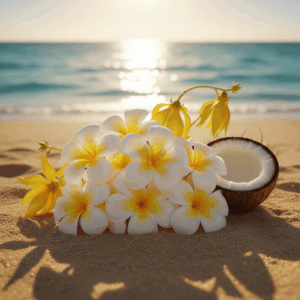
Frangipani Flower
The frangipani flower is a sacred flower in India whose abundant flowering is called for by ardent prayers. This sacred and delicate flower does not yield its perfume. Perfumers must resort to “a laboratory flower,” by proceeding to “a reconstitution,” that is to say, a formula integrating about ten components.
Tiare Flower and Monoi
Tiare is a tropical shrub on which grows the white tiare flower, the national symbol of Tahiti. It is now available as a natural product, by extraction. It is used sparingly, because its scent is ultimately quite disappointing.
Monoi de Tahiti: obtained by maceration of at least 10 tiare flowers per liter of refined copra oil (coconut oil); the product is then purified by filtration. Tiare flowers can also be treated in an artisanal way by a process close to enfleurage.
Pittosporum, Gardenia and Foul
- Pittosporum: This flower from a shrub (Australian laurel) has a scent between orange blossom and jasmine. It is impossible to have an essence or an absolute; the perfumer must therefore reproduce its smell using an accord.
- Gardenia: Its creamy and delicious smell has a very slight facet of fresh mushroom, just added with a touch of coconut. The perfumer will therefore make a reconstitution.
- Foul: A flower very close to gardenia highly appreciated in the Middle East. This one must also be reconstituted.
Other Solar Ingredients
- Bergamot and Tangerine: Recall the sun and freshness of Mediterranean countries (Calabria).
- Marine Notes: Synthetic notes (Calone, Helional) or natural ones derived from algae.
- Mimosa: Mimosa absolute is a natural product. Its powdery, floral, and rich scent expresses a green tonality due to the presence of leaves during extraction.
- Immortelle: Evokes the sun, the beach, the sea, the scents of the Corsican maquis. It is a spicy, racy flower very little used because it is difficult to tame.
- Coconut: Evokes holidays (Pina Colada). Worked from a molecule, aldehyde C18 (also possible in natural form).
Some Examples of Solar Perfumes
- Mayotte (Mahora) by Guerlain (discontinued)
- Quand Vient l’Été by Guerlain (discontinued)
- Ylang Vanille by Guerlain (discontinued)
- Embruns d’Ylang by Guerlain
- Mimosa Tiaré Aqua Allegoria by Guerlain (discontinued)
- Coco Fizz, Aqua Allegoria by Guerlain
- Terracotta Le Parfum by Guerlain
- L’Instant by Guerlain
- Cruel Gardénia by Guerlain
- Dune by Dior
- Ombre Bleue by Jean-Charles Brosseau
- L’Eau Ensoleillante by Clarins
- Beyond Paradise by Estée Lauder
- Sables by Annick Goutal
- Vanille Galante by Hermès
- L by Lolita Lempicka
- Moheli by Diptyque
- Songes by Annick Goutal
- Bronze Goddess by Estée Lauder
- Replica (Beach Walk) by Martin Margiela
- Ylang by Le Labo
- Sabbia Bianca by Profumum Roma
- Soleil Blanc by Tom Ford