White Musks in Perfumery: From Clean Note to Sensuality
Given that there are two musky perfumes in my collection, I thought an article on musks would be interesting. During various exchanges with passionate customers, I observed a real craze for white musks or musky notes. These are fluffy, cottony, very tenacious, comfortable notes. Some smell of baby skin, clean, others are fruity.
Inspiration and Creation: My History with Musk
During my travels to the Middle East, I discovered this habit that men and women have of applying musk-based oils all over the body, before putting on their perfume (soft blends of natural and synthetic musk notes).
I will soon write an article on natural animal musk (cf. Animal Musk), coming from the musk deer, even if we can no longer use it, alas.
I also discovered, in Lebanon, a flower very close to the gardenia, called foul (Arabian jasmine); I adored it. It was during this last trip that I got the idea to combine white musks and foul.
This resulted in the perfume Cruel Gardénia from the L’Art et la Matière collection by Guerlain. Work done in collaboration with a perfumer of triple nationality, Syrian, American, and French: Randa Hammami.
The “Musquinade”
White musks also inspired me for: L’Instant Magic which I worked on with the same perfumer. I wanted an overdose of white musks dressed in a large proportion of beautiful natural materials (cf. Natural Almond). I invented this name, “Musquinade,” as a nod to the famous “Guerlinade.”
In short: the Guerlinade is meant to express “the oriental side” of Guerlain. I draw your attention to the perfume Mitsouko, the Aqua Allegoria, Vetiver by Guerlain, the Eaux de Cologne, Jardins de Bagatelle, Chant d’Arômes, Parure, and many others. These perfumes do not possess the Guerlinade, but share a relief and a strong personality.
The 4 Categories of Synthetic Musks
In a comment, I saw that there was mention of nitrated musks (now banned). To be precise about these synthetic musks (cf. Synthetic Notes), it was necessary to comply with the law and regulations and replace them. Here is the result of my investigation: numerous chemical molecules have been created over a century as a substitute for natural musk.
1. Nitrated Musks (Banned at LVMH)
These are the oldest: developed from 1888 by A. Bauer. Olfactorily, these musks are the most powdery.
- Musk Ambrette: which the industry self-banned since 1981, due to its phototoxic and neurotoxic character.
- Musk Xylene (1893) and Musk Ketone (1894): These two musks were identified (in trace amounts) in human breast milk.
- Musk Moskene (1932) and Musk Tibetene: Both banned today in Europe, not because they presented a danger, but because the industry did not want to finance—due to their lesser use—the toxicological tests likely to demonstrate their perfect safety.
2. Polycyclic Musks (Years 1955 – 1970, Banned at LVMH)
These polycyclic musks which are generous and round and which act as base notes (cf. Base Notes) are cheap and above all, smell clean and cling well to fabrics. They are recognized as poorly biodegradable.
Moreover, they have been identified in small quantities in human breast milk. They are not in the process of being banned. Detergent manufacturers self-limit them for environmental protection reasons.
- Tonalide (IFF 1967) quite woody, earthy (12 euros/kg).
- Galaxolide (1954) clean, round, and blackberry fruity (IFF), widely used first in functional products then in fine perfumery (6 euros/kg).
- Fixolide.
- Celestolide (IFF).
3. Macrocyclic Musks (The Only Ones Authorized at LVMH)
These are the most recent and most used; some on this list are really expensive. For the moment, they are not the subject of any accusation or media attack.
- Muscone (Firmenich): powdery, fur-like, a slightly animal note a bit old-fashioned for my taste (480 euros/kg).
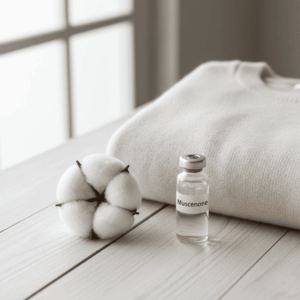
- Muscenone (Firmenich): powdery (400 euros/kg). I adore this one!
- Exaltolide (Firmenich): floral, angelica-like. Discovered in ambrette seed.
- Habanolide (Firmenich): metallic, waxy, woody, powdery.
- Ambrettolide (Givaudan): amber, fruity. Found in angelica juice.
- Globalide (Symrise): airy and clean.
- Musk T (Takasago) or Ethylene Brassylate: can be used to give a Galaxolide effect; Musk T is easy to use, it is round and soft.
- Dihydro Ambrettolide and Ambrettolide: fruity, and reminiscent of ambrette.
- Cosmone (Givaudan captive): Powdery, it allows giving a nitrated musk effect to compositions; this one too, I find delicious.
- Nirvanolide (Givaudan).
- Astrotone (Firmenich).
4. So-called “Linear” or Alicyclic Musks
Finally, the 4th new generation category of so-called “linear” or alicyclic musks. These latter musks have a linen and cotton effect.
- Helvetolide (1990): clean, white, milky, fruity very effective musk (Firmenich).
- Serenolide (Givaudan): soft, powdery.
- Moxalone (Givaudan).
- Romandolide (Firmenich).
- Applelide, Nebulone, Sylkolide: the latest musks found have softer and fruity accents.
Some Examples of Musky Perfumes
Here is a non-exhaustive list of perfumes containing musky notes:
- L’Instant Magic by Guerlain
- Bvlgari pour Homme
- Mûre et Musc by L’Artisan Parfumeur
- Flower by Kenzo (Muscenone in overdose)
- La Cologne by Mugler
- White Musk by Body Shop
- Original Musk by Kiehl’s
- Jovan Musk by Jovan
- Narciso Rodriguez For Her
- Fleur de Peau Diptyque
- Clair de Musc Serge Lutens
- Blanche Byredo
- Musc Invisible Juliette has a Gun
- Jasmine Musc Tom Ford
- Musc de Soie Van Cleef
- Musc Impérial Atelier Cologne
- Musc Outreblanc Guerlain
- Chloé
- Chance Eau Tendre Chanel
- Musc Pallida Hermès
- Eyes Closed Byredo
- Palermo Byredo
- Alto Astral Byredo
- The Musc Essentiel Parfums
- Parisian Musc Matière Première
- Un Musc by Obvious
More “Animal Musk” Note:
- Musc Ravageur by Frédéric Malle
- Muscs Koublaï Khän by Serge Lutens
- Musk Tonkin by Parfum d’Empire