The Gourmand Facet: Complete Guide to Sweet Notes (Vanilla, Caramel, Tonka)
Before defining the gourmand facet, one must know that a perfume is composed of a complex architecture, built around 5 to 10 different components, which assemble to create an “accord.” The main accord of the fragrance can then be dressed with several facets (the more facets a perfume has, the more complex it will be).
Furthermore, perfumes are distinguished into 6 olfactory families (citrus, floral, amber or oriental, chypre, woody, and fougère), and there are also numerous olfactory facets, including the gourmand facet.
What Is the Gourmand Facet?
In perfumery, gluttony is far from being considered a bad habit. Indeed, perfumes with a gourmand facet are today a new expression of femininity.
Unlike salty, acidic, or bitter flavors, the sweet taste has a regressive effect and tends to evoke a certain nostalgia linked to the sweets, cakes, and toys of our childhood.
Adolescence is often marked by gourmand and sweet perfumes, which seduce then, and can still be appreciated in adult life. Moreover, gourmand perfumes, far from being sickening, are on the contrary highly prized and refined. Generally, gourmand fragrances leave a powerful trail behind them.
People who appreciate this facet want to have skin “good enough to eat,” with scents that make the mouth water, and need a perfume that makes them want to bite into life. Gourmand perfumes can also represent a pleasant alternative to the temptation of gluttony caused by chocolate or other sweets.
History of Gourmand Perfumes
The first vanilla perfumes, which were not yet officially declared “gourmand,” were precursors of this new trend.
Guerlain largely contributed to the development of this facet, with perfumes such as: La Guerlinade (with its vanilla, vanillin, tonka bean, resins, and patchouli accord) found in Shalimar (1925), Habit Rouge (1965), and L’Heure Bleue (1912) with its marshmallow accord (based on orange blossom and vanilla) and in many other perfumes of the House of Guerlain.
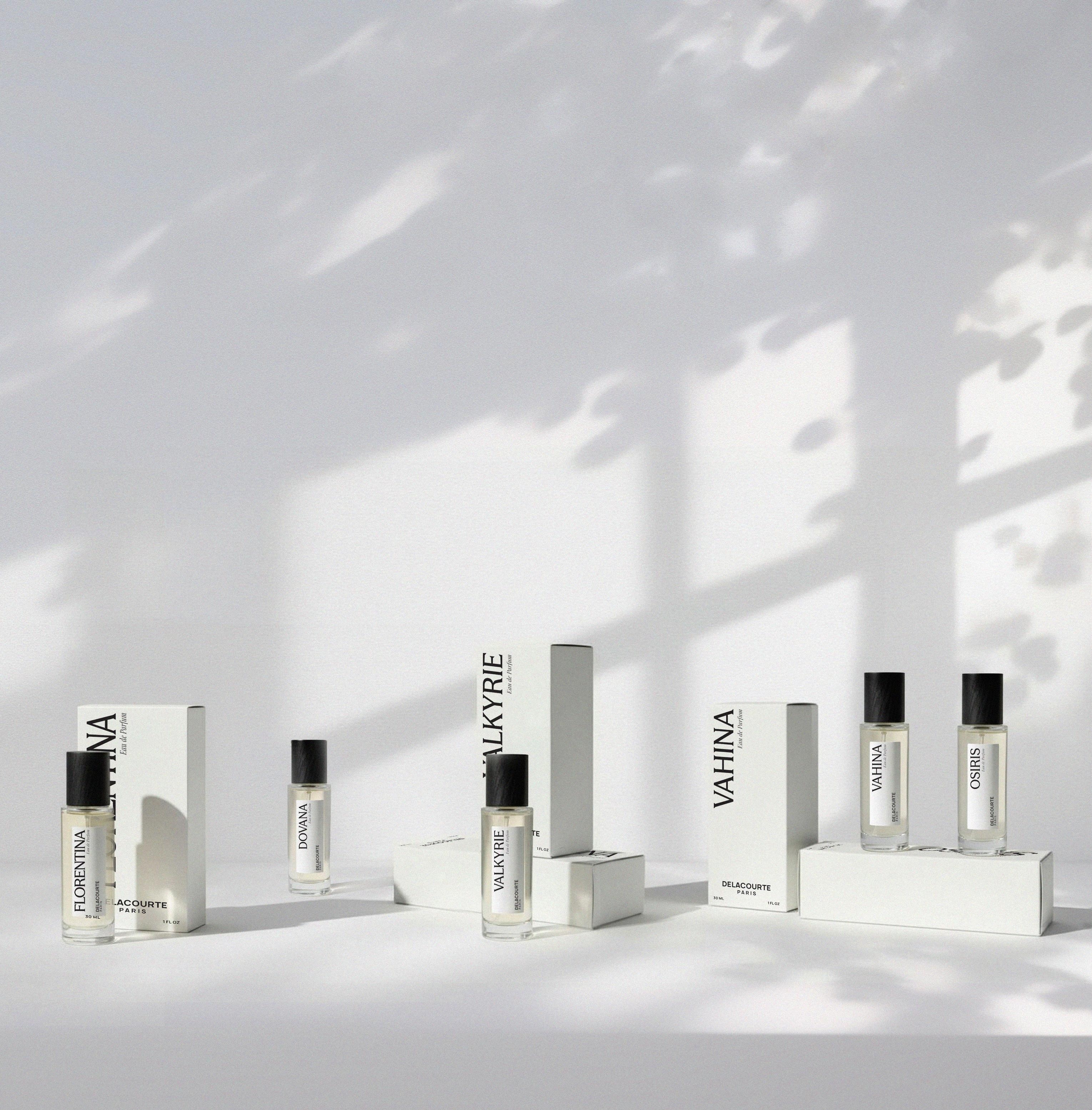
You will find the marshmallow accord in Florentina by Delacourte Paris (the marshmallow accord is the association of orange blossom and vanilla).
Certainly, gluttony was not “treated” literally at the time, but know that without Shalimar, there would not have been the perfume Angel (1992), which was the first to declare “gluttony” with its patchouli accord, red fruits, and caramel.
Angel was thus the leader of this new wave of gourmand perfumes, followed by Lolita Lempicka and many others.
Natural Notes of the Gourmand Facet
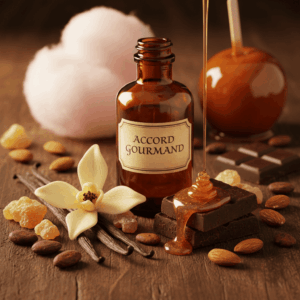
The palette of the gourmand facet is very wide. It includes, for example, notes such as: vanilla, benzoin, tonka bean, as well as numerous synthetic products.
Vanilla
The foody and sweet notes used in perfumery to reproduce the scent of vanilla are actually synthetic molecules: vanillin and ethyl vanillin.
There are different species of vanilla:
- Vanilla Planifolia: It comes from an orchid from Mexico, formerly pollinated by a bee. Today, pollen is collected by hand by women nicknamed “matchmakers.” A year and a half is necessary to obtain the fruit, the black vanilla pod, which is then scalded, covered for a whole day, then dried in the sun, which eliminates any bacteria.
- Madagascar Vanilla: It is found in about twenty different countries, but that of Madagascar is the most appreciated. It is a rare and luxurious material, therefore very expensive, because it exhales true olfactory wonders (with milky, honeyed, amber, woody, spicy, animalic, and rum notes).
- There is also another species of vanilla, from the botanical variety Tahitensis, which is more floral.
Vanilla can be treated in two ways: by macerating chopped pods in alcohol for a month (a technique no longer practiced today which allowed obtaining vanilla tincture) or by extraction of the pods with volatile solvent, which creates vanilla absolute. The scent of vanilla can also be obtained from synthetic products (vanillin and ethyl vanillin).
Good to know: It is said that vanilla is a remedy for anxiety and brings strength and health.
You will find Madagascar vanilla in the Vanilla perfumes of Delacourte Paris.
Benzoin
Benzoin is a balm secreted by the trunk of the Styrax benzoin, a tree of the Styracaceae family, native to Siam and Sumatra. This substance (also called “gum” or “benzoin tear”) is white in its liquid state and yellow once dry.
Benzoin exhales a very suave perfume, particularly appreciated in the form of incense. In perfumery, the gum is treated by volatile solvent extraction to obtain benzoin absolute. This raw material has a vanilla scent, soft, almondy, close to roasted coffee, but also a little honeyed, floral (with a carnation note), syrupy, or even somewhat medicinal.
Siam Benzoin is the variety most prized by perfumers (it is very rare and expensive, and has a strong vanilla facet).
Tonka Bean
The tonka bean comes from a South American tree, the “Dipteryx odorata.” Also called “coumarouna” or “sarrapia,” the tonka bean is a black seed that wrinkles as it dries (this is when it begins to exhale its true scent).
The tonka bean can be used in multiple ways: placed in wardrobes between piles of linen, treated by volatile solvent extraction in perfumes to obtain tonka bean absolute, grated in pastries, or to perfume snuff and pipe tobacco, like “Amsterdamer” (this use is now banned in France and the United States).
This raw material is a true fragrance in itself, thanks to its numerous facets of wood, balm, vanilla, almond, pistachio, tobacco, hay, etc.
The main molecule of this raw material is called coumarin, whose synthesis was developed in 1868 (it was used for the first time in Jicky, by Guerlain, with linalool and ethyl vanillin).
You will find the tonka bean note in Vahina.
Other Natural Gourmand Notes
There are many other notes used in the gourmand facet, such as:
- Bitter Cocoa Absolute: A chocolatey note, not very sweet.
- Bitter Almond: There is a natural note from an apricot kernel that gives this almond note, as well as benzoic aldehyde, a molecule. This natural almond is present in Florentina.
- Honey Notes: Which are natural. You will find them in Osiris.
Synthetic Gourmand Notes
The gourmand facet also includes synthetic notes, such as the caramel note and the hot milk note.
The Caramel Note
The caramel note consists of synthetic molecules like ethyl-maltol, maltol, sacrasol, coumarin, or furaneol. These allow obtaining numerous notes, ranging from caramel to cotton candy, not to mention candy apple.
The Hot Milk Note
Lactones notes, offering a pleasant scent of hot milk, were used for the first time in Feu by Issey Miyake.
Other Synthetic Notes
The chocolate note is also a synthetic note of the gourmand facet, and composes the base of the perfume Chocovan, by Givaudan. Very beautiful honeyed bases also exist in the gourmand facet of many perfumes.
Furthermore, fruity notes such as raspberry, strawberry, cherry, and mango get along very well with vanilla notes. Most of these fruits are possible thanks to the advent of synthesis. Some of these natural fruity notes are now found.
Perfumes with a Gourmand Facet
Here are some perfumes with a gourmand facet, for women and men:
Gourmand Perfumes for Women
- Angel – Mugler
- Lolita – Lempicka
- La Vie Est Belle – Lancôme
- La Petite Robe Noire – Guerlain
- L’Eau de Parfum Intense – Guerlain
- Mademoiselle – Rochas
- Black Opium – Yves Saint-Laurent
- La Nuit Trésor – Lancôme
- Hypnose – Lancôme
- Gucci Guilty Black – Gucci
- Decadence – Marc Jacobs
- Hugo Woman – Hugo Boss
- Luna – Nina Ricci
- Nina – Nina Ricci
- Ricci Ricci – Nina Ricci
- Bonbon – Viktor & Rolf
- Flowerbomb – Viktor & Rolf
- Wish – Chopard
Gourmand Perfumes for Men
- Habit Rouge – Guerlain
- A*Men – Mugler
- Fuel for Life Men – Diesel