The Kôdô Ceremony: The Art of Listening to Incense in Japan
Perfume is primarily perceived for well-being and seduction, but its spiritual dimension or at least its psychological effect are just as important. We understand the mechanisms poorly, but we intuitively know that perfume can induce states of happiness, of nostalgia by sometimes reawakening buried memories. Intellectual activity can be stimulated by perfume.
The Master and the Shino School
Last week, I attended the Kôdô ceremony, or the “Way of Incense,” at the Maison du Japon at Quai Branly. It was Souhitsu Issiken Hachiya who received us and offered the demonstration. He represents the 21st generation at the head of the Shino school, one of the two oldest schools teaching Kôdô.
He learned the spirit and discipline of “Kôdô” from childhood. He also learned the art of the tea ceremony from his grandfather, the nineteenth of the Souyou dynasty. For 10 years, he learned calligraphy from a Catholic nun.
Finally, he invested himself in tree plantations in Vietnam. There have been 20 grand masters of this school for 500 years. There are 200 Kôdô classes in Japan and one in Boston (in the US).
Incense: Precious Wood and Spirituality
Finding its origins in China, incense was introduced to Japan in the 6th century as part of Buddhist practices. They are also called jinkos and can be preserved for up to 1000 years. Some are kept with the treasures of the imperial court. These precious woods have been subjects of great covetousness and are worth “fortunes”.
Japanese incense comes precisely from woods called jinko or agarwood which, when wounded, secrete a resin as if to heal itself and become one with it (originating from the tropical forests of Vietnam, Laos, or Cambodia). This process takes about ten years.
This ceremony can be solitary, as samurai used to do for example before a battle, allowing them to find themselves or to measure their capacity for concentration, their memory, or elevate the soul. It can also be shared; it is then a game which allows, as the name Kôdô indicates, “to listen to the scents”.
The Course of the Ceremony
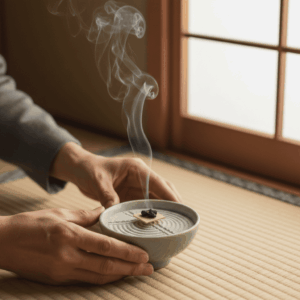
The Kôdô Master enters the room, moves with extreme precision, small measured steps, turns, and finally places himself sitting on his knees on the tatami. He unfolds his kit, containing the equipment, tweezers, spatulas, etc.
At the beginning, we were also sitting on our knees around him but after 5 minutes, we resumed a Western posture, sitting cross-legged or legs extended to the side, it was too hard!
The Master burns the tiny piece of incense on a porcelain vessel at the bottom of which charcoals were placed. Above the ash arranged with 50 lines, on 5 sides (5 being an important number symbolizing the 5 elements of the world: fire, earth, water, metal, wood).
Gestures and Woods
The master indicates the right gestures to properly hold the incense burner with the left hand underneath, the right hand on top to direct the swirls of incense precisely towards the nose. Three inhalations, exhalations to the side so as not to blow on the ash. One must memorize this scent and place the incense burner on the tatami and pass it to one’s neighbor.
This incense game consists of living through imagination a boat trip to three famous sites:
- Matsushima: symbolizes a landscape in northern Japan.
- Hashidate: long sandbar in the center of the island towards Kyoto.
- Itsukushima: designating an island near Hiroshima.
Then, the master of ceremonies mixes the three pieces of wood, and adds a fourth called the boat, and the game is announced by the master: “shukkô”.
The Game: Listening and Recognizing
The three incense burners are then passed in another order, plus the fourth, the boat “the intruder”. The game consists of recognizing and noting on a folded parchment the initials of the recognized scents, according to the order of their passage, ex: I M H B, all in total silence, contemplation, extreme concentration.
I thought I had recognized the different scents, sweet and light smells of guaiac wood, slightly woody, powdery, but the differences between the woods were very subtle!
Poetic Results
The master gives us the answer with appreciations imbued with poetry:
- Sankei: Four scents found in the right order. The journey was made without hindrance and allowed admiration of the three remarkable landscapes.
- Yugiri (evening mist): Two scents placed in the right place. You visited two sites, but at nightfall, the mist blocked the last view.
- Asagiri (morning mist): Only one scent found. The mist, from the morning, prevented you from enjoying a clear view.
- Kumokiri: No scent found. Then you will have known only a day of clouds and fog.
Result of my experience, I made the trip and the mist prevented me from admiring the view. I was reassured, my neighbors were not any brighter!
The 10 Virtues of Incense for the Japanese
- Sharpen the senses
- Purify the body and spirit
- Eliminate pollutants of the spirit
- Fight against fatigue
- Cure the feeling of loneliness
- Create a feeling of harmony despite the sources of daily stress
- Its abundance is not a nuisance
- Be satisfied with small quantities
- Resist the effects of time
- Daily use does not harm
As every time I have the chance to participate in a Japanese demonstration or event (tea ceremony, Sakura festival, floral art, etc.), I am always seduced by the rigor, precision, refinement, and perfection that emanate from Japanese culture.
Thanks to the TAKASAGO company.