Vetiver Root: The Green Gold of Perfumery
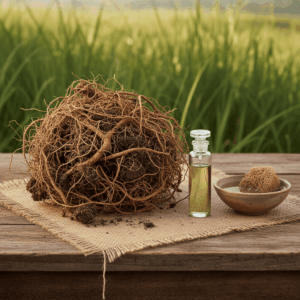
Vetiver root is an important note in perfumery; there are many qualities of it.
Description of Vetiver
Botanical name: Vetiveria Zizanioides.
Botanical family: Gramineae.
We know of a dozen species of vetiver, including Vetiveria zizanioides, the variety commonly used in perfumery.
It is a herbaceous plant with a height of one to two meters found in tropical zones.
It presents itself in the form of large green tufts whose root develops vertically to quite significant depths.
It is only the root, which is then dried, that is used. The green grasses are used for livestock.
The use of vetiver is quite recent in perfumery; global consumption at the beginning of the 20th century was one ton.
It rose to 250 tons at the end of the 1970s, to stabilize around 130 tons today.
History and Origins of Vetiver
Native to India, vetiver has been introduced to many tropical countries.
It is found in Brazil, China, Guatemala, and Madagascar. Indonesia and Haiti are the main producers.
Vetiver takes its name from the Tamil term vetiveru which means woven root.
It is called khus khus in many regions of India.
It is in Reunion Island that it is of the best quality, we speak of Bourbon vetiver, but its production there is unfortunately decreasing a lot.
Roots are extracted, in a dry state, when the plant is 2 or 3 years old.
In Reunion Island, vetiver has long served as thatch for roofs.
Processing and Manufacturing of Vetiver Raw Material
Vetiver essence is obtained by steam distillation of its roots.
This also allows the preparation of vetiverol which is not a constituent as a defined molecule, it is simply the name given by chemists of the time who did not have chromatography to all the sesquiterpene alcohols of vetiver.
There is also vetiveryl acetate which I appreciate even more than vetiver. More modern, purer, vibrant, rising, tonic.
Did you know that it is more expensive than the natural vetiver product?
It is also possible to manufacture vetiver absolute through volatile solvent extraction, although this is less often used.
Vetiver can also be treated by CO2; this treatment allows obtaining an essential oil very close to the smell of the natural raw material.
I have also smelled very interesting vetiver fractions; these are certain very specific parts of the essential oil, either the vibrant part or the solely woody part for example.
It takes on average 1000kg of dried roots to obtain 10 to 15kg of essential oil.
The distillation of the batch, about 800kg, will be distilled for 8 hours.
First there is the cutting, then the excavation, which is the action of shaking the roots with a curved fork until there is no more earth. Finally, distillation takes place from August until December.
Vetiver requires little labor and maintenance, its water requirement is limited, and vetiver has the property of fixing soils and fertilizing the earth.
Vetiver does not require specific treatment; this plant can grow without being treated with pesticides.
Olfactory Description of Vetiver
Olfactory family: Vibrant Woody
In general, the smell of vetiver is quite fusing, fresh, with hazelnut or peanut accents and fine smoky scents, but as with all natural raw materials, the scent varies depending on the sun, the soil, etc.
The scent of vetiver can have specificities and differences.
The so-called Bourbon vetiver from Reunion Island has an earthy, fine smell, with a slightly rosy facet. Alas, this vetiver has become rare.
Indian vetiver developed by Guerlain has many points in common with that of Reunion Island.
Haitian vetiver is woody, earthy, vegetal, smoky, warm, with an iris root side. It evokes the undergrowth.
Note that Java vetiver has an aromatic smell, quite distinct, even more earthy, less fine, bitter, with an extremely smoky smell that can evoke grilled bacon.
Vetiver essential oils possess immunostimulant, relaxing properties, used in aromatherapy; they help the organism in the fight against stress as well as benefits in disease prevention.
The essential oil also acts beneficially on the psyche; moreover, Indians found great virtues in it as they nicknamed it “the oil of tranquility”.
Use of Vetiver
Vetiver roots were used to weave curtains, screens, and fans on which water was sprinkled to refresh the atmosphere and give it a delicious scent.
Indeed, dry vetiver is very slightly scented; it must be moistened again to regain the initial smell of vetiver; it is then that the fresh and woody scents act a bit like air conditioning.
A few drops of essential oil placed in a container can refresh, for example, the interior of a car and perfume it pleasantly, making it more natural than car perfumes intended for this use.
Formerly, at Guerlain, there were in the catalog small bundles of vetiver sold to customers of Parisian boutiques; these bundles could be slipped into drawers for protection against insects.
Vetiver is a note traditionally associated with the masculine universe, even if some feminine perfumes possess it like Vétiver pour elle by Guerlain for example, now withdrawn from the market.
The fragrance Vétiver by Guerlain was worked around a very signed and recognizable accord, with of course vetiver associated with a blonde tobacco note, coumarin, and nutmeg; this is why it is truly unique.
For those who want to smell the vetiver note pushed to the extreme, do not forget Vétiver Extrême.
After the two opuses of Guerlain Homme in Eau de Toilette and Eau de Parfum that Thierry Wasser and I had worked around a Mojito accord.
Another very successful creation by Thierry Wasser since his entry as House Perfumer is the fragrance Guerlain Homme.
There are many common points with the other two creations of the same range but at the same time they are different because the vetiver note is overdosed there.
It also contains geranium which can give accents of the fougère accord.
The vetiver note is often associated with masculine notes but it is very present in feminine perfumes like Chanel N°5 and Must by Cartier.
It was encountered a lot in masculine perfumes, especially at the beginning of perfumery in Eaux de Cologne where there is a large quantity of citrus fruits like bergamot and lemony notes like verbena.
Then gradually men wore Eaux Fraîches then Eaux de Toilette, recently even some have been attracted by Eaux de Parfum and extracts which are starting to appear in the men’s perfume market.
Vetiver is also found in chypre perfumes, alongside mosses and patchouli.
Vetiver essence is also used a lot for leather or oriental perfumes with the addition notably of incense which blends wonderfully well with the scented note of vetiver.
Vetiver is a base note that brings a warm and woody facet to perfumes; it associates easily with other woody notes and other base notes such as sandalwood and cedar.
Main Constituents
Khusimol, isovalencenol.
Vetiver contains about 150 constituents, the main and best known of which is vetiverol (see details on this product above).
Some Perfumes Containing Vetiver
Vétiver by Guerlain is a masculine perfume but it is often also worn by women.
In the same spirit, woody and fresh: Vetyverio by Diptyque, Sels de Vétiver by The Different Company, Vétiver Moloko by Ex Nihilo, or in Terre d’Hermès where the scent of vetiver is very present.
But if it is associated with vanilla notes or hazelnut, or candied chestnut notes, it can become gourmand, even sensual, like the perfume by Byredo that I like a lot, Bal d’Afrique.
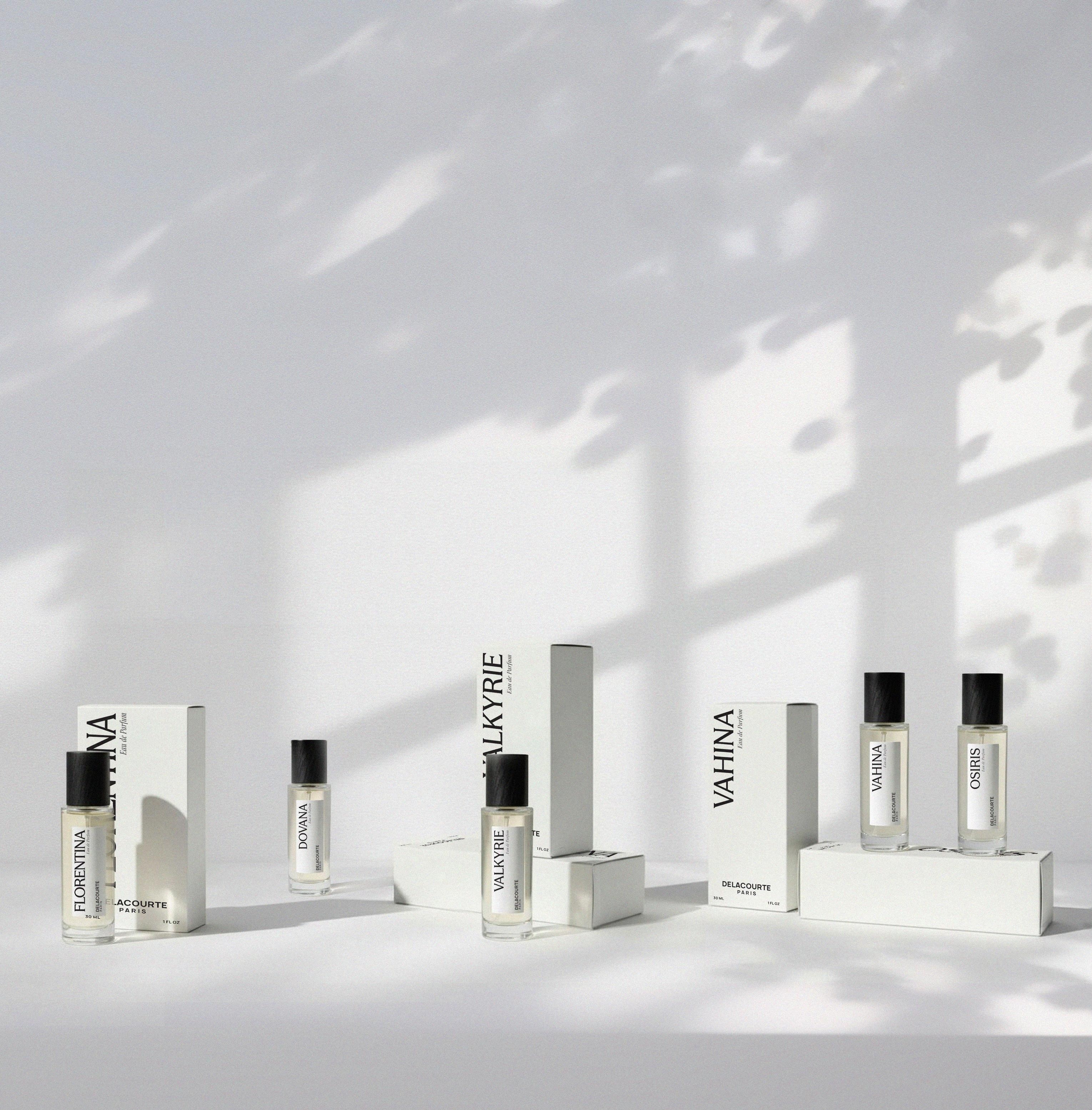
- Florentina Delacourte Paris
- Vétiver Guerlain
- Vétiver pour elle Guerlain
- Guerlain Homme Guerlain
- Vetiver Carven
- Habanita Molinard
- Chrome Azzaro
- Grey Vetiver Tom Ford
- Vetiver Extraordinaire Frédéric Malle
- Cœur de Vétiver sacré L’Artisan Parfumeur
- Vétiver Tonka Hermès
- Sels de Vetiver The Different Company
- Jardin après la mousson Hermès
- Vetiver Fauve Guerlain exclusif
- Baiser du Dragon Cartier
- The Beat Burberry
- Vetiver Oriental by Serge Lutens
- Vetiver 46 Le Labo
- Sycomore Chanel