The Spicy Facet: History, Categories (Hot/Cold), and Iconic Perfumes
In perfumery, fragrances are classified into categories, called “families” (according to the classification of the French Perfume Committee – CFP). There are six of them:
- The Hesperidic family
- The Floral family
- The Amber or Oriental family
- The Chypre family
- The Woody family
- The Fougère family (cf. The Aromatic family)
A perfume’s family is determined by its accord, or main theme, consisting of 5 to 10 different components, giving the fragrance its soul. Furthermore, each main theme, or family, can be dressed with one or more olfactory facets. The more faceted a perfume is, the more complex it will be.
The spicy facet can dress each of the families above.
History of Spices
The potential of spices was first exploited during Ancient Egypt. The Pharaohs’ subjects were great consumers of spices, both for daily use and for embalming during funeral ceremonies. The wealthiest Egyptians burned cinnamon in their homes to combat the foul odors rising from the streets.
Egyptian pharmacopoeias (collections of medical product prescriptions) consisted of large reserves of spices, most of which were considered true remedies.
The importance that the spice trade subsequently took on can be explained by several reasons. First, it was a lucrative trade; moreover, spices were easily transportable and consumed in large quantities, especially by the highest classes of society; finally, the success of spices is explained by the mediocre quality of the food consumed.
The latter, when not half-rotten, were bathed in salt (the only appropriate preservation method at the time) during mass production. Wines, beers, and vinegars shipped by boat were among the few preserved commodities. Spices were very expensive, and spicy drinks were therefore especially prized by people of a certain social class.
Until about the 16th century, the flow of spices followed the trail of Arab caravans to Constantinople and Alexandria. From there, the goods were shipped to their recipients by Italian vessels. The spice trade thus transformed the small cities of Venice and Genoa into brilliant metropolises.
Similarly, the economic wealth of the spice trade made possible great cultural advances in northern Italy, notably thanks to the generosity of patrons, rich merchants, towards artists, architects, and philosophers.
The Spice Trade
In the 15th century, old trade routes were interrupted, thus breaking the monopoly of Italian ports on the spice trade. The spice race and the relentless search for new trade routes launched great explorers onto the seas. Christopher Columbus in 1492, thinking he was heading for India, landed in the Bahamas where he discovered allspice and vanilla.
In 1498, the Portuguese explorer Vasco da Gama landed in India, where he discovered cinnamon, pepper, cloves, nutmeg, and mace.
* The expression “dear as pepper” used by Voltaire referred to the invective “pepper sack,” dating from the Middle Ages, which served to designate a very rich man (spices being very expensive at the time).
Categories of Spices
Two categories of spices are distinguished: hot spices and cold spices.
In perfumery, spices immediately evoke warmth and a “piquant” side. But while it is true that they can be hot, they are also vectors of freshness. Fresh spices act more as top notes, while hot spices develop mainly as heart notes and base notes.
1. Fresh Spices
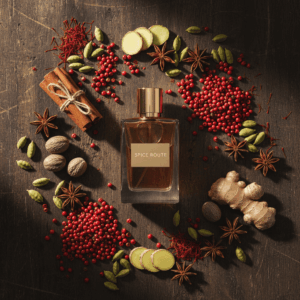
Spices considered fresh are cardamom, coriander, ginger, juniper berries as well as pink pepper and Timut pepper.
Cardamom
A plant native to India, cardamom comes from the same family as ginger and turmeric. It comes mainly from Guatemala and India.
In Egypt, it was called “the seed of angels,” it had divine properties, Cleopatra perfumed her palace with it before each visit of Mark Antony.
The plant itself can measure up to five meters. There is green and black cardamom. Its fragrant seeds are distilled during the production of essential oil intended for perfumery.
This cardamom essence is very expensive because it requires significant labor.
30 kg of cardamom yield 1 kg of essential oil, also exists as an absolute and can be treated by the CO2 process.
It is considered a cold spice, slightly camphorated, green, and terpenic.
Coriander
Native to the Middle East, coriander is also known as “Chinese parsley” or “Arab parsley.” It is from the same botanical family as the carrot. Its scent is very rising, fresh like citrus, lemony, and slightly camphorated. There are olfactory differences depending on the part treated (leaves or seeds).
Ginger
This spice, highly appreciated since its discovery by Marco Polo (who brought it back from China), corresponds to the rhizome of a tropical plant. Ginger is a rising note, prized by perfumers; it is fresh, hesperidic, and rosy. Its spicy side can sometimes give a soapy scent to perfumes.
Juniper Berries
Coming from the juniper tree (Juniperus communis), these small European fruits are used in cooking to accompany dishes, as well as in Gin production. Juniper berries are used in perfumery thanks to the distillation of the fruits.
Pink Pepper
Coming from South America, pink pepper, or pink berries, is a “false pepper,” fresh and airy, which pairs very well with citrus notes. It is frequently used in perfumery as a top note.
Timut Pepper
A variety of pepper used recently by perfumers, Timut (or Timur) pepper is a false pepper, close to Sichuan pepper. It diffuses grapefruit scents.
2. Hot Spices
Among the hot spices used in perfumery are: nutmeg and its shell (mace), cinnamon bark, peppers, saffron, and finally, pimento berries.
Nutmeg
Nutmeg has, among other things, anti-inflammatory and antiseptic virtues. It is also used in cooking to enhance a dish (it is part of the famous “Four Spices”).
Its note is spicy, dry, hot, and deep, and can evoke a leather note, with a medicated camphor side, a clove facet, and an earthy note.
Eugenol, methyl-eugenol, and Iso-eugenol are molecules present in clove and nutmeg. All these molecules are limited, or even banned, by IFRA laws (International Fragrance Association) and are naturally present in ylang-ylang and rose essence.
Cinnamon Bark
Cinnamon has been used for several millennia. Most cinnamon bark production is found in Sri Lanka, Seychelles, and Madagascar. The spice is harvested every two years and the wood, very fine, must dry in the sun before being treated by distillation.
Peppers
There are three kinds of pepper (black, white, and green). They come from different degrees of maturation, but from the same variety: Piper Nigrum. It is a very prized spice, both for consumption and in perfumery.
Saffron
Nicknamed “red gold,” saffron, which comes from a crocus pistil, is the most expensive spice in the world. It is not used in perfumery because it contains allergenic components. However, a substitute exists: safranal, which gives a very strong and spicy leather note to perfumes.
Pimento Berries
Native to the West Indies and mainly harvested in Jamaica, pimento berries are treated by distillation, as are the leaves (which are then called “pimento leaf”). Its perfume is spicy, situated between nutmeg and cinnamon, while evoking clove.
Spicy Perfumes
Here are some fragrances with a spicy facet, classified by spice:
Ginger Perfumes
- Déclaration Cartier
- Five O’clock Serge Lutens
- Allure Homme Sport Edition Blanche Chanel
- Eau de Gingembre Roger Gallet
- L’Eau Diptyque
- Fou d’Absinthe L’Artisan Parfumeur
- Safran Troublant L’Artisan Parfumeur
- Dzing L’Artisan Parfumeur
- Ginger Picante Guerlain
- Baptême du Feu Serge Lutens
Juniper Berry Perfumes
- Gin Lord Of Barbès
Cardamom Perfumes
- Voyage Hermès
- Cardamusc Hermès
- Déclaration Cartier
Pimento Berry Perfumes
- Mitsouko Guerlain
- Piment Brûlant L’Artisan Parfumeur
Saffron Perfumes
- Safran Troublant L’Artisan Parfumeur
- Saffron Jo Malone
- Black Saffron Byredo
Pepper Perfumes
- Poivre Noir Caron
- Parfum Sacré Caron
Coriander Perfumes
- Héritage Guerlain
- Gentleman Only Jean Couturier
- Intense Jean Couturier
- Coriandre Jean Couturier
Cinnamon Perfumes
- Opium Yves Saint Laurent
- Égoïste Chanel
- Rousse Serge Lutens
- Black Orchid Tom Ford
- Noël au Balcon Elo
- Dolce Vita Dior
- L’Eau Lente Diptyque
- Eau Diptyque
Nutmeg Perfumes
- Cacharel pour l’Homme Cacharel
- Vétiver Guerlain
- Opium pour Homme Yves Saint Laurent
- Tubéreuse Criminelle Serge Lutens
Perfumes with Spice Blends
- Noir Épices Frédéric Malle
- Spice Blend Dior
- Paprika Bresil Hermès
- Épices Marines Hermès
- Voyage Hermès
- Bois d’Arménie Guerlain
Perfumes with Confidential Spices
- Cumin, present in Femme by Rochas by Edmond Roudniska.
- Clove, which allows, with rose, to create the “carnation” note present in Coco by Chanel, Opium by YSL, Aromatics Elixir by Clinique, Miss Dior, Tam Dao by Diptyque, Florentina by Delacourte Paris.