Synthetic Molecules: History, Myths, and Olfactory Revolution
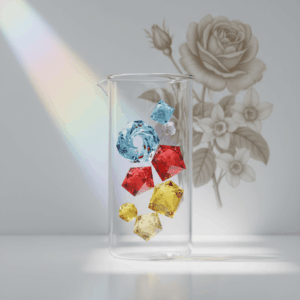
Modern perfumery was born at the end of the 19th century. At that time, perfumers began incorporating synthetic ingredients into their formulas, which amplified the professional’s palette, offering more creativity.
This also allows for obtaining more abstract olfactory forms. Today, chemists are capable of isolating aromatic compounds present in a natural raw material, purifying them, and obtaining their molecular structure. Once this structure is identified, the specialist can, using organic chemistry, recompose the molecules.
Just as pictorial art acquired a new dimension with synthetic dyes (the paint tube finally allowed artists to leave their studios), perfumery has reached new heights and enabled new sensations with synthetic products.
The Different Synthetic Raw Materials
There are two types of synthetic raw materials:
- Pure Synthesis: These are materials obtained solely by chemical reactions, such as esters, aldehydes, lactones, macrocyclic musks (white musks), or methylionones for violet notes, among others.
- Isolates (of natural origin): They come from natural products, such as indole (found in jasmine), geraniol (present in rose or geranium), linalool (in lavender and bergamot), vetiveryl (from Haitian or Javan vetiver) as well as certain musks, found in animal musk. The technique used is the “fractionation” of the essential oil. An isolate costs about twice the price of the corresponding essential oil.
There are products called hemi-syntheses which are made from isolates; they are even more expensive: for example, natural linalool isolate will be transformed into linalyl acetate. Many synthetic raw materials are therefore constituents of natural products.
What Does Synthesis Bring to Perfumery?
The use of synthesis in perfumery presents numerous advantages. Synthetic molecules bring many attractions to fragrances and facilitate the work of perfumers.
1. Creativity and Abstraction
Synthesis first brings original notes to the perfume, like aldehydes or marine notes, for example, and gives abstraction to fragrances. They therefore greatly enrich the perfumer’s palette.
There are, in fact, about 3,000 synthetic products and 1,000 natural raw materials available to the perfumer. Synthetic products also have the advantage of being obtainable at any time, in the desired quantities.
Moreover, synthesis allows the perfumer to reproduce fragrant floral notes that are too fragile to be distilled, notably flowers that do not yield their “soul,” those also called “mute flowers” (such as lily of the valley, lilac, freesia, lily, honeysuckle, gardenia, wisteria, peony, violet flower, etc.).
Synthetic materials also allow reproducing the scent of fruits whose essence is impossible to extract, such as strawberry (C16), peach (C14), coconut (C18), plum, raspberry (frambinone), etc. Even though more and more, the perfumer can now find an increasing number of natural fruity notes.
2. Tenacity and Sillage
Synthetic molecules also allow improving tenacity, and bringing power and sillage (trail) to the perfume.
3. The Sublimation of Natural Notes
Synthesis allows natural notes to be sublimated. For example, to enhance a natural vanilla with a gourmand effect evoking a pastry, one could add a synthetic ingredient, like vanillin, or ethyl-maltol, which possesses a caramel scent.
Thanks to research and advances in chemistry, we can now create ingredients possessing extraordinary evocative power right from the start.
Thus, perfumers are increasingly in quest of “naturalness” that certain natural materials cannot, paradoxically, offer them. Synthesis can give an illusion of the natural and evoke a carnal and enveloping note (example: vanillin).
Example: a note of Hedione will sublimate rose better and bring a more natural aspect (with a morning dew freshness), than bergamot or lemon, deemed more “classic”.
Synthetic Molecules Today
Currently, many new synthetic molecules are highly appreciated and allow obtaining very particular notes, such as:
- White Musks: evoke comfort and softness (with notes having a bit of a “comfort blanket” or “baby” effect), as well as refinement (with “cashmere” notes).
- Cashmeran or Ambroxan: for addictive, powerful, and diffusive notes.
- Ethyl-maltol: for sweet notes, like caramel.
- Limbanol, Cedramber, Karanal (Z11): for woody, nervous, and amber notes appreciated by men.
- Reconstituted Oud: True notes evoking oud wood are rarely natural, and often very expensive. They are often replaced by a blend of natural materials and synthetic materials.
- Evernyl: scent between barks and mosses warmed by the sun that takes you into the undergrowth.
- Ambrofix: recently developed by Givaudan, with its characteristic smell of ambergris, obtained by biotechnology (100% renewable from sustainable sugar cane).
- Mahonia: brings a petaly breath to a composition and transports you to the heart of a field of flowers.
Here are some other synthetic products regularly used in perfumery:
- Alpha Damascone: with an apple-cider smell (used in Nahema and Jardins de Bagatelle by Guerlain).
- Ethyl-maltol and Maltol: molecules with a sweet smell, close to caramel (used in Angel by Mugler, La Vie Est Belle by Lancôme, and La Petite Robe Noire Intense by Guerlain).
- Dihydromyrcenol: a fresh and modern citrus note (used in CK One by Calvin Klein, and Cool Water by Davidoff).
- Heliotropin: allows obtaining a smell of white glue and almond (used in L’Heure Bleue and Après l’Ondée by Guerlain).
- Galaxolide: a powdery, fruity, blackberry, and clean musk (used in White Musk by The Body Shop).
- Cis-3-Hexenol: with the smell of cut grass (used in Herba Fresca by Guerlain).
Misconceptions About Synthesis
It is common to have reservations concerning synthetic products, and one often hears objections such as: “A good perfume is a perfume that contains only natural ingredients” or “New fragrances are all synthetic”, or even “Synthesis is cheaper.”
In the collective unconscious, natural is by essence, positive. In reality, the majority of synthetic molecules are merely a “copy” of the same molecules found in nature. Now, while it is true that natural materials bring real added value, synthesis should not be considered negative for all that.
The Price of Synthesis: Furthermore, synthesis is not always less expensive than natural raw materials. For example, irone, a synthetic molecule existing in iris costs about €2,000 per kilo. A “luxury” molecule with a powdery smell (such as white musk) costs about €600, whereas a natural lavender essence costs €150 per kilo; that of neroli costs €3,000 and orange essence only €10!
You should also know that several years of research, using very sophisticated techniques, are sometimes necessary to succeed in discovering certain fragrant molecules interesting for perfumers and capable of being produced on a large scale.
As for legislation, it concerns both synthetic and natural products; all ingredients used in perfumery are subject to drastic toxicological tests, more significant on synthetics than on naturals.
One must know that a 100% natural perfume will very often perform less well in sillage and tenacity.
Without Synthesis, These Perfumes Would Not Exist
However, certain misconceptions die hard, such as those that imply a quality fragrance must only be natural. Yet, without synthetic ingredients, modern perfumery would not exist. For example:
- Without aldehydes, N°5 by Chanel would never have seen the light of day.
- Without coumarin, vanillin, and linalool, the first modern perfume Jicky by Guerlain would never have existed.
- Without ethylvanillin, Shalimar by Guerlain could not have offered such a memorable sillage.
- Eau Sauvage by Dior, without the yet shy hedione (extremely transparent floral note, tea facet, airy and jasmine-like) which transfigures the other notes and brings a fluid breath.
- Acqua Di Gió without calone (which reproduces the smell of the sea and iodine).
- Mitsouko by Guerlain would not be as perfect without its fruity peach note (aldehyde C14), used for the first time in a fragrance.
- Hexenol which scents of freshly cut grass, for green notes.
History: Chronology of Synthetic Molecules
Here is a chronology tracing the history of the great creations of synthetic materials in perfumery:
- 1833/1834: Dumas and Peligot isolate cinnamic aldehyde from cinnamon essence.
- 1844: Cahours finds the main constituent of anise essence: anethole.
- 1868: The English chemist, William Henry Perkin, synthesizes the odorant principle of the tonka bean: coumarin.
- 1882: Coumarin is used for the first time in Fougère Royale, created for Houbigant.
- 1869: Discovery of heliotropin used in Après l’Ondée, which also contains the anisic aldehyde molecule discovered in 1887.
- 1874: Chemists Tiemann and Reimer industrially manufacture vanillin.
- 1880: Discovery of quinolines, leather notes present in Cuir de Russie (let’s recall that there were several, notably Cuir de Russie by Chanel, and Cuir de Russie by Guerlain).
- 1888: Chemist Baur creates an artificial musk much less expensive than Tonkin musk (the latter being now banned).
- 1889: Jicky by Guerlain uses, in many natural products (which give a unique alchemy with the skin), the first synthetic products: coumarin, vanillin, and linalool, to boost natural vanilla, and tonka bean.
- 1900s: Moureu and Delange discover octine and methyl heptine carbonate, with a violet note (leaves).
- 1903: Blaize and Darzens participate in the creation of aldehydes.
- Around 1905: The Dupont company creates renowned manufactures like ionones, methylionone, as well as alpha amylcinnamic aldehyde, and acetivenol.
- 1908: Creation of hydroxycitronellal from citronella essence. At this date, creation of the peach note (C14), which will be used for the first time in Mitsouko by Guerlain.
- 1960: Great discoveries are made, like hedione, isolated from jasmine and discovered by the Firmenich company, which allowed the creation of the sublime perfume Eau Sauvage (1966) by Dior.
- Sandalore, added to natural sandalwood, allowed the creation of Samsara.
- 1963: Ethyl maltol is created. It is the famous caramel note, used for the first time in Angel by Mugler.
- 1966: Calone, a marine note, is used for the first time in New West Aramis.
- 1970: Damascones (isolated from rose and created by the Firmenich company) were used for the first time brilliantly for the creation of Nahéma and Jardins de Bagatelle by Guerlain.
- 1973: Creation of a widely used molecule, iso e super, a very soft woody note.
- 1990: Creation of helvetolide, a powdery musk.
Each year, new synthetic molecules are created, and new natural materials are discovered.
Conclusion
You should know that a perfumer constitutes their perfume organ (furniture allowing them to store and classify their bottles of essential oils), with about 1,000 products, which they choose according to their affinities from a range of 4,000 natural and synthetic materials.
The notes of synthetic products have therefore greatly enriched the perfumer’s organ, and have allowed creating certain notes like violet, lilac, lily, lily of the valley, and fruit notes that are impossible to treat naturally. All these discoveries contribute to the development, renewal, and enrichment of creation in perfumery.
Moreover, a perfume containing many synthetic products would be more linear and more stable on many supports (blotters, fabrics, skin, etc.). It will also be more tenacious and will have more sillage.
In addition, a perfume containing more natural products than synthetic products will evolve according to each skin, and will sometimes be “unrecognizable” from one person to another. This kind of perfume possesses different vibrations; it will have an “extra soul”.
Let’s get out of this binary and simplistic vision which consists of opposing the nice naturals against the bad synthetic products! The ideal therefore remains to have, in a fragrance, natural products in large proportion, accompanied by synthetic products, which will act as complements.