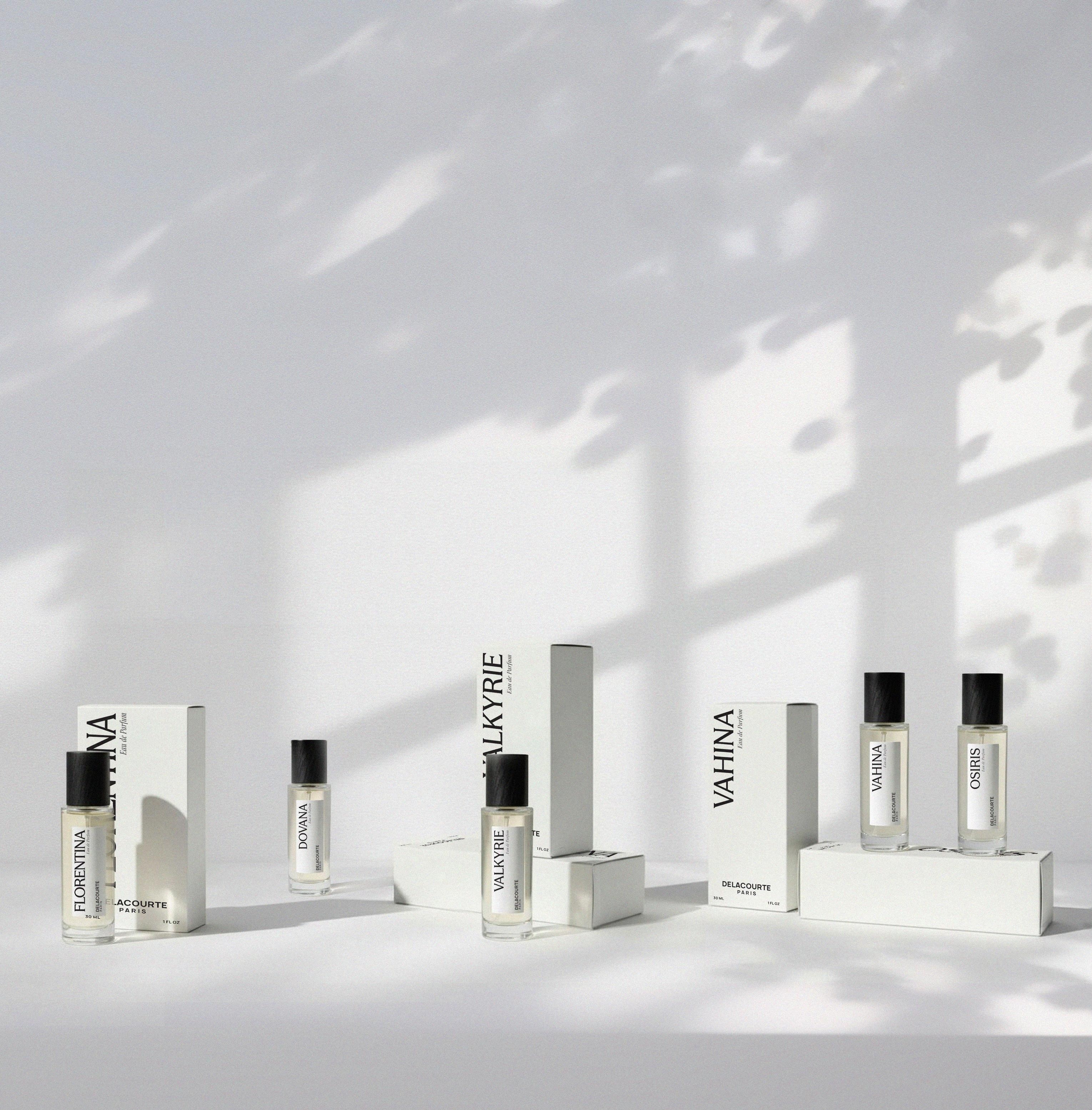
Where to Apply Your Perfume So It Lasts All Day?
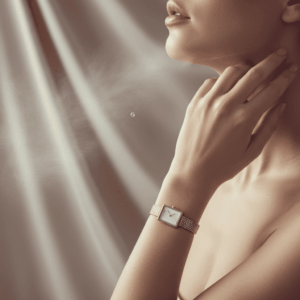
In common language, we say we “wear” a Delacourte Paris perfume with the goal of smelling good, for ourselves and for others. But upon reflection, couldn’t it also be the perfume that carries us? Let’s turn our attention to the question, starting with a bit of terminology.
What is the difference between Longevity and Sillage?
To fully understand how to properly apply your perfume and the terms we will use throughout this article, here are two definitions not to be confused:
- The sillage (or projection): This is the aura, the trace you leave behind you and in the memory of those you cross paths with.
- The longevity: A perfume can last on clothes and skin, yet not diffuse; we could say the fragrance is intimate, introverted. It is even sometimes called a “muted” scent.
The ideal scenario, when a perfume is well-constructed by the master perfumer, is when the olfactive pyramid is harmonious and balanced. It is under these conditions that you obtain a perfume that is both long-lasting and diffusing.
Where to Apply Perfume?
The golden rule: spray on pulse points.
To optimize the diffusion and longevity of your perfume, it is advised to apply it to the **pulse points**, which are areas where the body generates the most heat. Key areas include: the inside of the wrists, the base of the neck, behind the ears, and the inner elbows.
Where Not to Apply Perfume? (Mistakes to Avoid)
To guarantee the purity of the fragrance and the health of your skin, there are a few places to avoid when applying your perfume:
- Rubbing your wrists: This is the most common mistake! The act of rubbing creates heat, which breaks down the perfume molecules and alters its olfactive evolution. Simply spray and let it dry naturally.
- Behind the ears: Often recommended, this spot produces a lot of sebum and can interact negatively with the perfume. Prefer the base of the neck or the hairline, which are warmer areas without the risk of excessive alteration.
- On wounds or irritations: The alcohol contained in the fragrance can cause a burning sensation or skin irritation.
Why is the Skin Ideal for Wearing Perfume?
Experience shows us that a perfume does not fully reveal itself or express all its beauty on an olfactive strip—those paper blotters we use to smell it for the first time.
Les matières naturelles sont idéales car elles sont vivantes et nobles. Rien de tel que la laine, le cachemire ou le lin pour sublimer votre parfum.
But it is truly the skin, with all its uniqueness, that reveals it best, to the extent that “it is not the perfume that perfumes the woman or man, but the reverse.”
Why is Skin Scent Unique? (cf. Depending on Skin Type)
The skin has its own scent; it is unique, just like fingerprints, due to several factors.
- Firstly, its specific odor is the result of our lifestyle. Diet and medication intake play an important role, as does whether our lifestyle is active or sedentary.
- Secondly, the skin’s natural hydrolipidic film, a mixture of perspiration and sebum, is unique to everyone. This is why, when perspiration is excessive, the scent and hold of your perfume can be altered by humidity. Therefore, to always ensure your perfume is faithful to you, you can spray the fragrance onto your clothes, preferably on natural materials.
- Also, the skin’s scent varies according to its body temperature and the external temperature. It differs according to the skin’s texture, whether it is rather dry, supple, or soft.
How to Choose Your Perfume Well?
Firstly, it’s a story of encounter. The encounter between the perfume that attracted you and the inevitably unique scent of your skin. A magical alchemy is then created. The perfume suits you perfectly; it is truly in your skin.
The more natural raw materials the fragrance contains, the more it will change with the skin, because as we have said, natural raw materials are living and therefore evolving, while synthetic products are monolithic and more stable.
The fragrance will thus blend with this singular skin scent—yours—to create a unique perfume that is specific to you, the fruit of this alchemical encounter. It is, in short, a third effluvium.
So much so that we won’t say, “Oh, you’re wearing that perfume from such-and-such a brand!” but rather, “You smell wonderful! What perfume are you wearing? It’s divine!”
In summary: If you deprive yourself of this famous skin-perfume encounter, you risk missing out on truly magical alchemy that could enhance your perfume.
Where to Apply Eau de Parfum?
On the pulse points, where the skin is warmer because it is more irrigated by blood circulation.
At different strategic points:
- At the nape of the neck, on each side at the base of the ear, at the hairline, and not directly behind the ear
- In the hollow of the chest
- On the navel
- In the hollow of the wrists
- In the hollow of the elbows
How Many Sprays?
Do not use your spray bottle excessively and preserve your perfume bottle—only one spray at each pulse point.
Or, as Coco Chanel said, “Perfume the places where you would like to be kissed.”
What About Perfume for Men?
Men generally prefer to apply perfume with a quick gesture. They can therefore spray eau de toilette, eau de parfum, or eau de cologne on the torso, neck, and wrists for a unique imprint.
They can also apply a cloud of perfume to their scarf, or inside their jacket.
Perfuming Your Clothes
You can apply perfume to your clothes with eau de toilette or eau de parfum to **intensify your sillage**, after having applied the perfume directly to your skin.
To remember: Perfume on the skin + perfume on the clothes = assured sillage
If you genuinely do not want to perfume your skin, you can perfume only your clothes. The number of sprays will be higher, but everything depends on the perfume’s potency. The more powerful the perfume, the less you need to spray. It’s all about dosage; you must avoid wearing too much perfume so as not to bother those around you.
How to Properly Apply Perfume to Your Clothes?
- Only perfume fabrics made of natural materials: cotton, cashmere, silk, wool, linen. You will honor the fragrance, whereas you risk denaturing it by spraying it on synthetic clothes.
- It has been said that the color red is the best enhancer for perfume, and that the color blue is the least flattering due to the iron-based components it contains.
- Do not perfume light-colored clothes, as you risk stains.
- Do not perfume jewelry or furs either, as you risk damaging them.
- Vaporisez directly your eau de toilette; it is perfect for clothes.
- Or, for your eau de parfum, spray a cloud in front of you and walk into it immediately afterward; this is very pleasant and avoids stains.
Expert Tips for Optimizing Perfume Longevity and Sillage
- You can apply your perfume to your hairbrush or comb. This avoids having an initial spritz of alcohol on your hair, which could slightly dry out your locks.
- Place a few scented cotton balls delicately in your lingerie drawer.
- When washing, use a soap and, especially, a deodorant from the same line as your perfume. If one doesn’t exist, then choose unscented soap to avoid creating a cacophony with your favorite fragrance.
- After showering, apply a scented body lotion or cream to your body.
- If you do not have a scented cream in your chosen fragrance, then take an unscented body lotion and spray a few drops of your fragrance into the palm of your hand at the last moment, mix it, and this will be a lotion whose scent will marvelously and very faithfully enhance every centimeter of your skin.
- To perfect your sillage, include a few drops of eau de toilette in the rinsing water for your lingerie, or use the shower gel or shampoo in the same scent.
- What perfume experts call the layering technique involves applying successive layers of perfume. The more you layer different textures (soap, deodorant, lotion, cream, talc, eau de parfum, and eau de toilette) of the same fragrance, the more sillage and longevity you will have.