Alcohol and Spirit Notes in Perfumery: From Vine to Bottle
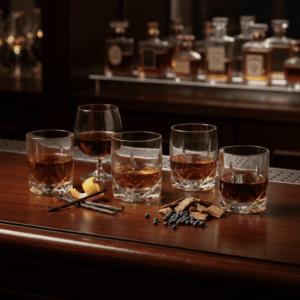
Alcohol, often from beet or sometimes wheat, is commonly used to dilute raw materials in a perfume.
Did you know that it is possible to use wine and liqueur notes in the heart of certain perfumes? Here is an overview of raw materials that are as surprising as they are spirited, bringing pep and sensuality to fragrances.
Wine Lees: Warmth and Sensuality
Wine lees are the organic deposit composed of tartar and yeast that forms at the bottom of vats during wine bottling. The essential oils of white or green wine lees, cognac, or brandy, are all extracted by hydrodistillation of the lees.
There is a multitude of wines and spirits, which yields several types of wine lees essential oils. Wine lees notes provide the perfume with a certain sensual and warm fruity alcoholic note.
Cognac: Smooth and Woody
Cognac is a wine brandy produced in France in the Cognac region, and its history is linked to distillation. The creation of cognac dates back to the 15th century. Charentes wine was then distilled to preserve its quality during transport across Europe to northern lands.
This resulted in a “burnt wine” appreciated by the Dutch, who gave it the name brandewijn, which became brandy in British territory. In the 18th century, Charentes producers adjusted their technique to a double distillation accompanied by aging this wine in oak barrels. This was the birth of cognac.
Cognac is obtained from grapes coming from white varietals such as Ugni Blanc, Folle Blanche, Colombard, and Folignan. After harvesting and pressing the bunches, the must formed is left to ferment. After seven days of rest, the beverage is distilled twice and aged in oak barrels for a minimum period of two years.
In perfumery, it is cognac essential oil that is used. It is extracted from cognac wine lees by hydrodistillation. Cognac brings smooth and sulfurous notes to the perfume. It belongs to the family of oriental raw materials because it is distinguished by vanilla notes. It also contains jasmine and candied fruit notes.
Absinthe: The Aromatic Green Fairy
This heady herb, native to Europe and Russia, possesses a large rhizome and green leaves. Discovered by the Egyptians in 1600 BC, the cultivation of absinthe is practiced in mountainous, dry, and sunny regions. After maceration, distillation, coloring, bleaching, fining, and aging, the absinthe liqueur is ready.
In perfumery, absinthe essential oil is obtained by hydrodistillation. Absinthe belongs to the aromatic olfactory family. It releases fresh, aniseed, mentholated, bitter, and slightly woody notes. This gives the perfume an eccentric and dynamic side; it is, of course, stripped of the molecules that make your head spin!
Rum: Exotic Gourmandise
Rum is a spirit that finds its origins in Central America. Rum distilleries are said to have existed in Barbados as early as 1688. Rum is produced by the distillation of sugar cane. It is then left to rest. After fermentation, crushing, and distillation, the rum can be aged to obtain different qualities.
In perfumery, rum is used naturally after extraction. The extravagances of this spirit are expressed in certain perfumes. Rum belongs to the gourmand olfactory family. Indeed, rum possesses hazelnut, vanilla, honey, ginger, cinnamon, or even burnished leather notes that wonderfully sublime oriental or woody fragrances.
Whisky: Peat and Smoked Barley
Whisky is a spirit obtained by the distillation of malted cereals. The history of whisky is shared today. Indeed, the Scots and the Irish dispute the origin of this drink. While the Scots rely on written records to prove their antecedence, the Irish explain it through the history of historical conquests.
However, whisky of Irish origin is closer to a perfumed spirit than to true whisky itself because the method of obtaining it is not the same.
In perfumery, whisky is used naturally, such as pure malt, a whisky exclusively obtained from germinated malted barley. This raw material is obtained by distillation of the whisky. Whisky belongs to the woody family.
It confers peaty, woody notes to the perfume but also evokes fresh flowers, dried fruits, honey, heather, caramel, hay, smoked barley, and even sometimes citrus, raspberry, and freshly cut grass.
Champagne: Sparkle and Celebration
Champagne is an effervescent wine produced in France. The name champagne finds its origin in the lands that cultivate it. Indeed, the lands of Champagne located in North-Eastern France have been producing this luxurious and joyful wine since the 3rd century AD.
However, the first Champagne house was not created until 1729. Champagne is produced according to the Champagne method. This consists of performing a double fermentation of the must, sometimes in vats, sometimes in the final bottle within the cellar itself.
In perfumery, we mostly find champagne accords reconstituted using raw materials such as ambrette, davana, juniper essential oil, fruity lactones… However, champagne essential oil can be obtained by distillation of champagne wine lees. Champagne belongs to the fruity notes.
In a perfume, it offers a myriad of subtle and mysterious notes thanks to its licorice, undergrowth, caramel, mushroom, red fruit, gingerbread, walnut, citrus, honey, almond, and green facets.
Limoncello: Italian Zest
Limoncello is a lemon liqueur native to Italy. The lemon harvest takes place from February to October. It was the entrepreneur Massimo Canale, originally from the island of Capri, who registered the Limoncello trademark. He obtained this precious liqueur by macerating lemon peels in purified alcohol for several weeks to extract all the aroma from the lemon, then a syrup of water and sugar is finally added.
In perfumery, limoncello is reproduced using citrus essential oils and aromatics. It therefore belongs as much to the citrus family as to the aromatic family. The limoncello note is sweet, citrusy, and slightly aromatic. It invites freshness during hot summer days.
Gin: Juniper Berries
Gin is a spirit that was born in the Spanish Netherlands at the end of the 17th century. Its name, Genever, became Gin when English distilleries appropriated it at the end of the 17th century.
Dutch gin is obtained by distilling alcohol from fermented rye and corn flours in which aromatics are soaked, mainly juniper berries, but also orange peels, licorice, anise, cardamom, almond, coriander, fennel, cumin.
In perfumery, gin is reconstituted in the form of an accord thanks to the numerous aromatics present both in perfumery and in the elaboration of this spirit. Gin belongs to the aromatic family. At the heart of a perfume, it brings aniseed, spicy, mentholated, citrus, gourmand, and camphorated notes.
Vodka: Icy Freshness
Vodka is also used in perfumery. Vodka obtained from the fractional distillation of rye, cereals, and potatoes appeared in the 18th century in Russia. Vodka can be flavored to give taste and break the raw side of this white alcohol (chili, cedar nuts, bison grass, lemon, caramel…).
In perfumery, vodka is reconstituted in the form of an accord. Vodka belongs to the aromatic-spicy family. Its green, spicy, aromatic, sometimes woody or fruity notes sublime the perfume with freshness and tonicity.
Selection of Perfumes with Alcohol Notes
Wine Lees
- Salute ! by Parfum d’Empire
- Donna Noir Absolu by Valentino
- Une Rose by Frédéric Malle
- Bloody Wood by Liquides Imaginaires
- Bello Rabelo by Liquides Imaginaires
Cognac
- Nevermore by Frapin
- Boss In Motion Green Edition by Hugo Boss
- Champaca Absolute by Tom Ford
- Encounter by Calvin Klein
- Parfum des Merveilles by Hermès
- Lady Million Empire by Paco Rabanne
- 1270 by Frapin
- Liqueur Charnelle by Huitième Art
Absinthe
- In Love With You by Armani
- Fou d’Absinthe by L’Artisan Parfumeur
- Absinthe Verte by Kilian
- Absinth by Nasomatto
- Glacialis Terra by L’Artisan Parfumeur
- Beauté du Diable by Liquides Imaginaires
Rum
- Spiritueuse Double Vanille by Guerlain
- Encounter by Calvin Klein
- Guerlain Homme by Guerlain
- Agua de Amor Amor by Cacharel
- Gourmand Coquin by Guerlain
- L’Ambre des Merveilles by Hermès
- Lolita Lempicka au Masculin by Lolita Lempicka
- Now Women by Azzaro
- Guerlain Homme Intense by Guerlain
- Idole by Lubin
- Straight to Heaven by by Kilian
- Passion boisée by Frapin
- Les jeux sont faits by Jovoy
- Speakeasy by Frapin
- Jazz Club by Maison Margiela Replica
- Rhum et Tabac by Comptoir Sud Pacifique
- Black Phantom by Kilian
Whisky
- Fumidus by Profumum Roma
- A*Men Pure Malt by Mugler
- Korrigan by Lubin
- Spirit of the Glen by D.S. & Durga
- Vi et Armis by BeauFort
- Baraonda by Nasomatto
- Malt by Akro
Champagne
- Vierge de Fer by Serges Lutens
- À La Folie by Mauboussin
- Ambre Russe by Parfum d’Empire
- Divine Decadence by Marc Jacobs
- Yvresse by Yves Saint Laurent
- Dom Rosa by Liquides Imaginaires
- Remarkable People by Etat libre d’Orange
- Niral by Neela Vermeire Créations
Limoncello
- Eau de Lacoste Fraîche L.12.12 Pour Lui by Lacoste
- Prada Candy, Eau de Toilette Florale by Prada
- Oud Immortel by Byredo Parfums
- Citron Regenerez – Liquid Sunshine by Ajne
Gin
- Gin Fizz by Lubin
- L’Humaniste by Frapin
- L’Heure Brillante by Cartier
- Juniper Sling by Penhaligon’s
Vodka
- Ambre Russe by Parfum d’Empire
- Vodka on the Rocks by Kilian
Written by Marie Bessin.