Amber in Perfumery: Ambergris, Oriental Accord and Amber Woods
The notion of amber is quite complex; let us lift the veil a little on this appellation.
1. Ambergris: The Sperm Whale’s Treasure
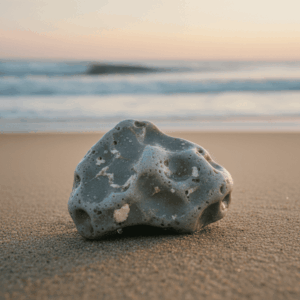
To the naked eye, amber is not very beautiful; it looks like a grey, blackish stone, quite light, reminiscent of pumice stone, but to the nose, it is exquisite. Amber is very rare and very expensive; it is one of the most expensive raw materials in perfumery.
Amber is also the only animal raw material authorized because the animal is neither made to suffer nor killed.
Origin and Formation
Ambergris is sort of a calculus produced by the sperm whale when it is overfed on octopuses or squids whose beaks wound the walls of its digestive tract, thus causing lesions. To bandage them, the sperm whale secretes a substance that resembles pebbles expelled via natural channels.
These substances will be carried by currents, tossed by waves; they will float, and the longer they float, for years if possible, the better the amber perfume will be. They then wash up on a deserted beach in New Zealand or Madagascar where they will be fished out by a collector on a happy morning.
Ambergris is expelled naturally by the sperm whale and it is the combined oxidation of seawater and sun that will transform this material into a raw material of perfumery.
A Precious and Ethical Material
Some blocks of amber can be huge, reaching more than 100 kg, but this is rare. In January 2013, a 3 kg block of ambergris was found in England; its value was estimated at more than 100,000 euros. For each purchase, meticulous work of selecting blocks is carried out by the raw material company that still sells amber.
The specialist is in charge of making this selection. Either he sells the raw amber blocks or he then performs a comminution (blending) of amber tincture. The comminution allows for consistency in the quality of the amber note, just like the comminution of rose or jasmine.
Important note: The sperm whale is not killed to recover this material. Ambergris that is not oxidized does not have the sought-after smell and therefore has no commercial value. Moreover, few sperm whales contain amber, barely 5% of the population. Perfumers are committed to preserving this animal, because without a living sperm whale, there is no amber.
Ambergris is not considered a product of the animal and therefore, as such, it is not listed under CITES (Convention on International Trade in Endangered Species of Wild Fauna and Flora).
Olfactory Description
Each block of amber is smelled individually and is chosen according to its scent, sometimes more iodized, or more marine, warmer, or even more animalic. The amber scent also has slightly tobacco, leathery, woody, camphorated facets, but unlike civet which is almost unbreathable, the scent of ambergris is pleasant when dried; its fragrance becomes almost creamy.
Ambergris was used in the 18th century in chocolate for its invigorating and aphrodisiac virtues. Casanova reportedly used a lot of it; perhaps he had a bottle containing these rare essences that were used at the time for their stimulating virtues. Ambergris was also used to scent gloves.
Perfumes with Ambergris
A few perfumes with generous sillage contain natural ambergris, certain old perfumes like Mitsouko by Guerlain (rather in the perfume extract than in the eau de toilette) and some more recent ones like the perfume Ambre Nuit by Dior or Ambre Sultan by Lutens.
One of the only synthetic raw materials that has an olfactory note close to true ambergris is Cetalox by Firmenich or Ambroxan. The sperm whale also yielded, at the time when it was still exploited, spermaceti or cetin which was the base of certain soaps including Guerlain’s soaps, the Sapocetis.
2. Ornamental Amber (Yellow Amber)
Amber-colored amber is a fossilized resin from a conifer; it possesses no perfume and is used for jewelry and ornaments; some attribute protective powers and good luck charms to it. It is said that an amber necklace would reduce teething pain in very young children.
3. The Amber Accord (or Oriental)
This accord was born from the perfume Ambre Antique by Coty, then in Jicky, sublimated in the Eau de Parfum Shalimar, and is also the base of the De Laire amber accord, Ambre 83.
It is composed of tonka bean, coumarin, vanillin, labdanum, patchouli, and resins like benzoin or incense, which are all base notes. Amber can have several facets like floral or aromatic for example.
A perfumer can add citrus fruits like bergamot to it, in top notes, powdery notes in heart notes like iris or jasmine to bring femininity, to accentuate sensuality in base notes with notes like musk.
You have certainly smelled the solid base found in the carved wooden ball, pomander, by L’Artisan Parfumeur; its scent is characteristic of the raw amber base and to have this paste formula, the liquid form is mixed with a dry solvent to transform it into a solid form.
This scent can also be found in lower quality in the souks of Marrakech in the form of white stone.
4. Amber Woods (Synthesis)
Perfumers have also called these synthetic woody notes amber woods, such as for example cedramber or boisambrene which are found in many perfumes for women and men.
Molecules with more vibrant scents, almost aggressive like for example Karanal which is now found in many perfumes in base notes for men or even Amberketal, Ambrocenide, Z11.
In the softer and more expensive notes, there are the famous Ambroxan and Ambrox. The molecule is synthesized in the laboratory from sclareol, a natural compound extracted from clary sage.