The Frangipani Flower in Perfumery: The Unique Scent of Tropical Sun and Escape
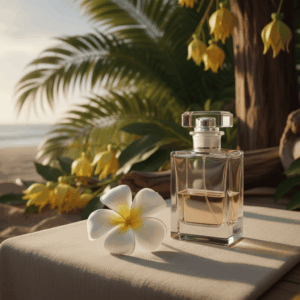
This flower reminds me of my first vacations in the Caribbean, as well as Mauritius, Réunion Island, Bali, and India. Ever since those travels, I’ve been especially fond of its scent, which evokes a sun-drenched fragrance of holidays and monoi (see Enfleurage).
I’ve always loved working with exotic and solar notes in my creations—like I did for Guerlain perfumes such as Terracotta, Mimosa Tiaré, or L’Instant. The frangipani flower has a remarkably complex scent, but its fragrance fades quickly after picking.
Origin, Symbolism, and Cultural Use of Plumeria
The frangipani (Plumeria) is a flowering shrub native to Central America, now common across Asia and tropical climates. Its blooms release a mesmerizing scent, especially at night. Note: the sap is toxic.
A Spiritual and Cultural Flower
In Laos, the dok champa is the national flower. The frangipani is seen as a tree of eternal life and is known as the “temple flower” in India and Bali, used as offerings. Its white petals symbolize the purity of the soul.
In the Pacific Islands, women wear it behind the ear—on the right if seeking love, on the left if taken. Like tuberose, jasmine, or tiare flowers, it’s used to weave floral crowns and necklaces.
Olfactory Description and the Technical Challenge of Extraction
The scent of this flower is complex, floral, and creamy, with strong apricot and almond facets. However, it poses a major challenge: it cannot be extracted naturally.
Distillation and solvent extraction fail to capture its fragile scent. Perfumers therefore recreate it through reconstruction, blending natural ingredients with select synthetic molecules.
Frangipani is often combined with solar flowers and white blossoms like tuberose, magnolia, and tiare. It usually appears in heart notes, but can be perceived as early as the top notes.
The Reconstruction: Blending the Facets
To recreate the aroma, perfumers use:
- Flowers with a strong solar facet like ylang-ylang and jasmine.
- Creamy and powdery notes (vanilla, almond, benzoin).
Its complex scent contains molecules also found in benzoin, mimosa, cassia, orange blossom, lavender, geranium, and rose.
The Origin of the Name “Frangipani” (Etymology)
The Latin name Plumeria honors botanist Charles Plumier. The French term “frangipani” may come from Muzio Frangipani, an Italian marquis who created an almond-scented glove treatment (frangipane) in the 17th century. The name became associated with the flower due to their shared almond-like facet.
Medicinal Properties and Iconic Perfumes
Therapeutic Uses
- Known for its calming and soothing effects.
- Traditional uses include: bark as a purgative (Caribbean), leaves aiding healing (Caribbean), and sap for treating warts (Asia).
Selection of Iconic Frangipani Perfumes (Solar and Escape)
- Solar Classics: Beyond Paradise – Estée Lauder, Bronze Goddess – Estée Lauder, Beige – Chanel, Kenzo Amour – Kenzo.
- Frangipani Soliflores: Frangipani Flower – Jo Malone, Osmanthus – Acqua di Parma (often confused with Frangipani due to fruity note).
- Exotic White Florals: Songes – Annick Goutal, Flower Red Edition – Kenzo, La Femme – Prada.