Enfleurage: Traditional Cold and Hot Extraction Technique
Enfleurage is a perfume manufacturing technique that consists of immersing raw materials in a fatty substance to absorb their scents. There are two different kinds of enfleurage: hot enfleurage and cold enfleurage.
This technique, widely used in the past, then abandoned, has been revived in recent years in Grasse.
Raw Material Extraction Processes
Here are the different raw material extraction processes that exist in perfumery:
History of Enfleurage: From Antiquity to Grasse
Already practiced in Antiquity, the enfleurage technique has been commonly used since the beginning of the 18th century. At the time, certain particularly fragile materials could not be treated by distillation and were therefore extracted by cold enfleurage, or by hot enfleurage.
Developed in Grasse, in the south of France, this extraction technique was once highly developed but was abandoned around the 1930s, as soon as the volatile solvent extraction process became reliable.
What is Enfleurage?
Enfleurage can be performed cold or hot, depending on the materials treated.
1. Cold Enfleurage
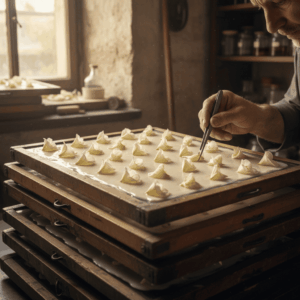
This extraction process is used for jasmine, daffodil, or tuberose, flowers too fragile to be heated. It consisted of spreading a layer of animal fat at room temperature on a plate surrounded by a wooden frame (chassis). The flowers had not to be subjected to high temperatures, so that the perfume would not be altered.
The process:
- The flowers are first sorted in order to keep only the freshest among them.
- They are then placed by hand, one by one, on the fat (it can be vegetable) where they rest for about 24 hours. The fat, finely spread, will then absorb their scents.
- The operation must be repeated several times, until the fat is saturated with the perfume of these flowers, which are then removed by hand.
At the end of the process, the fat is collected with a spatula, then washed with alcohol in beaters. This allowed separating it from the odorous molecules, and obtaining, after evaporation, the precious “pomade absolute”.
2. Hot Enfleurage (Maceration)
Also called “maceration”, this process allowed infusing more resistant flowers or other plants, in oils and fats made of 75% pork and 25% beef, and heated in a bain-marie between 40 and 60 degrees.
The flowers were stirred, using a wooden spatula, in the heated fat for two hours. The flowers used, renewed every day by fresh flowers, infuse for at least 24 hours.
The fat, which could also be heated by the heat of the sun, was then recovered by draining, thanks to large strainers, then filtered through cloth fabrics. The product was finally washed with alcohol in the beaters.
This hot enfleurage was used for May rose, orange blossom, and mimosa. These materials allowed obtaining very rich and elegant products, reserved for exceptional compositions.
Disadvantages and Modernity of the Technique
Enfleurage, whether performed hot or cold, presented several disadvantages, such as:
- Low yield: 1 kg of fat could absorb 3 kg of flowers.
- A manual technique requiring demanding know-how, therefore qualified personnel.
- A very long process.
- A large amount of equipment (frames, beaters…) is necessary.
- One must succeed in controlling the heat of the room in which the enfleurage took place.
Moreover, this method requires a large workforce, it is very expensive and therefore cannot be used for classic perfumery flowers.
The final product, called “pomade absolute”, is reserved for major perfumery houses or those who invest a significant price in their concentrate. Note that at Guerlain, recently the enfleurage of tuberose was carried out in mango butter: Flora Bloom by Guerlain.
The Enfleurage Technique Today
This old technique has now been replaced by volatile solvent extraction and CO2 extraction, or sofact. Enfleurage is little used today. But new enfleurage initiatives are being practiced again in Grasse, notably for tuberose.
The Exception of Monoi from Tahiti
In Tahiti, there still exists, in a confidential manner, an enfleurage operation. It is carried out not on wooden frames, as in the 18th century, but by “soaking” Monoi flowers, or Tiaré flowers, for a period of 10 days.
These flowers are treated in coconut oil, in order to obtain Monoi de Tahiti Appellation d’Origine Contrôlée (Protected Designation of Origin). This oil, used on the body or hair by women, men, and children, is still part of local customs and rituals. One recognizes true Monoi by the tiare flower, placed inside the bottle.
The traditional method sold only in Tahiti consists of mixing coconut oil with tiare flowers and also with a very surprising ingredient: the abdomen of the Hermit Crab, to accelerate the fermentation of the mixture. This mixture is then placed in the sun, in the open air.
But this traditional Monoi oil cannot be sold for export, given the regulations in force.
Enfleurage and the Olfactory Pyramid
Products obtained thanks to enfleurage participated in base notes, notes evaporating slowly, and allowing to “fix” the perfume to make it last over time.
Indeed, one must know that, even if perfumes evoke poetry, dreams, and arouse emotions, they rely above all on sharp scientific and physical notions. A fragrance is a complex, refined, and delicate composition of notes chosen for their ephemeral or, on the contrary, tenacious side, and which constitute what is called “the olfactory pyramid”.
Perfume is very often represented in the form of an olfactory pyramid, the tip of which consists of top notes (the most volatile notes, smelled just after spraying the perfume), the middle part by heart notes, and the base by base notes.
This is an apparently simple and educational diagram, but which proves to be much more complex in reality, because the different notes respond to, embrace, and interlock with each other and can sublimate one another.
Conclusion
Enfleurage gives excellent results and allows having very high-quality essences.
Unfortunately, the process is very expensive and complex.
It has mostly been abandoned (except for a few Grasse producers who still resort to it in an artisanal and confidential way).