Green Notes in Perfumery: Galbanum, Blackcurrant and Cut Grass
If you had a grandfather or someone close who took you when you were very small to his garden to pick peas under an eye filled with tenderness, if you had the privilege of shelling freshly picked green beans with him. You also loved the smell of cut grass and nasturtium flowers. The smell of crumpled leaves on your hands.
If all these smells remind you of good memories, move you, then you are good candidates for green notes. All these scents are the symbol of spring, of nature gorged with dew and sap. Here are some that are natural and that are coming back strongly in niche perfumes.
Definition of Green Notes
The green note is defined by the smell of a crumpled leaf, a cut stem, fresh grass wet with dew; it is a facet that gives a lot of dynamism, cheerfulness, and naturalness to the perfume. A symbol of renewal and spring.
It is increasingly present in new releases; for memory, it was really used for the first time in overdose and in a very intense form in Vent Vert by Balmain (1947), revisited in 1991 and 1999 and recently with the use of a daring note full of character: the galbanum note.
1. Galbanum: Intense Green Gold
The Spirit of the Plant
Galbanum is mentioned in ancient Egypt 2000 years B.C., for the creation of different types of incense. Galbanum is a plant of the Umbelliferae family (shape of colored umbrellas) with yellow flowers that grows in Iran, Afghanistan, or Turkey. It requires a sunny climate.
Galbanum is a milky white gum when it first flows. The gum is harvested by incision of the plant’s roots. It is then distilled to obtain an essence or treated with solvent to then obtain the resinoid.
Olfactory Description
Classified as a green note, I would even say dark green, it is as herbaceous as it is fresh, bitter as it is balsamic. It is also vegetal and earthy, resinous, rising, and powerful. It is a dark green, earthy, screeching note, an intense undergrowth note, reminiscent of peas, potatoes, nasturtium flowers, damp and peppery.
It is a very difficult note to work with, “which marks the top note very quickly and which can be rasping.” It requires perfect dosage or dressing to give harmonious effects.
Use and Renewal
Galbanum can also serve to recreate green floral notes such as hyacinth, narcissus, or gardenia. Galbanum can also be used in chypre perfumes.
We find this galbanum note which had been shunned for many years; now it is treated in a softer and more contemporary way in Untitled by Martin Margiela, in the new No. 19 by Chanel (powdery which I find very successful), in A Scent by Issey Miyake (very close to the universe of Chanel’s No. 19), as well as in Bas de Soie by Serge Lutens and also in Bel Respiro in the Chanel exclusives.
Some perfumes with green “galbanum” tonality:
- Vent Vert by Balmain
- N°19 by Chanel (1971)
- Cristalle by Chanel
- Bel Respiro by Chanel
- Vol de Nuit by Guerlain (1933)
- Chamade by Guerlain (1969)
- Miss Dior by Dior
- Untitled by Margiela
- Bas de Soie by Serge Lutens
- Eau de Lierre by Diptyque (2006)
- Eau de Campagne by Sisley (1974)
- Virgilio by Diptyque
- Must by Cartier (1981)
- Silence by Jacomo (1978)
- Alliage by Estée Lauder (1972)
- Splash Grass by Marc Jacobs (2006)
- Private Collection by Estée Lauder (1973)
- Premier Figuier by L’Artisan Parfumeur (1994)
- French Lover and En Passant by Frédéric Malle
2. Lentisk (Mastic): The Corsican Maquis
The Spirit of the Plant
The Lentisk Pistachio is a small Mediterranean shrub. This beautiful material which the Egyptians were fond of, has crossed the ages, fell into disuse, and has just been rehabilitated. It is, like galbanum, difficult to tame.
From its Latin name “lentiscus,” the Lentisk Pistachio is a mastic tree; its plant produces pretty red flowers that will slowly turn black; the arrival of its buds generally marks the end of spring. The resin of the Lentisk Pistachio, commonly called mastic, finds an increasingly important place in perfumery, but also in medicine and food.
Olfactory Description
Lentisk Pistachio essential oil is obtained by steam distillation of the leaves and fruits of the plant. It can also be found by molecular distillation; this method gives more modern, purer products.
It is a green, resinous, turpentine-like smell, a bit tobacco-like, slight nuance of tea. Lentisk pistachio presents a fresh, lively, very “textured” and green perfume with assumed accents of resin and turpentine. Its smell recalls the Corsican maquis or the garrigue.
Aromatic principles: Gamma-terpinene, Limonene, Alpha-pinene, Myrcene, Terpinene, Limonene, Geraniol, Linalool.
Perfumes with lentisk:
- Corsica Furiosa by Parfum d’Empire
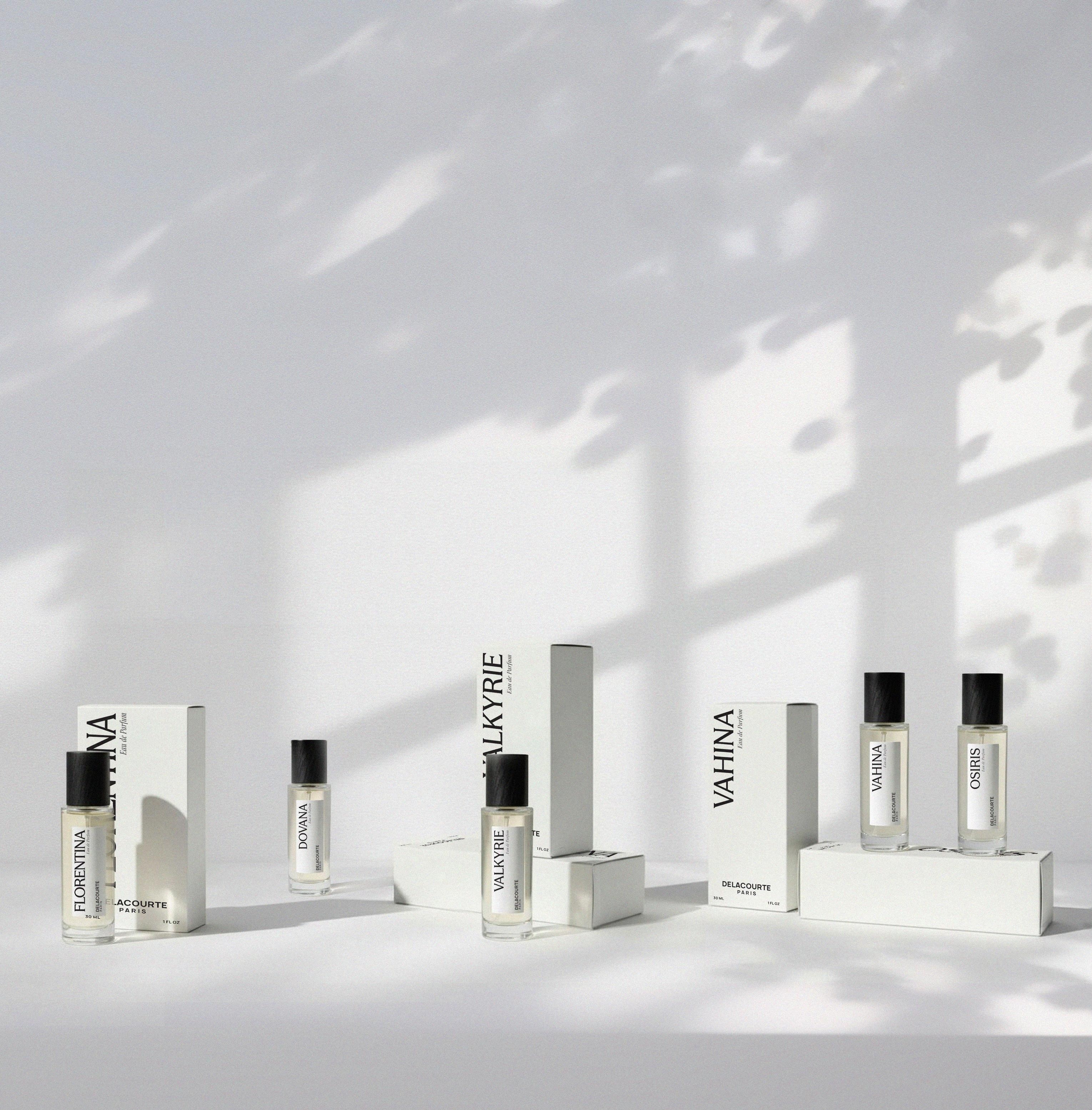
- Smeraldo by Delacourte Paris
3. Angelica: Crunch and Indulgence
The Spirit of the Plant
Angelica, I knew it because my mother ordered every Sunday a cake covered with candied angelica sticks; besides, I only ate the pieces of angelica running on top of the cake, which looked like grasshoppers.
This acid bitter/green/raw/sweet mixture gave me the idea for the creation of Angélique Noire by Guerlain, a co-creation with Daniela Andrier. Archangel Michael during an apparition explained the protective properties of the plant hence its name: Angelica.
Angelica Archangelica, which means the herb of angels, is native to Europe and Siberia; the plant is cultivated in France, Belgium, and Germany. From the Umbelliferae family, this plant loves damp regions. The essential oil is obtained by distillation.
Olfactory Description
- Seed essential oil: green, slightly aniseed, musky, spicy, hay, cedar-like.
- Root essential oil: very aromatic, aldehydic, green, raw.
In perfumery: Angélique Sous La Pluie by Frédéric Malle, Angélique Noire by Guerlain.
4. Blackcurrant Bud
Blackcurrant production takes place essentially in France, in the Burgundy region. Young buds are harvested at the beginning of the year and the absolute is obtained by volatile solvent extraction.
Its smell is at once green, fruity, blackcurrant and can smell of boxwood; worn badly, the blackcurrant bud can interfere with the skin and give a sometimes unpleasant note (“cat pee” effect). Nowadays, there are qualities of Blackcurrant bud rid of this annoying smell. The absolute is quite expensive and therefore essentially used in luxury perfumery.
Perfumes: Pamplelune by Guerlain, Chamade by Guerlain, First by Van Cleef.
5. Violet Leaf
Violet is native to Europe, Asia, and North Africa. Flowering from April to October. Many species are odorless. It is the Viola odorata that is the most fragrant. The violet flower does not give up its secret; 100 years ago its perfume was worth 10 times the price of gold. Fortunately, ionones came to the rescue of the perfumer to reproduce this subtle smell.
On the other hand, we use in the form of absolute, the product of the violet leaf which is harvested before flowering. Its smell is quite particular: green smell, cucumber, green bean, slightly sulfurous, earthy, leather, harsh and rasping.
Perfumes using the leaf (sometimes combined with ionones): Grey Flannel by Geoffrey Beene, Fahrenheit by Dior, Chamade pour Homme by Guerlain.
6. Rhubarb and Other Natural Notes
I love, like the English, rhubarb in all its forms! It is not a natural note, it is therefore a composition, worked around the molecule Rhubafuran, orchestrated with natural and synthetic raw materials.
Other natural green notes: petitgrain, certain mints, basil, tarragon. Note that Narcissus, daffodil, and mimosa naturally possess quite pronounced green notes.
7. Synthetic Green Notes
You may have noticed that there are few natural notes; synthesis has brought us many notes in this green facet, here are some essential notes:
- Cis-3-hexenol, Cis-3-hexenyl acetate, Triplal. Specialties from IFF: Vivaldie, Cortex, and Galbascone, Hexanal etc.
- With fruity facet: liffarome, stemone (necessary to create a fig), cassis base.
- With a slightly vegetable side: asparagus and also gardenia (styrallyl acetate).
- Cucumber or violet leaf note: Nonadienal, folione.
- Undecavertol.
8. Selection of Perfumes with Green Tonality (By Style)
Green perfumes associated with an oriental note:
- Obsession by Calvin Klein (1985)
- Dune by Dior (1991)
- Dior Addict by Dior (2002)
- Angélique Noire by Guerlain (2005) – Angelica, which is not classified in green notes, gives a very pleasant and soft green crunch.
- Pleasures by Estée Lauder (1995)
- Envy by Gucci
- DKNY by Donna Karan (1999)
- Les Belles by Ricci (1996)
More floral green perfumes:
- Champs Elysées by Guerlain
- Herba Fresca Aqua Allegoria by Guerlain (very minty)
- Anaïs by Cacharel (1979)
- Daisy by Marc Jacobs
- Alliage and Beautiful by Estée Lauder
In the freshness register:
- Chrome Legend by Azzaro
- Boss Pure by Hugo Boss
- Guerlain Homme
- Homme by Lacoste
- Intense Fabulous Me by Paco Rabanne
Other perfumes with green tonality:
- Cologne du Parfumeur by Guerlain
- Un Dimanche à la Campagne by Guerlain (renamed Herbes Troublantes)
- Jardins en Méditerranée by Hermès
- Un Jardin Après La Mousson by Hermès
- L’Ombre dans l’Eau by Diptyque
- Iris by Prada
- Synthetic Nature by Frédéric Malle
- H24 by Hermès
- Oyedo by Diptyque
- Eau de Rhubarbe Ecarlate by Hermès
- Pulp by Byredo
- Lazulio by Diptyque
- Infusion de Rhubarbe by Prada