Iris Pallida: The Blue and Powdery Gold of Perfumery
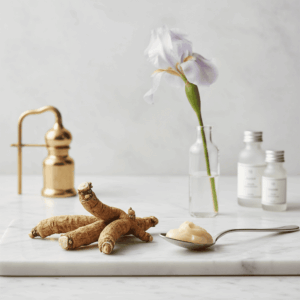
Iris is one of my favorite raw materials and one of the most expensive raw materials in perfumery; it is present in large quantities in L’Heure Bleue which I adore and in Florentina which I created.
Botany and Origins
Iris comes from the Iridaceae family; it is native to the Far East, and the main producers are in Italy, Morocco, and China. There are 2 botanical varieties which are Iris Pallida and Iris Germanica.
Iris flowers have a delicious scent; I was lucky enough to smell some irises that diffused a chocolatey note. Almost at the price of gold, the iris hides its olfactory treasure in its roots, often called rhizomes, or stems.
The Powdery Note
It should be noted that the powdery note is to be distinguished from the very gustatory vanilla note. The origin of the powdery note’s name comes from the first rice powders which were scented with iris at the time; gloves were also often scented with this fragrance.
I perceive the powdery note as a rather dry note, slightly woody with violet accents; if it were a color, it would be a pastel tone. It is a very evanescent note, difficult to grasp, airy.
Iris Pallida: The Patience of Excellence
Iris Pallida, native to Italy, is called a rhizome, but more precisely, we can say it is an underground stem on which adventitious roots can form. In Italy, iris is grown on ungrateful, stony, and poorly exposed steep terrain. The steepness excludes the possibility of mechanizing cultivation. Planting takes place from mid-September to mid-October.
The 6-Year Process
These odorless stems will then be cleaned, dried, and harvested at 3 to 4 years old. Indeed, it takes at least 3 years before the iris reveals its perfume (the harvest takes place in the 3rd year after planting between mid-July and mid-August).
Iris stems will patiently secrete irone, the major constituent of iris perfume. They are then stored in bags for another three years until complete desiccation and the appearance of the majestic smell. Six years are therefore necessary for Iris Pallida to deliver its olfactory masterpiece.
Then, the rhizomes or stems are reduced into fine particles and treated by distillation; we then obtain a paste called iris butter whose maceration in an organic solvent and extraction finally lead to iris absolute.
The Expert’s Opinion
I only like Iris Pallida; other varieties and terroirs lack the elegance of the Florentine one. I would like to know who had the idea or intuition to sow this little seed that gave the iris root, to wait 6 years to finally treat these very unsightly rhizomes to finally obtain this marvel that is iris absolute.
History and Mythology
Everything about it is perfection. Its flower is a splendor; its bearing is haughty, majestic, and sovereign. Emblem of royalty, Fleur de Louys in homage to Louis the Pious became Fleur de Lys through a confusion of language. In Greek mythology, the iris was considered the messenger of the gods. Iris means rainbow in Greek.
Olfactory Description
For perfumers, iris is the incarnation of luxury, through the beauty and purity of each of its facets. In a perfume, it exhales a radiant, unique warmth, both powerful and controlled.
Its scent is multi-faceted with delicious notes between violet note and mimosa note, woody accents, a light raspberry note, and a carrot note. Moreover, very often in perfumery, to replace or support the iris effect, carrot seed essence is added.
Iris Germanica and Extraction Techniques
In Morocco, the Germanica variety is more robust and simpler to cultivate, but the scent is less sophisticated. Rhizomes or stems are pulled up and cleared of their soil. There are then two possible treatments:
- Peeled Rhizomes: they are peeled manually then washed. This step is long and tedious; one person processes 40 kg of rhizomes per day.
- Unpeeled Rhizomes: they are cut into slices. The rhizomes are then dried for 10 days and stored in hangars under precise conditions of aeration and humidity for 3 years.
It is during air drying that irone, the noblest and most expensive constituent of iris, develops. Rhizomes therefore require 6 years of processing before reaching their optimal quality.
Finished Products (Butter vs Absolute)
After 6 years, the rhizomes are reduced to powder; 3 treatments are then possible:
- Iris Absolute: Steam distillation of iris powder which gives a waxy and white paste or concrete or butter (10 to 35% irone), then vacuum distillation is performed with wax absolute (65% to 85% irone).
- Iris Resinoid Powder: Iris powder treated with Volatile Solvent Extraction (viscous product containing 1 to 3% irone).
- Tincture: Iris powder treated by tincture or iris infusion containing minute quantities of Irone.
The two main constituents of iris are irone, a very expensive constituent representing the quality of the iris, and myristic acid. Irone alone can be used, which is a product of absolute luxury. Iris butter can be calibrated in terms of its irone content (8% for example) by adding natural myristic acid containing irone which itself comes from the process of obtaining the absolute.
Perfumes Where Iris Plays an Important Role
- Iris Pallida L’Artisan Parfumeur
- Infusion d’Iris Prada
- Iris Ganache Guerlain
- Homme Dior
- L’Heure Bleue Guerlain
- Après l’Ondée Guerlain
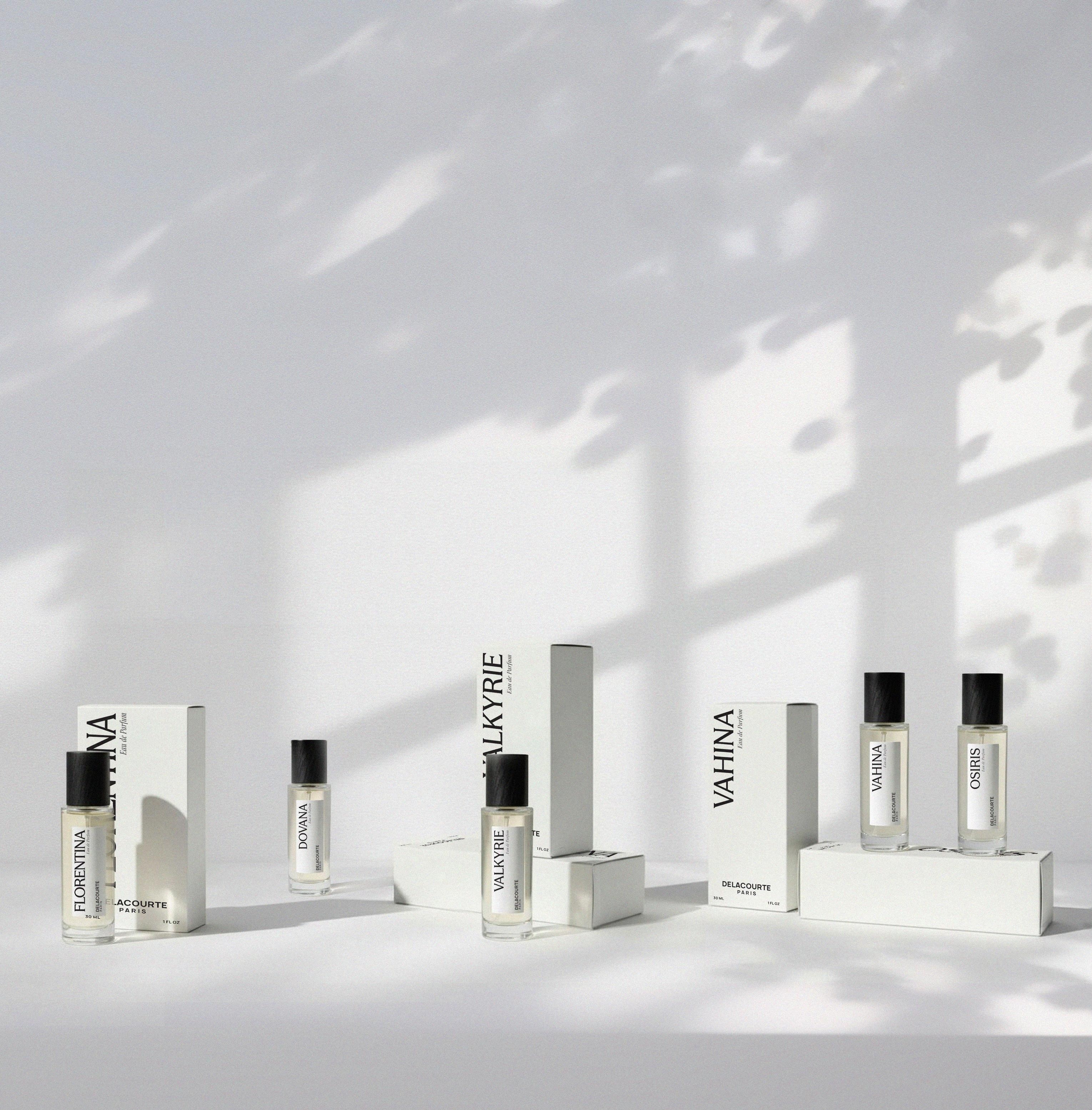
- Florentina Delacourte Paris
- Insolence Guerlain by Maurice Roucel and Sylvaine Delacourte